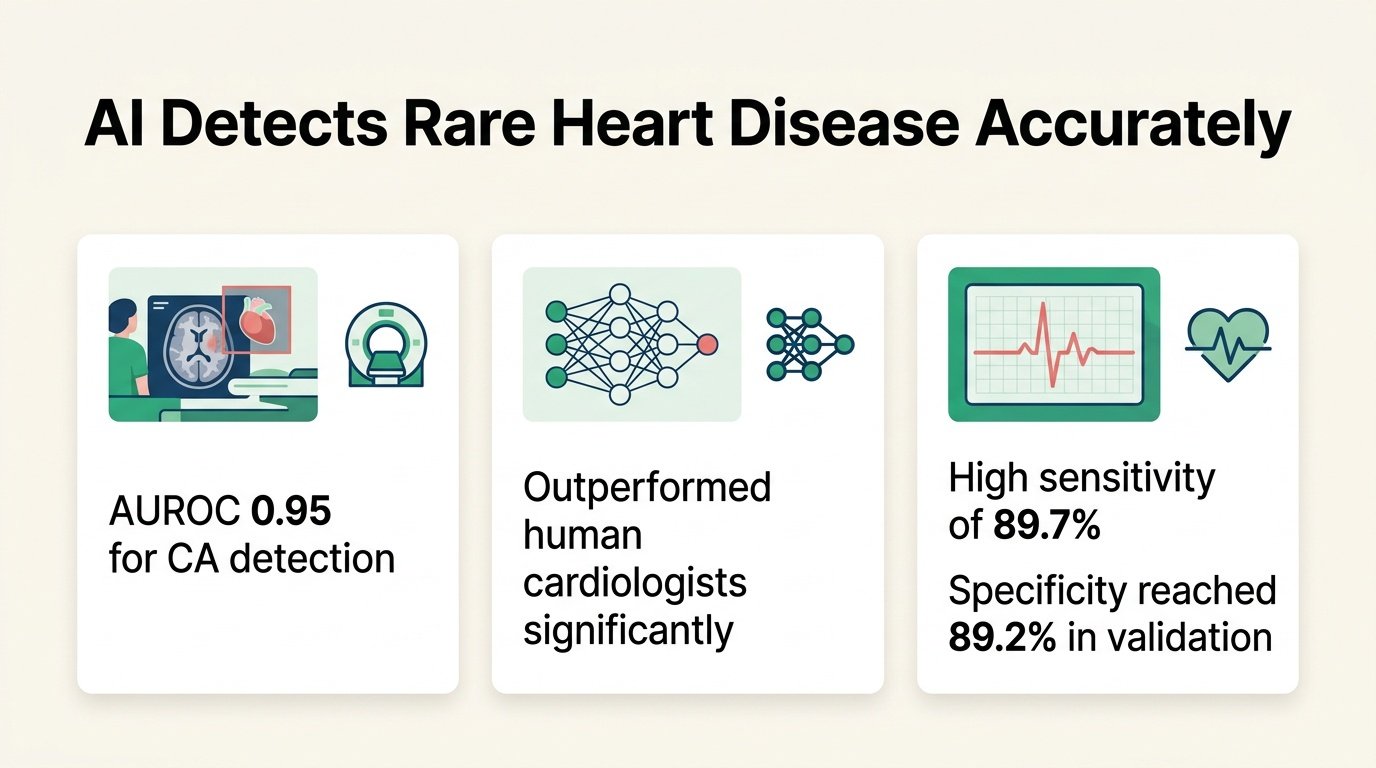
A new machine learning model stops doctors from misdiagnosing cardiac amyloidosis as more common heart conditions.
How do you treat a patient when their heart scans look identical to two other completely different diseases? For years, cardiac amyloidosis has hidden in plain sight, masquerading as hypertrophic cardiomyopathy or hypertensive heart disease. By the time clinicians spot the difference, the damage is often done.
That diagnostic confusion is where patients slip through the cracks.
This challenge is not just about building a better algorithm. It challenges the traditional clinical reliance on single-modality imaging. By forcing simple electrocardiograms and standard echocardiograms to talk to each other through a unified model, researchers have bypassed the need for expensive, invasive biopsies. The real triumph here is the reduction of complexity, distilling 28 clinical variables down to just seven key markers.
Simplifying the diagnostic puzzle
The researchers trained their model using a derivation cohort from Peking Union Medical College Hospital. This group included 290 cardiac amyloidosis patients, 215 with hypertrophic cardiomyopathy, and 160 with hypertensive heart disease. To prove the algorithm could work in the messy reality of different clinical settings, they tested it across 10 other hospitals in China. This external validation cohort comprised 126 cardiac amyloidosis patients, 240 with hypertrophic cardiomyopathy, and 190 with hypertensive heart disease.
The system uses a Super Learner architecture that combines four distinct machine learning models: Extra Trees, Histogram-based Gradient Boosting, LightGBM, and Multi-Layer Perceptron. Rather than relying on hundreds of obscure data points, it uses just seven critical features. These include the Sokolow–Lyon index, interventricular septal thickness, systolic blood pressure, left-ventricular posterior wall thickness, tricuspid annular plane systolic excursion, average E/e′, and left-ventricular ejection fraction.
How the model performed
- The Super Learner achieved an area under the curve (AUC) of 0.97 during the initial derivation phase.
- In external validation, it maintained an AUC of 0.96 for identifying cardiac amyloidosis.
- The model also successfully distinguished the mimics, scoring AUCs of 0.93 for hypertrophic cardiomyopathy and 0.91 for hypertensive heart disease.
- A simplified clinical scoring system, designed for quick bedside use, still achieved a robust AUC of 0.90.
The road to the clinic
The researchers even deployed this tool as a WeChat-based screening program, putting diagnostic power directly into clinicians’ pockets. This is highly specific to cardiac amyloidosis, where early detection completely changes the prognosis but is rarely achieved due to a lack of specialists. By using cheap, ubiquitous tests like ECGs, the model makes expert-level screening widely accessible.
However, we must temper our enthusiasm. This was a retrospective study. The model performed well across 10 hospitals, but retrospective data can hide biases in how patients were originally selected. Before this tool can be safely deployed worldwide, it must prove its worth in prospective, real-world clinical trials.
Read the full study in BMC Medicine.