
Flawed data practices in machine learning are inflating the accuracy of brain-wave schizophrenia tests by up to thirty percent, masking a quiet reproducibility crisis.
For years, researchers have claimed that artificial intelligence can spot schizophrenia from brain waves with near-perfect accuracy. These studies routinely report success rates that seem too good to be true. A new analysis suggests they are.
By reviewing the existing literature and re-running the math, researchers exposed a systemic flaw in how these models are trained. The high performance is not a triumph of pattern recognition. Instead, it is the result of statistical cheating, often done by accident. This challenges the validity of dozens of high-profile papers and suggests the field is building clinical tools on quicksand.
The illusion of accuracy
The core of the problem lies in how scientists split their data to train and test their algorithms. To prove an AI works, it must be tested on data it has never seen before. When researchers fail to keep these datasets strictly separate, information leaks from the training phase into the testing phase. The model essentially gets to study the test answers beforehand.
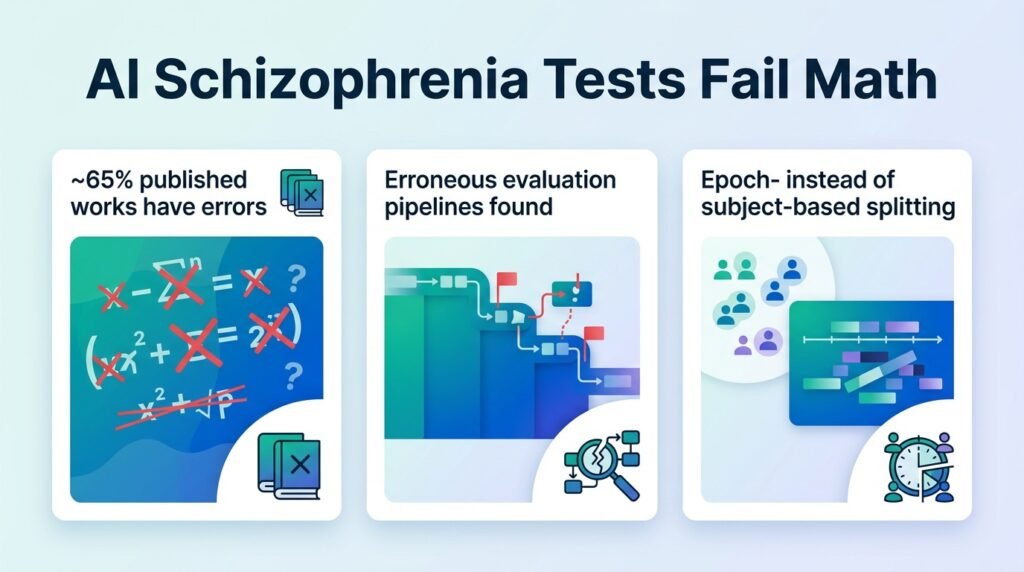
A rigorous review of the state-of-the-art literature revealed that roughly 65% of published papers on this technology contain these pipeline errors. To prove the impact of this leakage, the study authors tested three open schizophrenia EEG datasets. They ran the data through both leaky and leakage-free machine learning models to measure the exact difference in performance.
The results show how easily bad math creates false hope:
- Standard literature claims classification accuracy rates of 95% and above.
- Information leakage artificially inflates schizophrenia detection accuracy by up to 30%.
- More than half of the analyzed studies used epoch-based instead of subject-based data splitting.
Sloppy data splitting
The most common error is splitting data by “epochs” rather than by individual patients. An EEG records multiple short segments of brain activity from a single person. If an algorithm trains on some segments from Patient A and tests on other segments from the same Patient A, it is not learning the signature of schizophrenia. It is simply learning to recognize Patient A’s unique brain signature.
Another frequent mistake is ranking and selecting brain-wave features before partitioning the data. This gives the AI a sneak peek at the broader dataset. When these leaks are plugged, the near-perfect accuracy numbers collapse, revealing that the algorithms are far less capable than advertised.
Why clinical translation stalls
This is not just an academic debate about coding best practices. It explains why promising laboratory tools repeatedly fail when deployed in real hospitals. An algorithm that scores 95% in a leaky lab test will likely misdiagnose real patients because it never learned the actual biology of the disease. It learned the quirks of the training data.
Before these tools can assist in clinical decision-making, the field needs strict, standardized testing protocols. Until then, any claim of near-perfect AI diagnostic accuracy should be met with deep skepticism. We are not yet ready to trust algorithms with psychiatric diagnoses.
Read the full analysis in Translational Psychiatry.