Training diagnostic AI no longer requires massive, expensive libraries of real patient photos.
How do you train an algorithm to read a rapid medical test for a brand-new virus? Traditionally, developers had to wait months to collect, label, and clean thousands of real-world patient photos. This data bottleneck keeps diagnostic software locked behind the gates of wealthy institutions that can afford proprietary image libraries.
A new preprint paper introduces SynSight, an AI pipeline that trains itself entirely on synthetic images to segment and classify rapid diagnostic tests (RDTs). By skipping the real-world data collection phase, this approach challenges the long-held belief that medical AI must feed on actual clinical history to perform safely in the wild.
This shift matters because it democratizes diagnostic software. While traditional deep learning in medical imaging relies on vast repositories of actual clinical scans, synthetic pipelines flip this model. Instead of hoarding patient data, developers can generate simulated test strips on demand, matching the pace of mutating pathogens. This could dismantle the competitive advantage of large medical corporations.
High accuracy, fake training
The researchers tested their synthetic-only pipeline on two highly prevalent infectious diseases. Despite never seeing a real patient photo during its initial training, the AI matched or exceeded typical human reading accuracy when validated on real-world tests.
The performance metrics from the study highlight the viability of this approach:
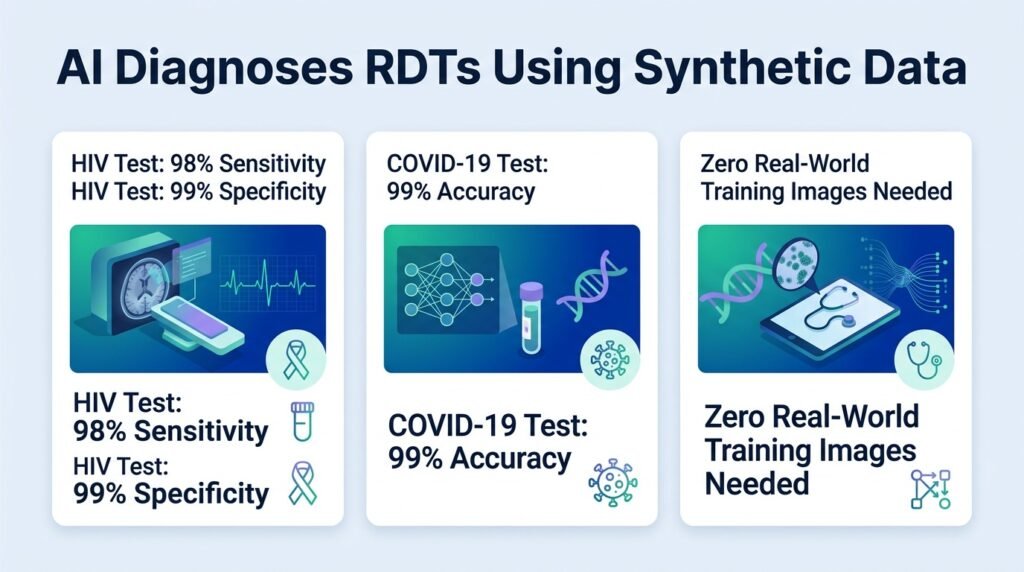
- The pipeline achieved 98% sensitivity and 99% specificity when interpreting HIV rapid tests.
- The system reached up to 99% accuracy when classifying COVID-19 rapid tests.
- The workflow eliminates the need for real-world training images, allowing rapid adaptation to new test designs.
These numbers suggest that simulated training data is no longer a poor substitute for the real thing. It is a viable replacement that performs at clinical grade.
The physical world bottleneck
Of course, synthetic data is not a magic cure for clinical validation hurdles. While convolutional neural networks in medical image analysis excel at pattern recognition, they remain sensitive to real-world chaos. A synthetic image generator must perfectly mimic every crease, shadow, and smudge that a user might introduce in a poorly lit clinic.
If the synthetic training set fails to account for cheap smartphone cameras or bad lighting, the AI could fail in rural clinics. This study is a preprint and still requires extensive field testing across diverse geographic regions before clinical deployment. We must see how it handles physical degradation, like expired test strips or blood volume errors, which synthetic generators might struggle to predict. However, the proof of concept is clear: the data monopoly in medical AI is cracking.
Read the full preprint on medRxiv.