A new model bypasses complex clinical charts to predict long-term death risk using nothing but raw billing codes.
Why do we spend billions of dollars and countless clinical hours hand-curating patient phenotypes to predict who will die? For decades, risk stratification has relied on labor-intensive clinical indices. This new study challenges that entire paradigm. By feeding raw administrative data straight into machine learning models, researchers outperformed established clinical gold standards without needing a single curated medical history.
This suggests we have been overcomplicating risk prediction. The administrative exhaust of healthcare—the codes submitted for billing and prescriptions—holds more predictive power than structured clinical summaries.
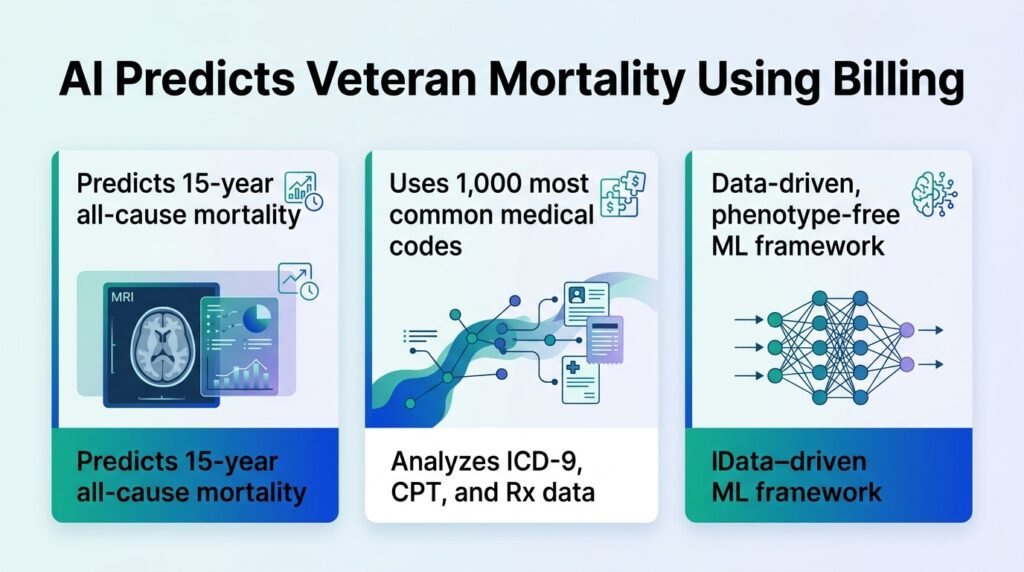
The study analyzed a massive cohort of 2.3 million Veterans in the largest integrated U.S. healthcare system. Instead of relying on predefined clinical phenotypes, researchers pulled the 1,000 most common outpatient medical codes across three categories: ICD-9 diagnoses, Current Procedural Terminology (CPT) codes, and prescription drugs. They trained three machine learning algorithms, including a three-layered neural network, to predict 15-year all-cause mortality.
This builds on previous efforts to predict outcomes in the VA system, such as comparing machine learning to regression methods for mortality. But extending the horizon to 15 years using only outpatient data is a different beast.
The billing code advantage
The machine learning models consistently beat traditional clinical baselines like the Charlson Comorbidity Index (CCI), Elixhauser, and VACS indices.
- The ML models achieved C-statistics ranging from 0.82 to 0.84.
- In contrast, the refitted traditional indices scored lower, between 0.739 to 0.804.
- The predictive edge remained consistent across subgroups, including patients under 65, those over 65, Black patients, and Hispanic patients.
- Cardiovascular diseases and mental health treatments emerged as the strongest long-term indicators.
Why this matters
This shifts the focus of predictive medicine. If billing codes predict long-term mortality better than curated clinical indices, then clinical complexity might be a distraction for risk stratification. It means we can flag high-risk patients years in advance using automated data pipelines that already exist for billing.
However, this approach is not without friction. Administrative codes are notoriously messy and influenced by billing incentives rather than pure clinical reality. Furthermore, the VA patient population skews heavily male and older, which might limit how well these findings apply to the general public. While previous VA studies have successfully mapped shorter-term risks like 30-day COVID-19 hospitalization and death, predicting a 15-year horizon requires stable, long-term data access that many private health systems lack.
If healthcare systems can operationalize this, they can automate risk stratification at scale without burning out clinicians. The data is already there, waiting in the billing department.
Read the full preprint in medRxiv.