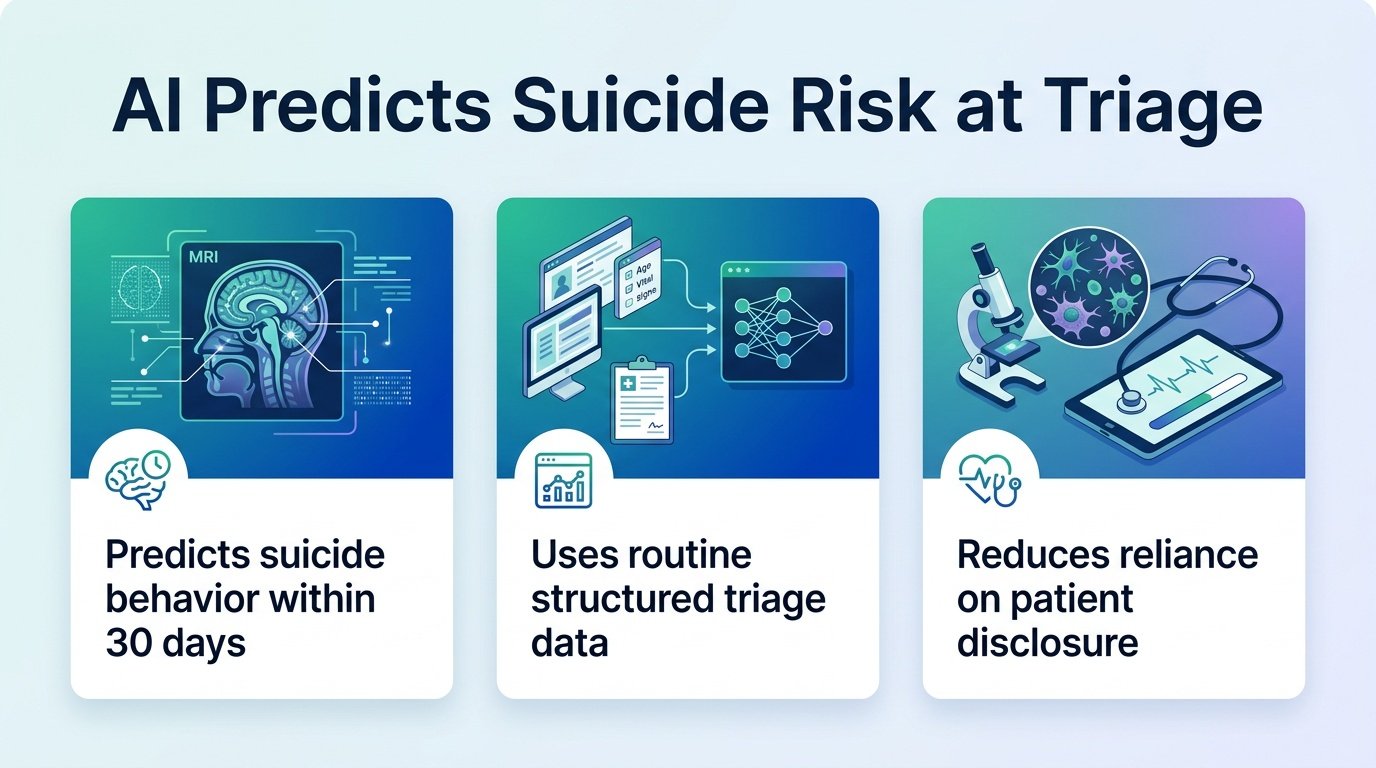
An algorithm can spot patients at risk of suicide within 30 days using only basic emergency room intake data.
How do you spot a patient in crisis when they will not admit they are struggling? Emergency departments are too chaotic for long psychiatric screenings, and patients often hide their pain. This reality forces clinicians to rely on guesswork during triage.
This study challenges the idea that we need deep psychological profiles to predict self-harm. By relying solely on routine triage data, it suggests that the body’s vital signs and basic history speak louder than a patient’s self-reporting. This shifts the clinical focus from active disclosure to passive data patterns.
The signal in the noise
Researchers tested five machine learning models on structured triage data to predict suicide-related behavior within 30 days of an emergency visit. The models included logistic regression, random forest, XGBoost, LightGBM, and a multilayer perceptron. The LightGBM model performed best, achieving an area under the receiver operating characteristic curve (AUROC) of 0.88 and a recall of 0.79.
That high recall means the tool catches nearly four-fifths of at-risk patients who might otherwise slip through. The algorithm found its strongest predictive signals in prior psychiatric history, age, and basic physiological variables. However, the area under the precision-recall curve (AUPRC) was low at 0.25, with an F2-score of 0.41.
This low precision is the critical detail. A 0.25 AUPRC means that many flagged patients will not actually attempt self-harm. In a busy emergency department, false alarms can desensitize staff, a common barrier noted in research on implementing machine learning models in clinical practice.
Rethinking the intake process
This finding matters because it proves we do not need specialized psychiatric screening tools to identify immediate risk. If an algorithm can flag risk using routine vitals, clinicians can intervene without waiting for a patient to ask for help. This is especially vital for vulnerable groups who may present with atypical symptoms, as highlighted in studies on suicide risk detection in older adults.
But we must be realistic about the limitations. The model has not been tested prospectively in a live hospital environment. Until it undergoes external validation, it remains a promising math equation rather than a proven clinical tool.
Key performance metrics
- 0.88 AUROC, showing strong overall discrimination.
- 0.79 recall, capturing the majority of at-risk patients.
- 0.25 AUPRC, indicating a high rate of false positives.
- 30-day prediction window using only structured triage data.
Read the full analysis in Scientific Reports.