
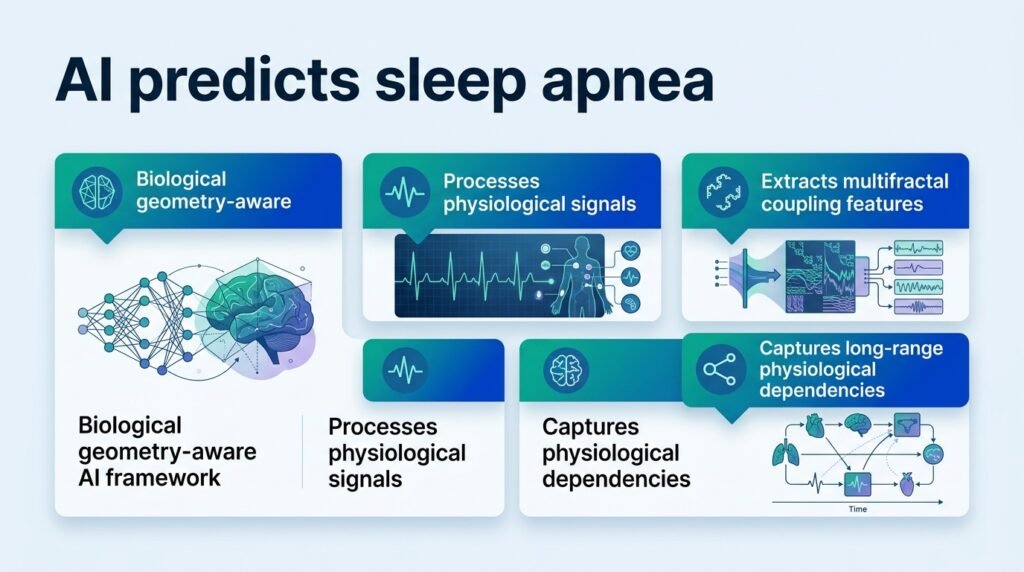
A new AI model analyzes complex bodily rhythms to spot severe sleep apnea without the need for expensive overnight lab tests.
Why does diagnosing sleep apnea still require patients to sleep in a clinical lab wired to dozens of noisy sensors? The gold standard, polysomnography, is slow, expensive, and deeply uncomfortable. Yet millions of people remain undiagnosed while their risk for heart disease and organ damage quietly climbs.
This new framework challenges the assumption that we need invasive setups to capture sleep health. By focusing on “multifractal coupling”—how different bodily systems sync over long periods—the AI turns simple physiological signals into a highly accurate diagnostic tool. It suggests that the secret to diagnosing complex sleep disorders lies not in collecting more raw data, but in analyzing the hidden mathematical relationships between the data we already have.
Analyzing the body’s geometry
The researchers built a biological geometry-aware AI framework to track these long-range dependencies in physiological signals. Instead of looking at isolated heartbeats or breaths, the system measures how these systems interact over time. To prove the model works, researchers tested it across **five diverse patient groups** containing more than **35,000 subjects**. This massive dataset ensures the findings are not just a fluke of a single local clinic’s patient mix, which has historically been a major failure point for clinical AI.
What the data shows
The model’s ability to map these complex biological relationships yielded highly consistent results across all test groups.
- Achieved area-under-the-curve (AUC) values exceeding 0.91 for sleep apnea prediction.
- Improved diagnostic accuracy by 8% to 18% over current state-of-the-art models.
- Demonstrated rapid convergence, meaning the AI learns to identify patterns quickly without needing endless computing power.
The reality of deployment
This matters because sleep apnea is notoriously difficult to track outside of a clinical setting due to noisy data. By proving that multifractal coupling remains stable across **35,000 individuals**, this study shows that mathematical relationships in our biology are universal enough to bypass local demographic differences. This shifts the diagnostic bottleneck from hardware availability to software processing.
However, we must remain realistic about the limitations. While the AI shows high accuracy across diverse cohorts, the paper does not detail how this model performs on cheap consumer-grade wearables versus clinical-grade sensors. If the system still requires medical-grade inputs to achieve that **0.91 AUC**, the barrier to widespread home adoption remains high. Clinicians should view this as a powerful tool for triaging patients, not yet a replacement for clinical oversight. Future research must test this algorithm on noisy data from smartwatches to see if the mathematical relationships hold up.
Read the full study in Nature Communications.