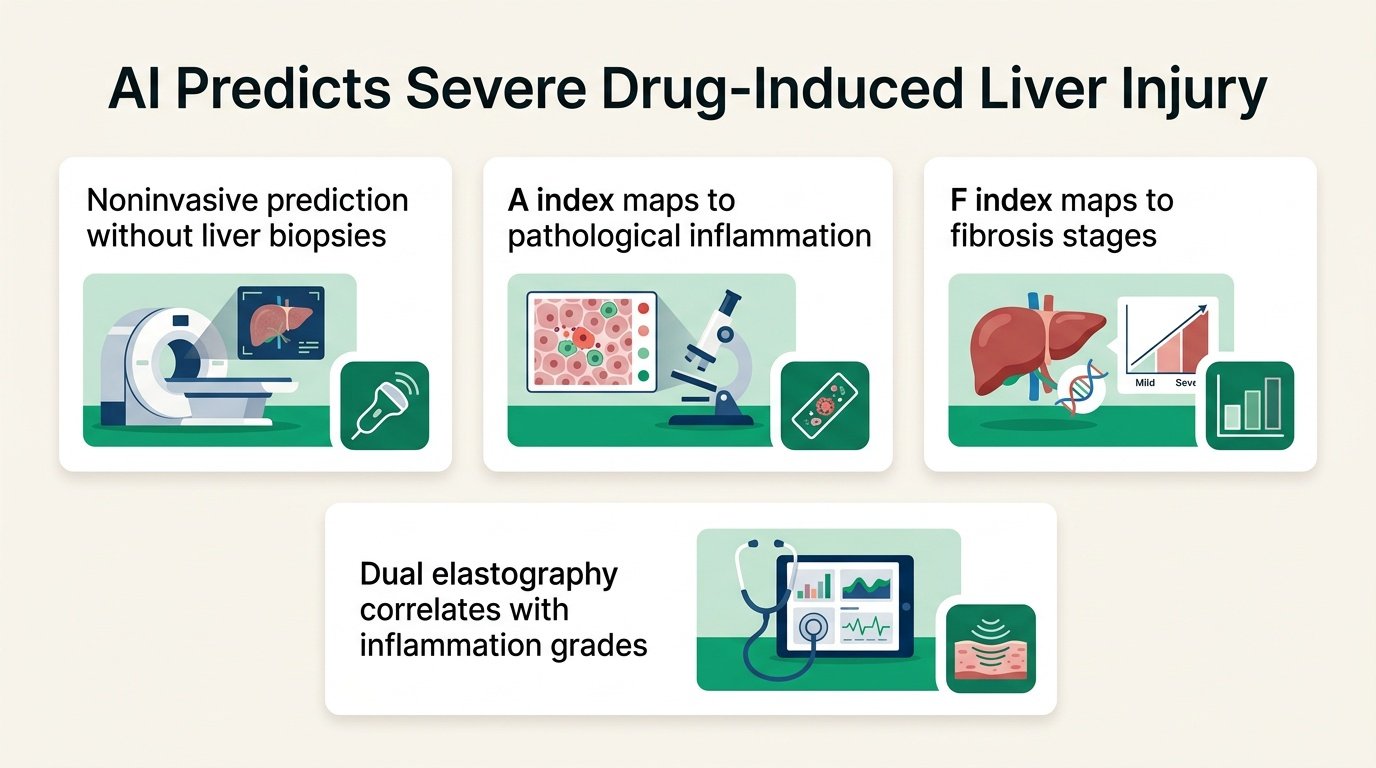
A new machine learning model uses dual ultrasound measurements to identify severe liver damage, offering a way to bypass painful and risky biopsies.
When a patient suffers from drug-induced liver injury, doctors face a dangerous diagnostic blind spot. Standard blood tests are notoriously vague. This leaves clinicians to choose between guessing the internal damage or sticking a long needle into a highly vascular, compromised organ.
This new model challenges the assumption that we must extract physical tissue to grade acute liver damage. By combining dual elastography with basic clinical data, the algorithm achieves diagnostic accuracy that could make routine liver biopsies for drug injuries obsolete. This is not just about patient comfort. It is about speed in critical care, where waiting for pathology results can delay life-saving treatment decisions.
The clinical trial data
Researchers built and validated the model using a prospective multicenter cohort of 305 patients. The cohort had a median age of 49 years (interquartile range of 40-56) and included 98 male participants. Among these patients, 55 had severe drug-induced liver injury while 250 did not.
Severe injury was strictly defined by pathology as a Scheuer inflammation grade plus fibrosis stage of 5 or higher. The researchers split this dataset into a 7:3 ratio to train and test eight different machine learning models, optimizing them with Bayesian methods.
How the algorithm performed
The star of the trial was an optimized regularized regression model. By analyzing dual elastography-derived activity and fibrosis indices alongside standard serum biomarkers, the algorithm mapped liver tissue health without physical invasion. The dual elastography indices emerged as the dominant predictors during SHAP analysis.
The model achieved strong diagnostic metrics in the test set:
- An Area Under the Curve (AUC) of 0.862, showing high overall accuracy.
- A sensitivity of 81.2% to reliably catch severe tissue damage.
- A specificity of 74.7% to rule out low-risk patients.
The shift in clinical practice
This finding matters because drug-induced liver injury is highly volatile. Clinicians must decide instantly whether to withdraw a suspect drug, start aggressive therapy, or prepare for a transplant. Waiting for a biopsy is a luxury these patients do not have.
However, the tool has clear limits. The training set relied on only 55 severe cases, which is a small sample size for machine learning. The model must prove its accuracy in larger, more diverse global populations before clinicians can fully retire the biopsy needle. Even with these limitations, the open-access online risk calculator represents a major step toward real-time, noninvasive triage.
This study was published in European Radiology.