A new AI model separates what doctors cannot change from what they can, offering a blueprint for safer postoperative prescribing.
Why do clinical prediction models so often collect dust on hospital servers? Most of them tell clinicians who is at risk, but they fail to show how changing a treatment decision actually alters that risk. This leaves doctors with a bleak forecast and no clear path forward.
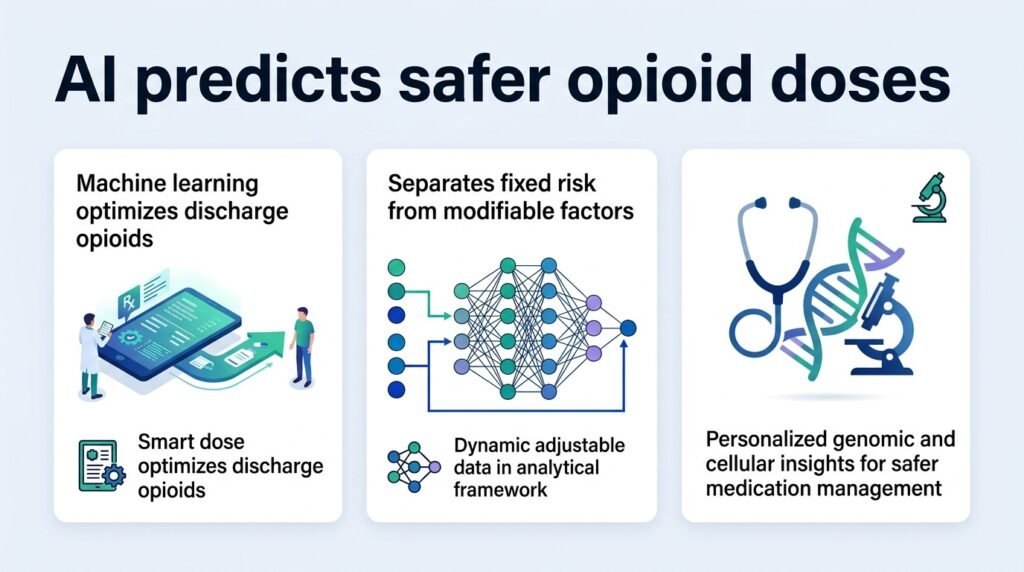
A new preprint challenges this passive approach to clinical AI. By separating fixed patient risks from modifiable prescribing decisions, researchers have built a model that acts as an active advisor rather than a passive alarm. This shift is critical for high-stakes decisions like postoperative pain management, where overprescribing can trigger long-term dependency.
Predicting the modifiable path
The researchers built the Hierarchical Clinical Fusion Transformer (HCF-Transformer) to evaluate risk across four postoperative complications. They trained and validated the model using data from 157,853 unique diabetic surgical patients. This is a notoriously difficult cohort to manage, with baseline complication rates in the data ranging from a high of 47.2% for prolonged opioid use to 1.8% for acute opioid-associated outcomes.
Instead of treating these outcomes as inevitable, the model first maps the patient’s unchangeable baseline risk. It then simulates different discharge opioid regimens, ranking them using a custom Total Relative Risk metric.
How the model performed
The system outperformed standard machine learning baselines, showing high predictive accuracy across all four target complications:
- An AUROC of 0.798 for predicting prolonged opioid use.
- An AUROC of 0.808 for chronic pain.
- An AUROC of 0.712 for 30-day hospital readmissions.
- An AUROC of 0.922 for acute opioid-associated outcomes.
The model’s risk recommendations varied significantly across different discharge options (ANOVA p < .01, eta-squared > .01). This statistical variance is the real story. It proves the AI is not just generating generic warnings, but is actively identifying specific, lower-risk drug regimens tailored to individual patient chemistry.
The analytical takeaway
This architecture matters because it targets the exact point of clinical leverage. A surgeon cannot change a patient’s diabetic status or surgical history at the moment of discharge. They can, however, change the number of pills in the prescription. By isolating this single modifiable variable, the model provides actionable choices instead of abstract risk scores. It shifts the paradigm from predicting bad outcomes to actively preventing them.
However, some skepticism is warranted. The model was trained on a retrospective cohort of diabetic patients, meaning its performance in the chaotic environment of a live clinic remains unproven. It also awaits formal peer review. Until prospective trials show that doctors actually change their behavior based on these recommendations, this remains a highly promising mathematical framework rather than a proven clinical tool.
Read the full study in medRxiv.