
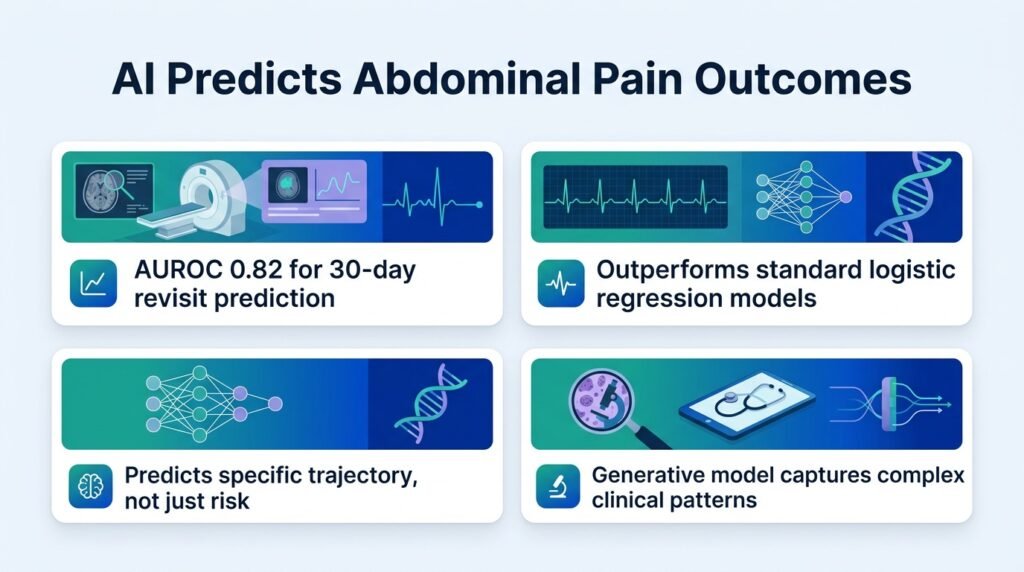
A new generative model beats traditional machine learning at predicting which discharged emergency patients will return to the hospital.
When a patient leaves the emergency room with abdominal pain, doctors rarely know what happens next. Will they recover at home, or will they return in critical condition? Standard risk models only predict if a patient will return, failing to forecast the severity of that return.
This study challenges the reliance on narrow, task-specific predictive models. By using a generative foundation model called Curiosity, researchers showed that predicting entire clinical trajectories is not only possible but far more accurate. This shifts the paradigm from simple binary risk alerts to complex, multi-step patient tracking.
Tracking the patient journey
The retrospective study analyzed a random sample of 3,000 patients drawn from 150,030 eligible adults discharged from emergency departments within the Epic Cosmos network in 2022. The cohort had a median age of 47 years and was 65.3% female. Researchers tracked these patients over a 30-day follow-up period to evaluate how well the Curiosity model mapped their post-discharge paths compared to standard XGBoost models.
Superior trajectory accuracy
The generative model outperformed traditional machine learning across multiple metrics:
- Curiosity achieved a 30-day admit-revisit AUROC of 0.83, compared to 0.70 for XGBoost.
- The model’s area under the precision-recall curve (AUC-PR) reached 0.37, nearly tripling the XGBoost score of 0.13 against a low cohort base rate of 4.1%.
- Curiosity correctly identified the most likely trajectory out of 36 possibilities for 45.9% of patients, while XGBoost managed only 41.0%.
- The median edit distance for Curiosity was lower at 1.28 compared to 1.40 for XGBoost, indicating closer alignment with actual patient paths.
- The model demonstrated a median absolute calibration error of just 1.30 percentage points across 45 transitions.
While earlier predictive tools focused on static endpoints like mortality, as seen in research on dynamic machine learning in intensive care, Curiosity models the entire sequence of events. This is a crucial step forward. Instead of crying wolf with generic return alarms, the system tells clinicians how a patient will return.
Real-world limitations
However, the study relies on retrospective data from a single year. Real-world clinical environments are messy, and EHR systems vary globally, a challenge documented since early efforts in implementing computer-based patient records. If Curiosity cannot adapt to varying data quality across different hospital networks, its predictive power will degrade.
Furthermore, a model that predicts a trajectory does not automatically improve care. Clinicians must still decide how to act on these predictions. If hospitals use this tool to justify keeping patients longer in already crowded emergency departments, it could worsen the very bottlenecks it aims to solve.
Read the full study in medRxiv.