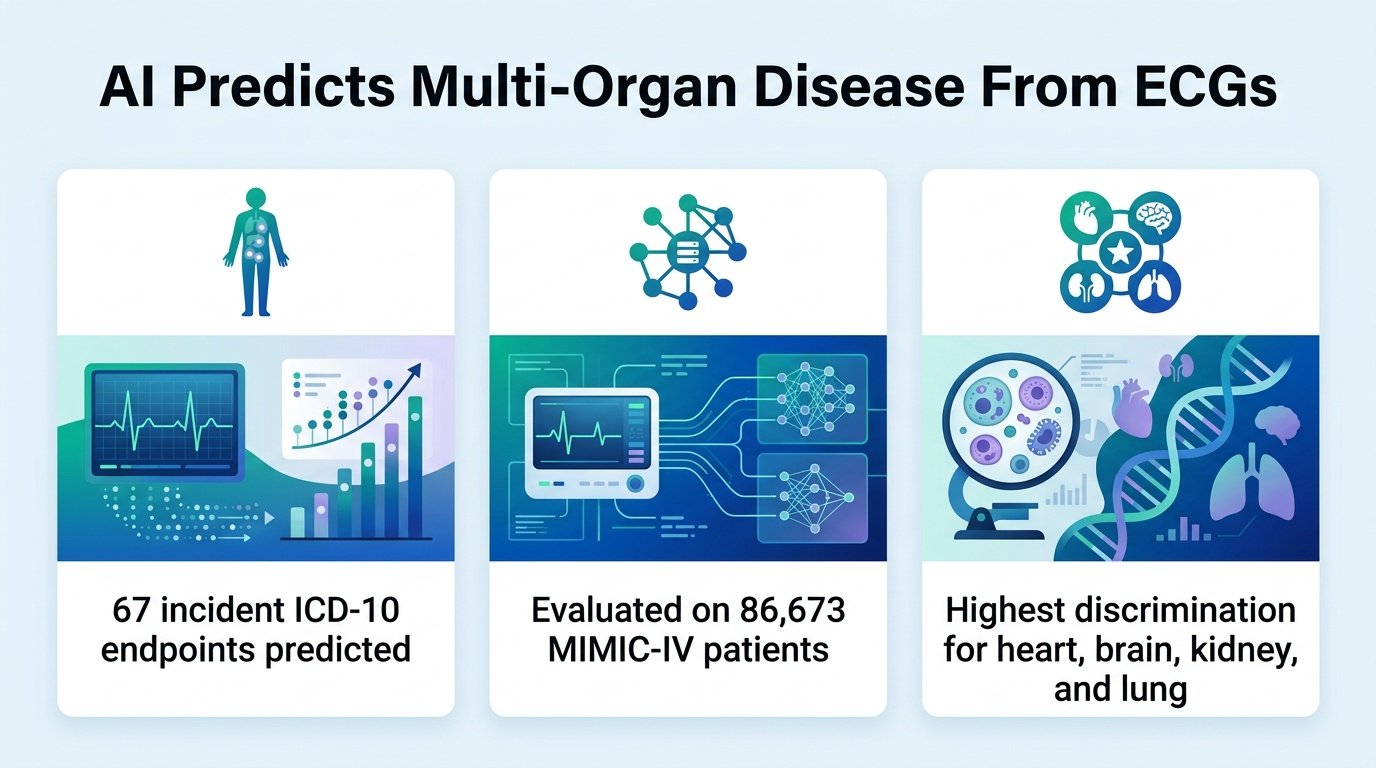
A new AI model shows that a simple heart scan can flag future brain, lung, and kidney diseases years before they manifest.
Why should a heart doctor look at a brain? For decades, the electrocardiogram has been treated as a single-organ tool, meant only to spot heart attacks or irregular rhythms. A new study challenges this narrow view by using the heart’s electrical signals to peer into entirely different organ systems.
This shifts the ECG from a diagnostic tool to a systemic crystal ball. It suggests that systemic aging and disease leave early, readable signatures in cardiac electrical activity. If a simple heart test can predict dementia, we must rethink how we screen for cognitive decline. It implies the heart is a mirror for the entire body’s vascular health.
Predicting across organ systems
Researchers built a multitask survival model called ECG-RISK using data from 86,673 patients in the MIMIC-IV database. The algorithm analyzed ECG waveforms, demographics, and routine lab data to predict 67 different health outcomes. The results reveal a stark divide in what the heart can tell us about the rest of the body.
The model performed exceptionally well on heart, brain, kidney, and lung endpoints, with organ-level C-indices ranging from 0.796 to 0.825. However, it struggled to predict liver and pancreatic conditions. This suggests that some organ failures do not echo through the cardiovascular system in a readable way, drawing a clear boundary for where this technology works.
- Dementia prediction reached a remarkably high C-index of 0.891.
- Heart failure risk was predicted with a C-index of 0.857.
- The model showed clear separation among risk groups across nine aggregated outcomes.
Interestingly, adding expensive laboratory tests to the demographic and ECG data did not always help. The incremental improvement gained from lab inputs varied substantially across different diseases. This means a basic, low-cost ECG alone does most of the heavy lifting for risk prediction, questioning the need for complex blood panels in early screening.
The clinical friction ahead
The high accuracy for dementia is the standout finding here. Cognitive decline is notoriously difficult to screen early without expensive imaging or invasive spinal taps. If an ECG can flag dementia risk early, it opens the door to lifestyle interventions long before symptoms appear.
Before clinics adopt this model, several hurdles remain. The data comes from a single hospital database, meaning the AI needs external validation on diverse patient groups. The researchers also did not account for competing risks, which can skew long-term predictions in older patients who might die of other causes first.
Yet, the implications are clear. We are moving toward a future where a single, routine test can screen for multi-organ decline. This could change preventive medicine, turning every standard cardiology visit into a comprehensive health check.
Read the full preprint study at medRxiv.