
A new AI model proves that the messy, unformatted text in patient charts is actually the most valuable tool for choosing liver cancer therapies.
How do doctors choose the right therapy when a patient has liver cancer? Clinicians usually focus on structured lab values and tumor sizes, yet the most critical clues often hide in the unstructured scribble of a radiology report. This disconnect forces medical teams to make high-stakes decisions without a complete picture of the patient’s history.
This study challenges the status quo by showing that AI can ingest both structured data and raw medical text to predict the best treatment path. For years, developers built models that only looked at clean, tabular data like blood counts. By proving that textual narratives and socioeconomic factors drive the algorithm’s decisions, this research suggests that the “soft” data we often discard is actually the signal, not the noise. It forces us to rethink what clinical data is actually worth collecting.
This shift aligns with ongoing efforts to address the challenges of translating algorithms into real-world oncology clinics, as discussed in recent reviews on responsible AI translation in HCC.
How the model works
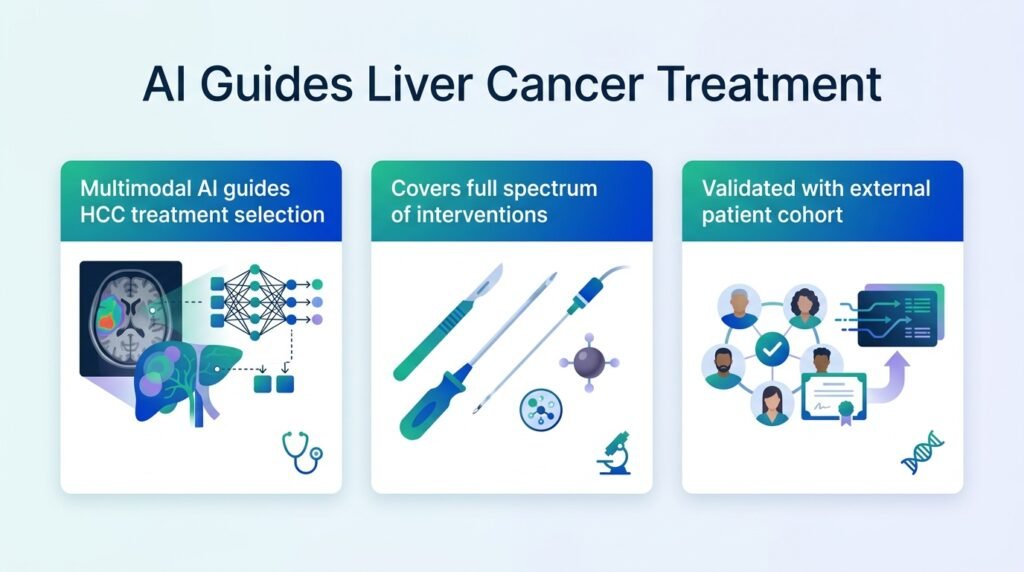
Researchers built a model called Embedding-Augmented Extra Trees, or ET-Emb. It merges classic structured clinical variables with text embeddings from medical histories and radiology reports. The system evaluates five primary treatment paths: open resection, laparoscopic resection, transarterial chemoembolization, radiofrequency ablation, and chemotherapy.
The team trained the model on a development cohort of 1,043 liver cancer patients treated between January 2017 and December 2023. To test its real-world utility, they ran it against an external validation group of 55 patients from Wuxi Peoples Hospital.
The key performance metrics
The model proved highly capable of mimicking complex oncological decision-making. Here is how it performed across the cohorts:
- In the development cohort, the model achieved an ROC-AUC of 0.84 ± 0.04 and a PR-AUC of 0.55 ± 0.06.
- In the external validation cohort, performance remained strong with an ROC-AUC of 0.77 ± 0.02.
- The external validation PR-AUC reached 0.47 ± 0.03.
- SHAP analysis revealed that textual clinical narratives and socioeconomic determinants were the primary drivers of the model’s predictions.
The limits of text
The drop in performance during external validation—from an AUC of 0.84 to 0.77—highlights a persistent bottleneck. Text formats vary wildly between hospitals. If an AI relies heavily on local writing styles, it may struggle when deployed in a new clinic.
Furthermore, we must ask whether socioeconomic factors should guide treatment selection. While these factors reflect real-world access to care, training an AI on them risks baking existing healthcare disparities directly into the algorithm’s recommendations. This ethical hurdle is a known pain point in the clinical management of hepatocellular carcinoma using AI tools.
This research was originally published in medRxiv.