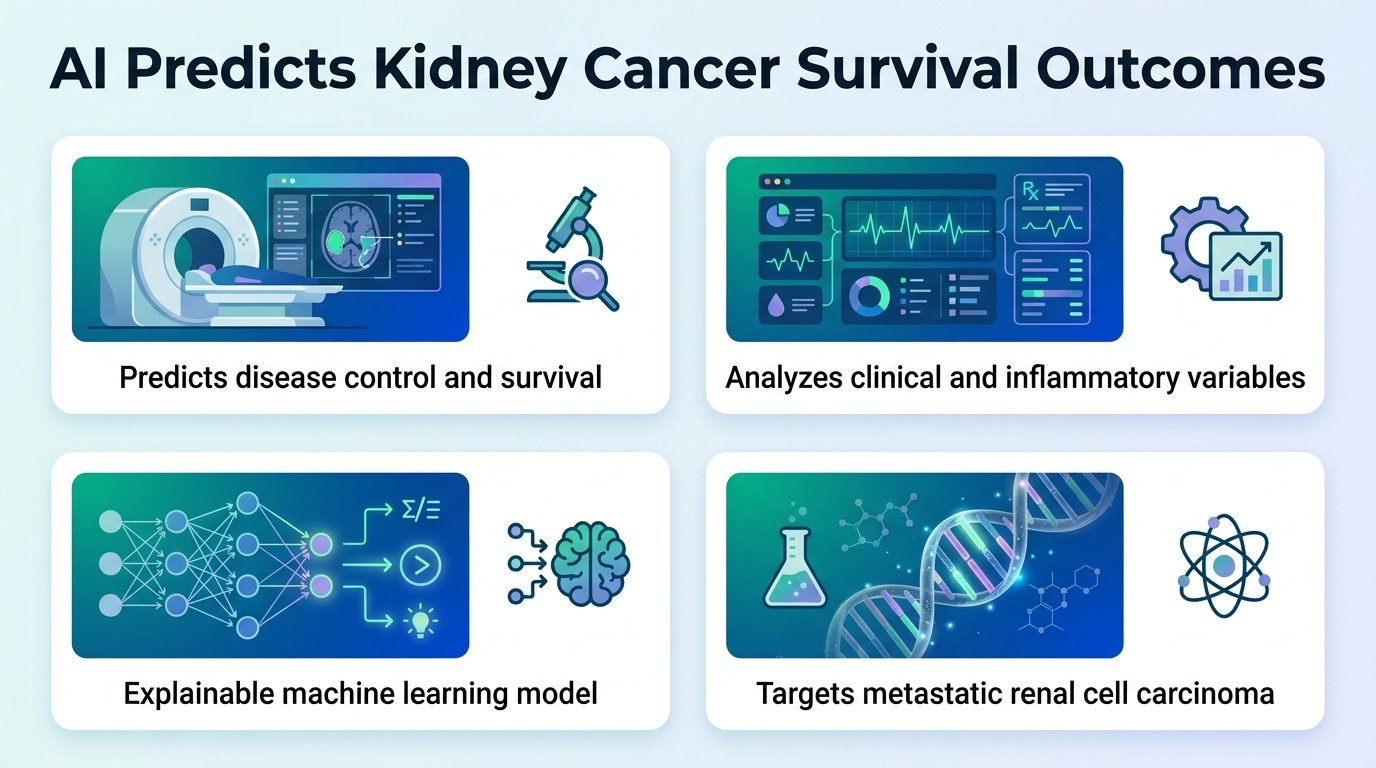
A new machine learning model uses basic blood markers to predict how kidney cancer patients respond to immunotherapy.
Why do some advanced kidney cancer patients thrive on immunotherapy while others decline rapidly? Doctors currently rely on clinical staging, but it often misses the mark. This leaves patients facing toxic side effects and high costs for treatments that might not work.
The Meet-URO 15-AI study shifts the focus from complex genomic sequencing to everyday blood work. By feeding standard lab values into an explainable AI model, researchers achieved solid predictive power. This challenges the assumption that we need expensive, high-tech biomarkers to guide immunotherapy. Instead, the answers might already be hiding in routine complete blood counts.
Researchers analyzed data from 571 patients with metastatic renal cell carcinoma who received nivolumab as a second-line or later treatment. The team built machine learning models using clinical and inflammatory variables to predict survival and disease control. The standout performer was a support vector machine model paired with feature selection. It predicted six-month overall survival with an F1-score of 0.81 on the test set and 0.77 in external validation. For continuous overall survival, a random survival forest model hit a concordance index of 0.68.
What the AI found
Instead of acting as a black box, the model used Shapley additive explanations to show its work. It relied on a few critical, easily accessible metrics:
- Inflammatory indices and the established IMDC score
- Hemoglobin levels
- Lymphocyte and platelet counts
The clinical reality
This finding matters because it democratizes precision oncology. High-end genetic testing is restricted to elite cancer centers, but standard blood draws are available everywhere. If basic lab work can predict survival with an F1-score of 0.77 in external validation, community clinics can make better treatment decisions without waiting weeks for expensive assays.
However, we must remain cautious about clinical AI deployment. Just as radiation oncologists debate the safety of large language models in clinical workflows—as discussed in a study on ChatGPT’s reliability in radiation oncology—predictive models also need rigorous, real-world testing before replacing human judgment.
The study is retrospective, meaning it looks backward at existing data. While the external validation is promising, the model still needs prospective trials in active clinics to prove it actually improves patient survival. A concordance index of 0.68 also shows there is still significant room for error.
Read the full study in npj Precision Oncology.