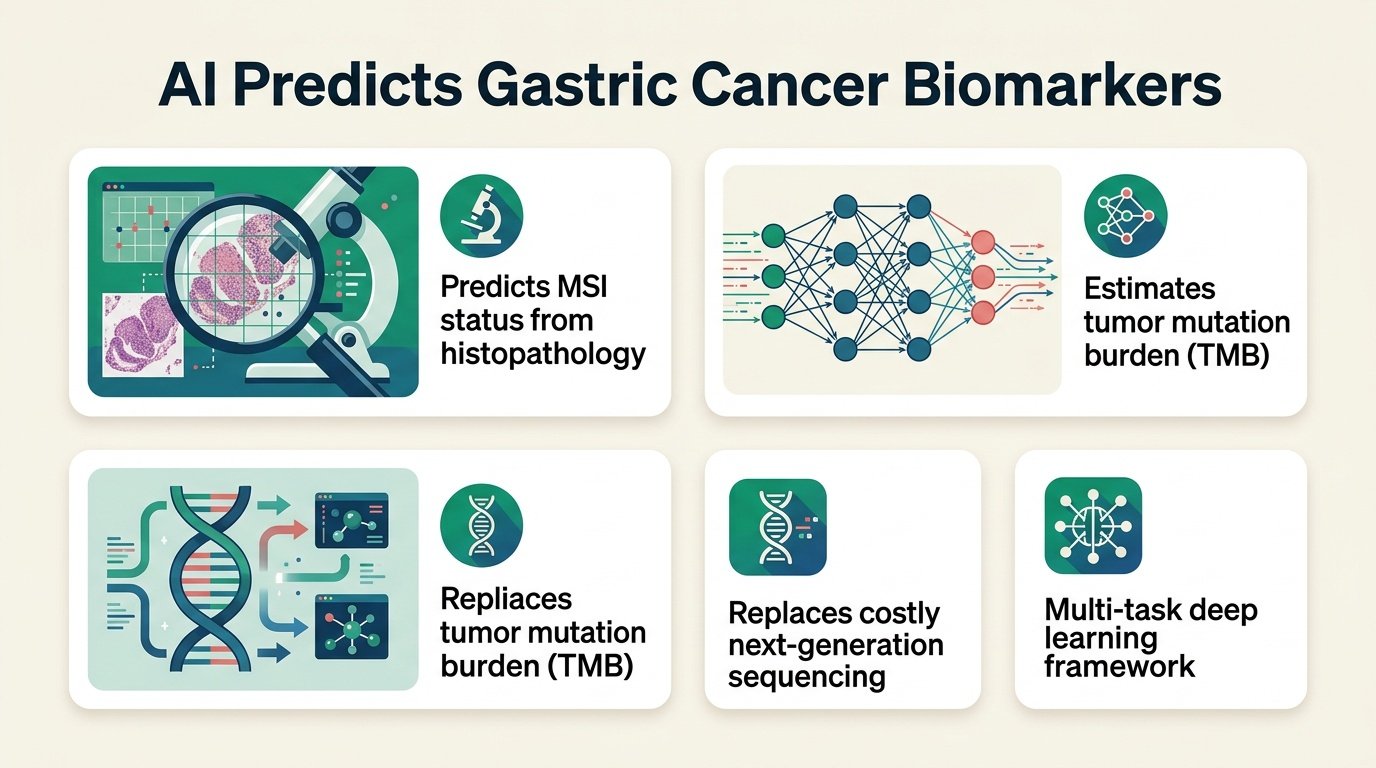
A new multi-task AI model predicts two critical gastric cancer immunotherapy biomarkers from routine biopsy slides, but its real-world drop in accuracy highlights a persistent industry bottleneck.
Can a single algorithm replace thousands of dollars of genetic sequencing? Oncologists rely heavily on microsatellite instability (MSI) and tumor mutational burden (TMB) to select candidates for immunotherapy. Yet, the high cost and complexity of next-generation sequencing keep these tests out of reach for many clinics worldwide.
This new research challenges the necessity of separate, expensive molecular pipelines. By training one neural network to predict both markers simultaneously, researchers are betting on biological overlap. But the real story is the performance gap when the tool leaves the lab.
The study trained a multi-task deep learning model on whole slide images and clinical data from 312 patients in the Cancer Genome Atlas (TCGA). To test its real-world viability, researchers validated the system on an independent cohort of 121 gastric cancer patients from the Chinese Academy of Medical Sciences. The architecture fused ResNet50 image features with structured clinical data like age, gender, and tumor stage.
The performance gap
On internal testing, the model achieved strong results, with area under the curve (AUC) values of 0.828 for MSI and 0.836 for TMB. This outperformed standard single-task networks like ResNet18 and VGG. However, the numbers dipped when tested on the external hospital cohort, falling to 0.78 for MSI and 0.74 for TMB.
This drop is not just a minor statistical variance. It exposes a critical limitation in AI-driven pathology: scanner variability and domain shifts. If an algorithm’s accuracy drops by up to nine percentage points just by changing hospitals, it cannot yet replace physical sequencing.
Instead, its immediate value lies in triaging. It can flag high-probability patients in low-resource clinics who desperately need confirmatory sequencing. This builds on previous efforts to stratify gastric cancer patients using deep learning on H&E slides, such as the 2023 study on molecular features. While earlier models often relied on simpler architectures, like those discussed in ResNet18-based MSI classification research, this multi-task approach attempts to capture the spatial overlap between TMB and MSI.
Key trial metrics
- Internal test set performance reached an AUC of 0.828 for MSI and 0.836 for TMB.
- External validation AUC dropped to 0.78 for MSI and 0.74 for TMB due to scanner domain shifts.
- The training pipeline utilized a cohort of 312 patients, validated against 121 external patients.
The path forward
The spatial concordance shown in the model’s attention maps proves that MSI and TMB leave similar visual footprints on tumor tissue. This biological reality validates the multi-task design.
However, until developers solve the scanner-compatibility problem, this tool remains a highly promising triage filter rather than a diagnostic replacement.
Read the full study in Frontiers in Oncology.