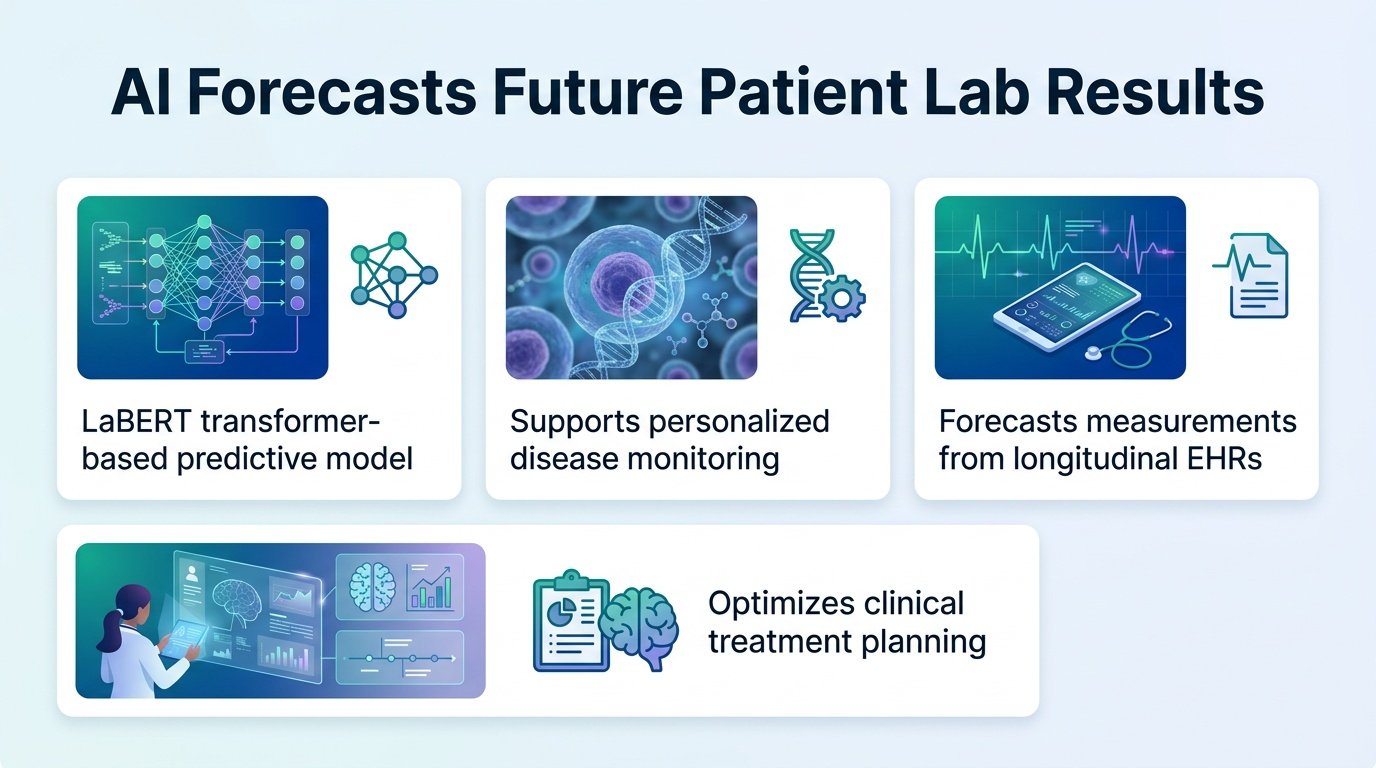
A new transformer model can simulate how a patient’s lab values will react to specific drugs before they are even prescribed.
Doctors routinely order blood tests to see if a drug is working. But what if they could simulate the patient’s biological response days before the needle ever touches the skin? A new model called LaBERT aims to do exactly that by turning static electronic health records into dynamic forecasting tools.
This challenges the traditional reactive loop of medicine. Instead of waiting for a patient to deteriorate or show side effects, clinicians could test drug scenarios in a digital sandbox. This moves AI from a passive summarization tool to an active clinical simulator.
For years, clinical AI has focused on predicting mortality or readmission risks. While useful, those metrics do not tell a doctor what to do next. Predicting specific lab values like kidney function or blood clotting times gives clinicians actionable data they can use to adjust doses in real time.
Researchers trained and tested LaBERT on a massive dataset of 583,535 clinical visits from 255,769 patients in the MIMIC-IV database. The model outperformed standard baseline methods across the board. It slashed the mean squared error of future lab predictions from 0.77 to 0.53, while pushing the coefficient of determination (R2) from a weak 0.29 to a much more respectable 0.51.
Testing the drug effects
The real test of a clinical simulator is whether it actually understands pharmacology. To prove this, the researchers ran a perturbation analysis. They swapped out the patients’ real medications for randomized drug sets.
The model proved highly sensitive to these changes. It predicted future patient states more accurately using the actual prescribed medications in 81% of visits. This confirms the model is not just memorizing patient trajectories but is actually learning the specific impacts of treatments.
The model also successfully ran counterfactual analyses. It accurately reproduced well-known drug reactions across different time horizons, including:
- Reduced prediction error by 31% compared to baseline models.
- Accurately modeled warfarin-induced increases in international normalized ratio (INR).
- Successfully simulated heparin-induced increases in activated partial thromboplastin time (aPTT).
The limits of simulation
While these results are promising, a model is only as good as its training data. MIMIC-IV is an intensive care database. ICU patients have highly volatile biology, which may not represent how a chronic outpatient responds to medication over months.
This work builds on prior efforts like a multi-headed transformer approach for clinical time-series, as well as TimelyGPT which focuses on long-term forecasting. However, LaBERT’s ability to handle counterfactual drug scenarios marks a critical step toward true personalized medicine.
If clinical trials validate these simulations, the workflow of prescribing high-risk drugs like blood thinners could change. Doctors will simulate the dose first, check the predicted lab trends, and only then write the prescription.
Read the full study in medRxiv.