Static bone density scans miss how a patient’s body changes over time, but a new deep learning model proves that tracking those physical trajectories can prevent missed fracture risks.
How do we predict if an aging patient will break a bone? For decades, medicine has relied on a single snapshot: the baseline dual-energy X-ray absorptiometry scan. This static approach ignores how a person actually ages.
By treating bone loss, height loss, and weight fluctuations as a continuous story, a new model called HyTrax challenges the gold-standard clinical tool. It suggests that relying on one-off tests leaves vulnerable patients unprotected. Clinicians must rethink how they define risk.
Researchers built HyTrax using data from 27,512 postmenopausal women in the Women’s Health Initiative. They then tested its transportability on 1,193 participants from the Framingham Heart Study. The model tracks sequential measurements of hip and spine bone mineral density, grip strength, height, and weight.
The study yielded several key performance metrics:
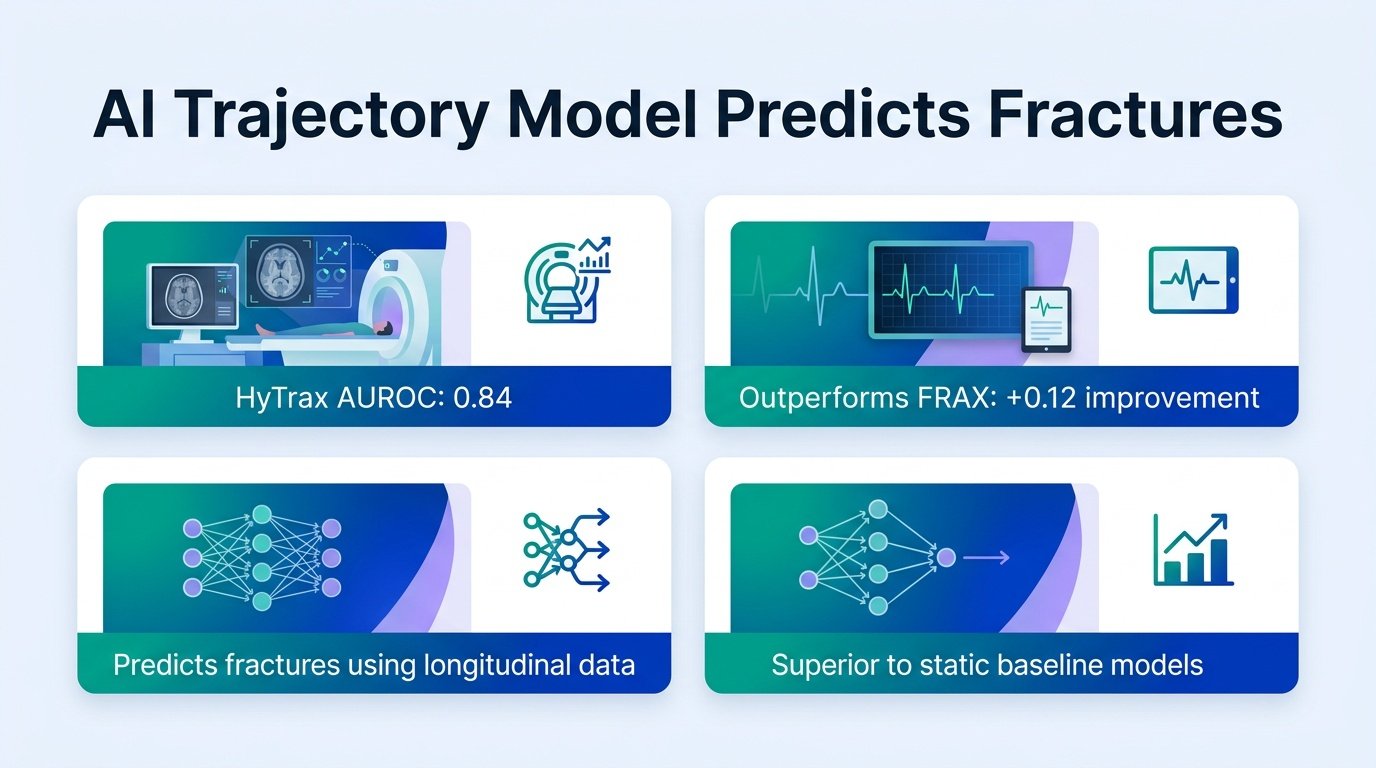
- The ensemble model achieved a time-dependent AUC of 0.85, outperforming the standard FRAX-BMD model at 0.82.
- The model improved risk stratification with a Net Reclassification Improvement of +26.5% in the primary cohort.
- When tested on the external Framingham cohort, the model maintained an AUC of 0.74.
This shift toward continuous monitoring aligns with broader efforts to integrate predictive algorithms into orthopedic care, as discussed in Value-based Healthcare: Can Artificial Intelligence Provide Value in Orthopaedic Surgery?.
The power of trends
The real value of this model lies in its explainability. The algorithm flagged early weight fluctuations and overall height loss as critical warning signs for future fractures. These physical changes are often dismissed as normal parts of aging, but they are actually early indicators of systemic frailty.
By ignoring these trends, current clinical guidelines miss the window for early intervention. A patient might have a stable bone density score but still be at high risk due to rapid height loss. HyTrax proves that the rate of physical decline matters just as much as the baseline score.
The real-world friction
However, we must look closely at how this model travels. The drop in performance on the external Framingham cohort highlights a persistent challenge in medical AI. Models trained on massive, specific trial data often lose sharpness when applied to different clinical populations.
Additionally, gathering repeated, high-quality bone density scans over years is difficult in standard clinical practice. Most insurance plans only cover these scans every two years. This limit restricts the real-world data stream HyTrax needs to work.
Ultimately, HyTrax proves that static risk scores are no longer sufficient. If clinics want to prevent fractures, they must stop looking at patients as frozen snapshots.
Read the full study in medRxiv.