A new AI model predicts disease risk even when half of a patient’s protein data is missing, bypassing a major roadblock in clinical diagnostics.
What happens to a diagnostic AI when the clinic runs a cheaper, stripped-down blood test? Usually, the algorithm breaks.
This vulnerability has kept proteomic forecasting locked in research labs. If an AI requires a perfect, expensive panel of thousands of proteins to work, it will never see real-world clinical use. A new study tackles this head-on by treating proteins like words in a sentence, allowing the algorithm to read the clinical picture even when some words are missing.
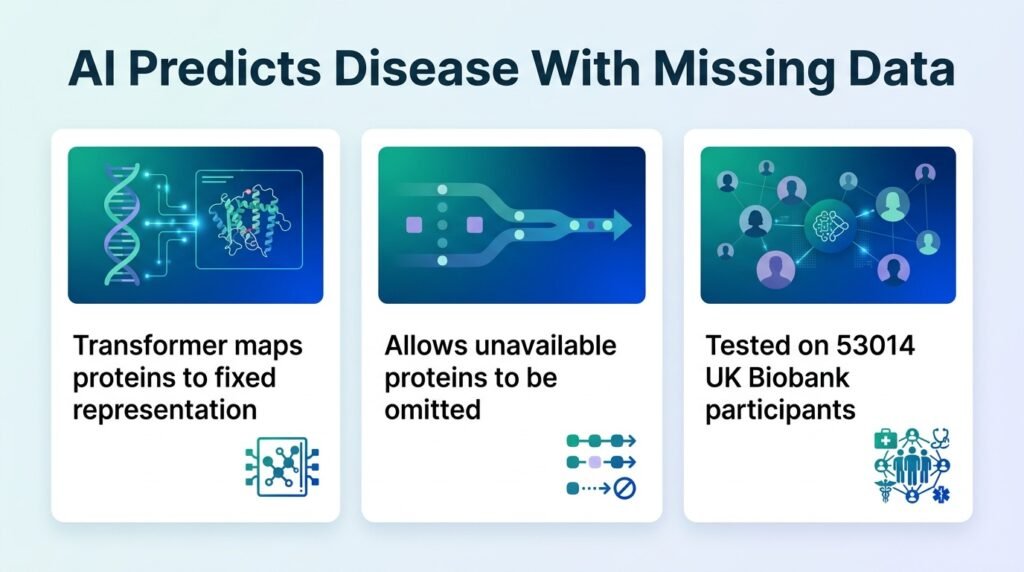
Researchers built a self-supervised protein-token Transformer. Instead of guessing or “imputing” missing data, this model maps whatever proteins are available into a fixed-dimensional format. This allows clinicians to simply omit unavailable proteins rather than trying to statistically estimate them.
To test this, the team used plasma proteomic profiles from 53,014 participants in the UK Biobank Pharma Proteomics Project. They trained the AI on comprehensive profiles of 2,920 proteins. Then, they deliberately cut the data in half to just 1,460 proteins to see if the system would fail.
How the AI performed
The model showed remarkable resilience when facing incomplete data:
- With all 2,920 proteins, the model achieved a median AUC of 0.679 across 144 diseases.
- Dropping to half the proteins without refitting the model only lowered the median AUC to 0.637.
- Retraining just the disease-specific models on the partial data brought the AUC back up to 0.673.
- The model beat standard LASSO risk scores by a median paired AUC difference of 0.027 under partial coverage.
Under partial coverage, the protein-token risk scores were highly comparable to standard LASSO risk scores that had been fully refitted using outcome labels, showing a tiny median difference of just 0.003. This means clinicians do not need to constantly retrain complex statistical models from scratch every time a lab changes its testing menu.
The clinical reality check
This is a major step toward practical clinical tools. In the real world, different labs use different assay setups. Forcing hospitals to adopt identical, expensive testing panels is a non-starter. This architecture proves we can build a single foundation model that adapts to whatever tools a local clinic has on hand.
However, the results show some clear boundaries. Performance remained highly stable for cardiovascular, kidney, and metabolic diseases. Yet it fluctuated wildly when predicting autoimmune conditions. This suggests that while some biological pathways are redundant enough for AI to piece together from partial clues, complex immune-mediated diseases still require specific, high-fidelity measurements.
Even with these limitations, the model added predictive value. Under partial coverage and without any refitting, the protein-token representations improved disease discrimination beyond standard clinical covariates for 10 of 12 focused diseases.
Why this matters
This shifts how we should evaluate diagnostic AI. We must stop chasing perfect accuracy under idealized laboratory settings. The real test of a clinical algorithm is its adaptability to messy, incomplete data.
By showing that a model can lose half its inputs and maintain most of its predictive power, this research provides a blueprint for software that survives the transition from the lab to the clinic.
Read the full preprint on medRxiv.