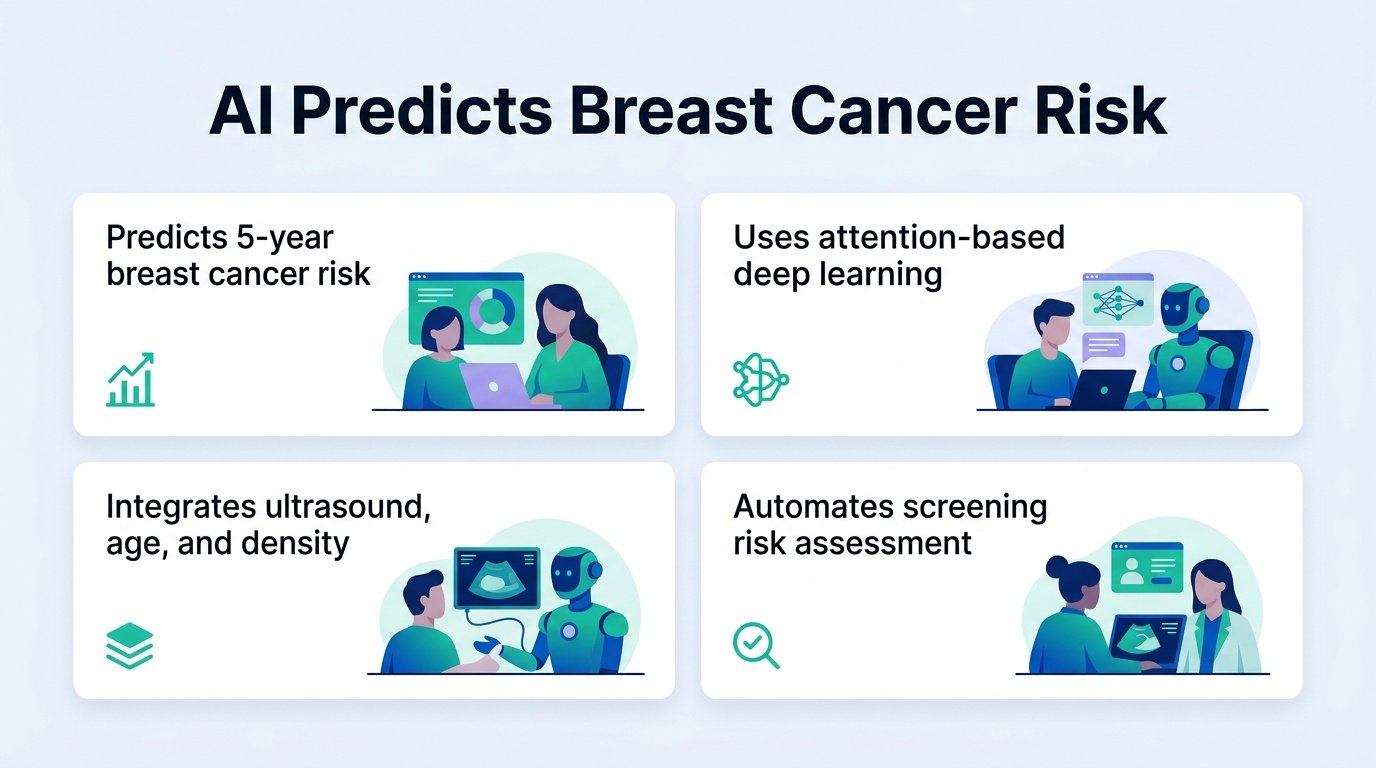
A new deep learning model outperforms traditional risk scores by extracting hidden risk signals directly from routine screening ultrasound images.
Why do we still rely on questionnaires to predict breast cancer when we have high-resolution imaging? For decades, clinical guidelines have used the Tyrer-Cuzick model, relying on family history and lifestyle. It is notoriously imprecise for individual patients. This new research suggests the tissue itself holds the real predictive power, even before visible tumors form.
This shifts ultrasound from a diagnostic tool for finding current lumps to a prognostic tool for predicting future risk. It challenges the status quo of screening schedules by offering a personalized timeline based on actual tissue patterns rather than generic age milestones.
The data behind the shift
Researchers trained the AI model, BUS-Risk-Net, on a massive dataset of 295,298 breast ultrasound examinations from 122,072 women imaged between 2012 and 2020. The system combines image features with basic clinical data like age and breast density. The performance gains over traditional clinical methods were clear across different testing groups:
- In a matched cohort of 240 women, the AI achieved a 5-year AUC of 0.632, beating the full Tyrer-Cuzick score of 0.514.
- In a larger test set of 19,548 examinations from 9,015 women, the AI achieved an AUC of 0.679, compared to 0.594 for the reduced clinical model.
- Observed 5-year cancer incidence ranged from 0.0% to 5.8% after AI stratification, compared with just 2.1% to 3.6% using density categories alone.
Beyond simple breast density
Clinicians often rely on breast density alone to gauge risk, but this metric is a blunt instrument. This AI model successfully stratified patients within the same density categories. This aligns with broader efforts to integrate artificial intelligence in breast cancer care to find patterns invisible to the human eye. By refining risk tiers, clinicians can avoid over-screening low-risk patients while closely monitoring those in the highest tier.
The clinical implication is significant. If we can accurately identify women with near-zero risk over five years, we can safely extend their screening intervals. Conversely, those flagged in the high-risk tier can be fast-tracked for advanced imaging.
The limits of prediction
Despite the statistical victory, an AUC of 0.679 is not a crystal ball. It means the model still misclassifies a notable portion of patients. This study is also retrospective and lacks external validation on different patient populations or ultrasound machines.
Before this tool can guide clinical decisions, prospective trials must prove it actually improves patient outcomes. As discussed in research on AI in breast cancer care, translating algorithmic accuracy into real-world clinical utility requires multidisciplinary validation.
Read the full study in medRxiv.