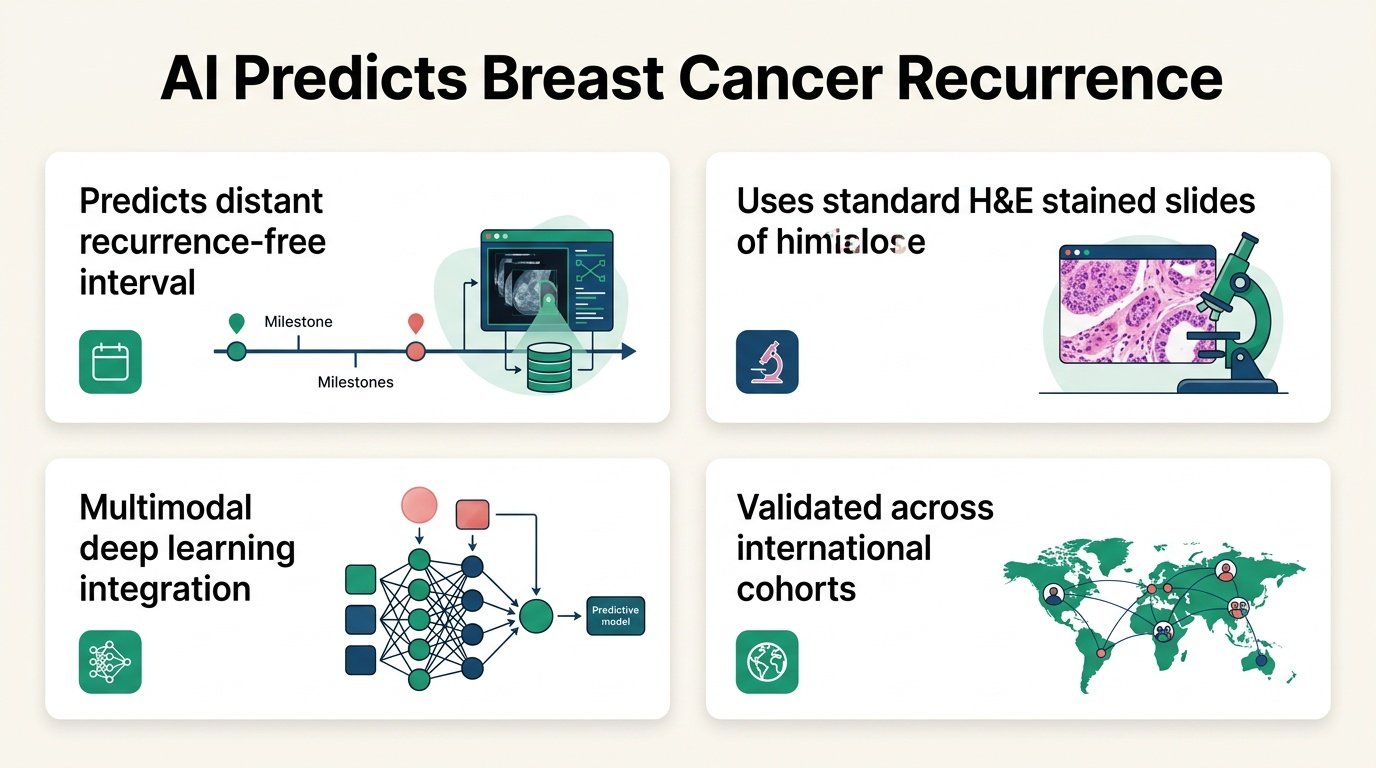
A new deep learning tool outperforms traditional genomic tests in predicting breast cancer recurrence, using nothing more than standard tissue slides and basic clinical data.
Why do we spend thousands of dollars on complex genomic sequencing when the answers might already be hiding in plain sight on a standard glass slide? For years, oncology has assumed that predicting breast cancer recurrence requires deep molecular profiling. This assumption is now being directly challenged.
The validation of RlapsRisk BC suggests that routine pathology slides contain structural clues that match or exceed the predictive power of genetic assays. This shifts the debate from whether AI can assist pathologists to whether expensive genomic tests are always necessary. It forces us to rethink the economics of cancer prognosis.
Researchers developed and internally validated the tool on seven retrospective cohorts totaling 6,039 patients. They then tested its performance across three international cohorts containing 594 patients with early-stage, ER-positive, HER2-negative breast cancer.
Strong predictive power
The tool successfully sorted patients into low- and high-risk groups, showing a hazard ratio range of 3.93 to 9.02. The difference in outcomes was stark. Low-risk patients had a five-year distant recurrence rate of just 0.85% to 4.73%, while high-risk patients saw rates climb from 6.26% to 34.74%.
This builds on previous efforts to extract deep features from tissue, such as using deep learning for breast cancer diagnosis from histopathology images. However, RlapsRisk BC goes further by directly forecasting long-term patient outcomes. When combined with standard clinical variables, the AI improved the c-index by 0.05 to 0.19, proving it adds independent prognostic value.
Challenging genomic assays
The most provocative finding is how the AI stacked up against established genomic tests. At matched specificity, RlapsRisk BC achieved a sensitivity of 0.85 compared to just 0.33 for Oncotype DX. It showed a similar advantage against EndoPredict, scoring 0.74 in sensitivity compared to the genomic test’s 0.49.
This performance suggests that spatial tissue architecture, much like the characterization of tumor-infiltrating lymphocytes via deep learning, holds critical microenvironmental clues that genomic sequencing misses.
- Internal validation across 6,039 patients and external testing across 594 patients.
- Hazard ratios for recurrence risk ranging from 3.93 to 9.02.
- Five-year recurrence rates of 0.85% to 4.73% for low-risk versus 6.26% to 34.74% for high-risk.
- Sensitivity of 0.85 versus Oncotype DX’s 0.33 at matched specificity.
The road ahead
We must remain cautious about these results. This was a retrospective validation, meaning the tool looked backward at existing data rather than testing patients in real-time. Prospective clinical trials are still required to prove that changing a patient’s treatment based on this AI actually improves survival.
If prospective trials confirm these numbers, the financial implications for oncology clinics are massive. We may soon see a world where expensive molecular assays are reserved only for the most ambiguous cases.
Read the full study in medRxiv.