
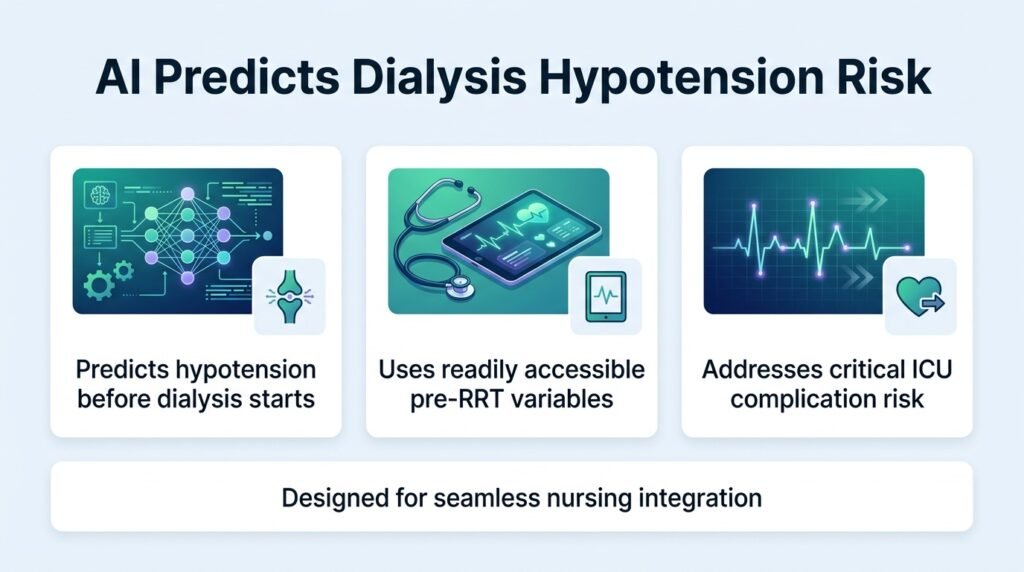
A new machine learning model helps ICU nurses predict dangerous blood pressure drops before starting renal replacement therapy.
When a critically ill patient’s kidneys fail, starting dialysis can save their life. Yet this very treatment often triggers a sudden, dangerous drop in blood pressure. If clinical teams cannot anticipate this crash, the patient faces a high risk of organ damage or death.
This risk is the real bedside challenge. While predictive models exist, they are rarely built for the clinicians who actually run the machines: ICU nurses. By focusing only on data that nurses can easily grab before therapy starts, this new tool shifts the focus from retrospective analysis to active prevention. It challenges the trend of building complex, data-heavy models that look great in theory but fail in a chaotic ICU.
How the model works
Researchers built and tested the model using data from 1,342 patients in the MIMIC-IV database. They then validated it externally using a cohort of 133 patients from an intensive care unit in China. By testing the model on a completely different patient population, the team adhered to rigorous validation standards, a practice championed by the TRIPOD reporting guidelines.
The gradient boosting machine (GBM) emerged as the top-performing algorithm. It achieved an area under the curve (AUC) of 0.801 in the external validation set, proving its reliability across different hospital systems. The model relies on clinical markers that are already part of routine nursing assessments.
The algorithm analyzes a specific set of clinical variables to calculate risk:
- The patient’s age and lactate levels.
- Baseline hemodynamics, specifically mean and systolic blood pressures.
- Treatment factors like RRT modality and vasopressor use.
- The precise time interval between ICU admission and the start of therapy.
Bedside reality check
This finding is highly specific to ICU workflow. Instead of waiting for complex lab calculations, nurses can input these routine variables into a web-based prototype built on the Streamlit framework. This practical design aligns with the push for better clinical decision support in complex therapies, as discussed in literature on the management of CRRT patients.
However, the study has clear limits. The external validation cohort was small, with only 133 patients. While the model performed well, it must be tested in larger, more diverse hospital systems before widespread adoption. If it holds up, it could change how ICU teams manage patient stability during dialysis.
Read the full study in BMC Nursing.