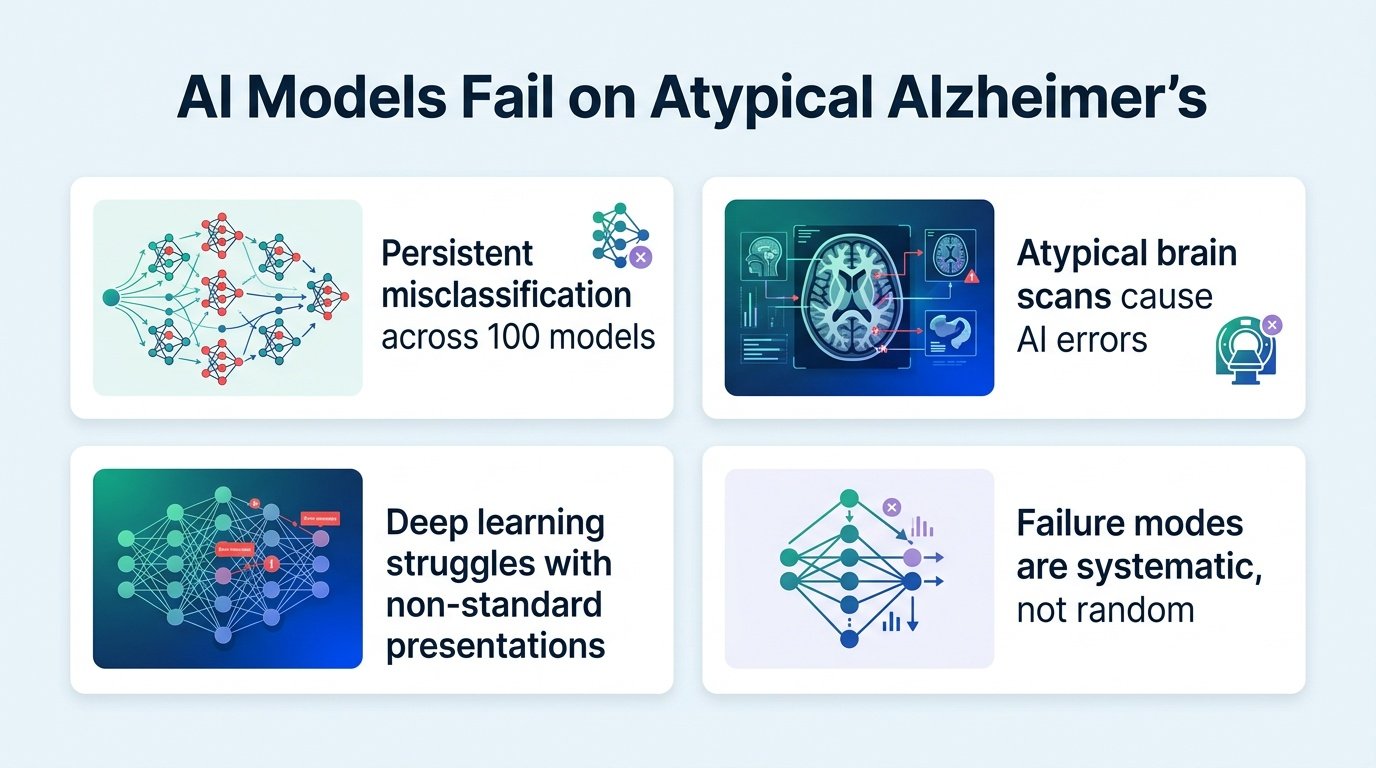
Deep learning models trained to spot Alzheimer’s disease are systematically blind to atypical forms of brain decay, raising doubts about their readiness for real-world clinics.
If a diagnostic AI system achieves high accuracy on paper, we usually assume it just needs more data to close the remaining gap. But what if the errors are not random? What if the algorithm has a systematic blind spot that leaves certain patients entirely invisible?
This is the reality exposed by a new analysis of deep learning models designed to detect Alzheimer’s disease from structural MRI scans. The findings challenge the comfortable assumption that AI diagnostic errors are merely a matter of catching a disease too early. Instead, the technology appears fundamentally blind to specific, atypical biological variations of cognitive decline.
The systematic blind spot
Researchers trained two deep learning architectures across 100 model instances using brain scans from the Alzheimer’s Disease Neuroimaging Initiative. They wanted to see if the same patients were being missed across different models and training runs. They identified a distinct subgroup of patients who were persistently misclassified as cognitively normal, despite having confirmed Alzheimer’s disease.
These missed cases did not show the classic pattern of brain shrinkage. Instead, the false negatives were heavily enriched with hippocampal-sparing and minimal atrophy subtypes. Because the AI models rely heavily on typical patterns of hippocampal decay, patients with these rarer forms of the disease bypassed detection entirely.
The five-year delay
Clinicians might hope that these patients would eventually be flagged as their neurodegeneration progressed. To test this, the researchers analyzed longitudinal follow-up scans over several years. They wanted to see if the false negatives would eventually turn into true positives as the brain changed.
The results were sobering. A change in the AI’s prediction was only observed in a small subgroup of these patients. Furthermore, triggering a correct diagnosis required intervals of up to five years of disease progression. For many patients, the model’s prediction never changed, proving that the error was not a staging issue but a failure to recognize atypical disease presentation.
Key findings from the data
- Deep learning models consistently failed to classify a specific subgroup of Alzheimer’s patients across 100 different training configurations.
- The persistently misclassified patients exhibited a distinct atrophy profile, with a high concentration of hippocampal-sparing and minimal atrophy subtypes.
- Correcting a false negative prediction over time required up to five years of disease progression, and only occurred in a portion of the cohort.
Rethinking clinical AI
This finding forces us to rethink how we evaluate clinical AI. High overall accuracy metrics can easily mask the fact that a model is entirely blind to minority patient populations. If an algorithm only recognizes the most common biological pathway of a disease, it cannot be safely deployed in diverse clinical settings.
We must acknowledge the study’s limitations. The sample size of the persistently misclassified subgroup was small, and the data came from a single, highly curated research dataset. More work is needed to see if these blind spots persist across more diverse, real-world imaging databases.
Even with these limitations, the takeaway is clear. We cannot simply feed algorithms more of the same data and expect them to improve. Developers must actively train and test models on rare disease subtypes to ensure that diagnostic tools do not leave atypical patients behind.
Read the full preprint study in medRxiv.