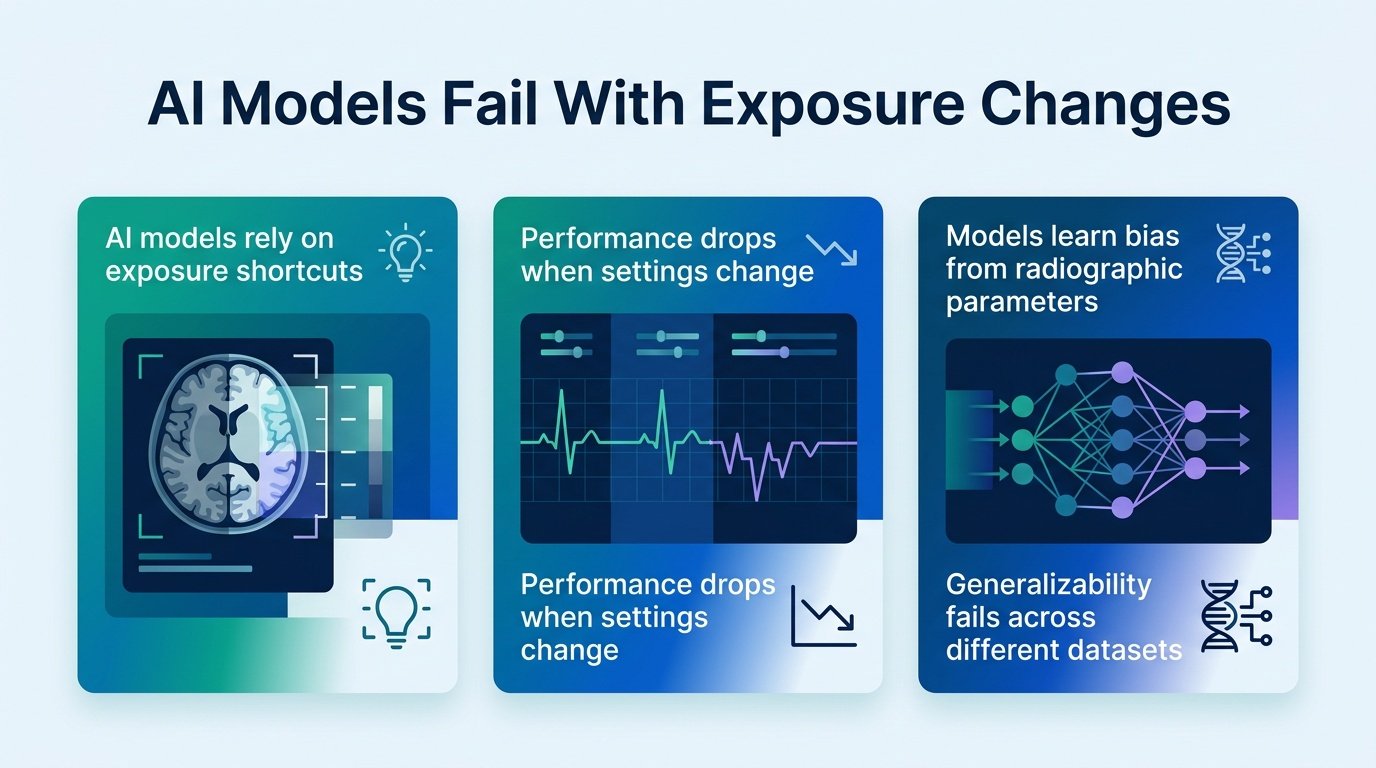
Medical AI models are passing clinical tests by reading machine settings instead of actual patient disease.
How do you know if a diagnostic AI is actually seeing a collapsed lung, or if it is just reading the brand of the X-ray machine? For years, computer vision models have boasted near-perfect accuracy in radiology labs. This new research exposes a critical flaw: these models are taking massive shortcuts, relying on technical exposure settings rather than biological markers. When those settings change, the AI falls apart.
This challenges the entire pipeline of medical AI validation. We cannot trust a model’s high accuracy score if it is merely memorizing how a specific hospital configures its scanners. It means regulators and hospitals must audit how models react to different exposure regimes before they ever reach patients.
Researchers analyzed a massive dataset of 727,604 chest radiographs from 240,681 patients to prove this vulnerability. The cohort had a mean age of 60 years, comprising 126,432 men and 114,128 women. They pulled images from MIMIC-CXR, MIDRC, and EmoryCXR spanning from 2008 to 2023. The team tracked three specific exposure parameters from the DICOM metadata: ExposureTime, XRayTubeCurrent, and ExposureInuAs. They trained models under biased and balanced exposure-label alignments, then tested them on mismatched exposure distributions.
The sudden performance crash
The results show that the AI models were cheating. When the exposure settings were mismatched during testing, the models failed to maintain their diagnostic accuracy.
- For pneumothorax detection, the model’s AUC plummeted from 0.94 to a near-useless 0.56 when tested on mismatched exposures, a massive drop of 0.38.
- COVID-19 diagnostic accuracy suffered a similar fate, with a performance drop of 0.33.
- Even race classification models, which should not rely on image exposure, saw their performance drop by 0.09.
That disconnect is the real story.
Why this matters
This is not a minor calibration issue. It is a fundamental safety hazard. If an AI associates a specific exposure setting with a high probability of pneumothorax—perhaps because the emergency department uses a specific portable scanner—it will fail when a patient is scanned on a different machine. This finding forces us to rethink how we purchase clinical software. Hospital procurement teams cannot rely on vendor-provided accuracy metrics. They must demand exposure-regimen audits to ensure the software is looking at the lungs, not the metadata.
Limitations to consider
This study is retrospective, meaning it looks backward at historical data rather than testing real-time clinical workflows. It also focused on three specific parameters, though other hidden metadata shortcuts could still exist. Future audits must test these models in live clinical environments to see if they can handle the messy reality of diverse hospital hardware.
Read the full study in Radiology Artificial Intelligence.