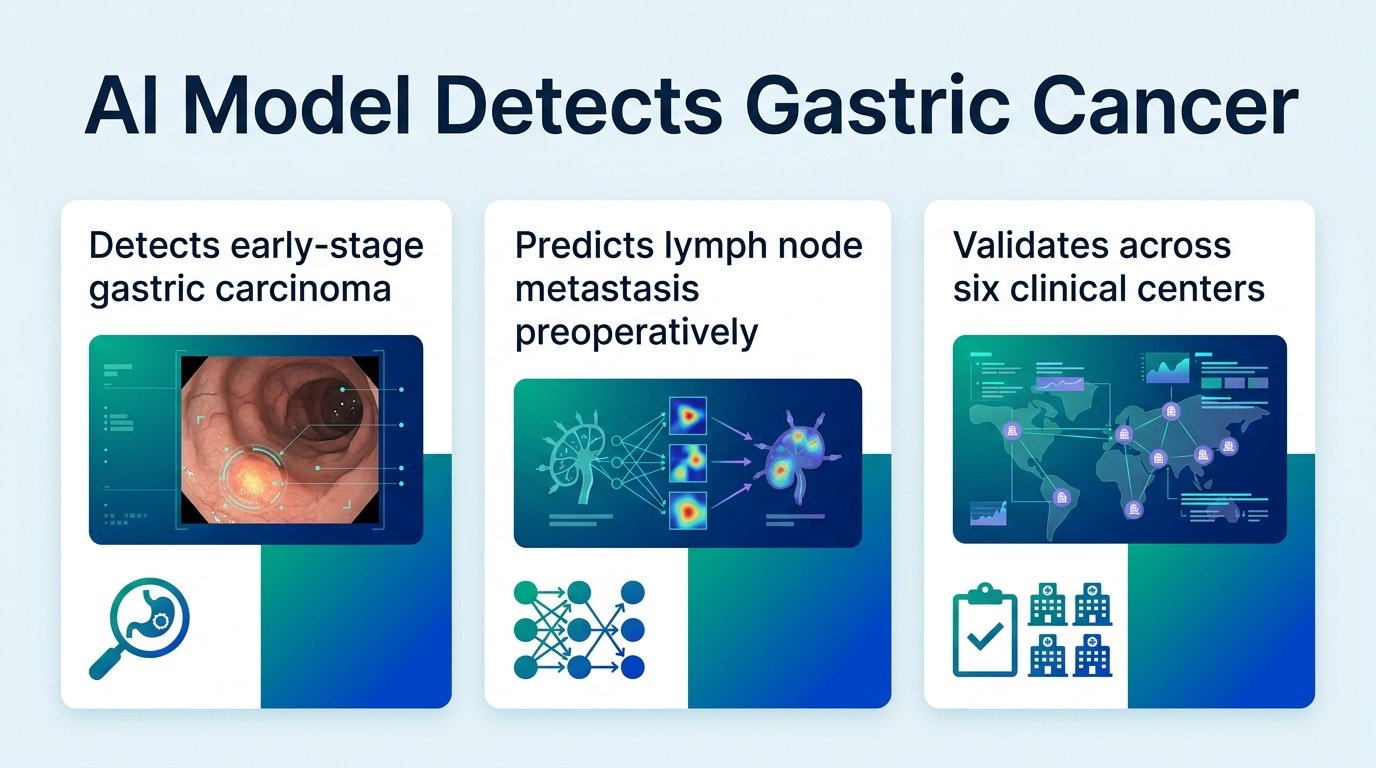
A new artificial intelligence model can classify gastric biopsies and predict lymph node spread, significantly cutting pathologist workloads without sacrificing accuracy.
Can an algorithm reliably predict if a patient’s stomach cancer has already spread to their lymph nodes, just by looking at a standard tissue biopsy? Usually, this prognosis requires surgical resection or expensive imaging. A new study challenges the assumption that simple biopsy slides hold too little data for such complex, predictive tasks.
This is not just about automating routine lab work. The real value lies in extracting hidden prognostic signals directly from the initial diagnostic biopsy. If software can spot these signals early, it changes the entire pre-operative treatment planning pipeline, allowing clinicians to fast-track aggressive therapies for high-risk patients.
To build and test the Gastric Biopsy Artificial Intelligence Model (GBAIM), researchers gathered a massive multi-center dataset. They retrospectively collected 20,711 whole-slide images from 17,086 patients across six different medical centers. To prove the tool works in real-time clinical settings, they also prospectively enrolled 3,698 images from 2,965 patients.
How the system performed
- In external testing, the model achieved 96.1% sensitivity and 95.0% specificity.
- In prospective real-world validation, it maintained 93.4% sensitivity and 99.0% specificity.
- Pathologists using the tool improved their diagnostic accuracy by 1.7% to 39.0%.
Pathologists work much faster
The real test for clinical technology is how it performs alongside human experts. In reader trials, GBAIM helped all nine participating pathologists make better decisions. More importantly, the system slashed their diagnostic time by 29.4% to 50.5%.
This dramatic time savings addresses a critical bottleneck in pathology departments worldwide. Rather than replacing humans, the tool acts as a high-speed triage assistant. This clinical utility aligns with recent trends in hierarchical feature fusion for whole slide classification, which aims to make model processing more efficient.
The limits of metastasis prediction
The most provocative aspect of this research is GBAIM’s specialized sub-models. The fine-tuned GBAIM-T model, designed to separate early-stage from advanced gastric cancer, achieved an area under the curve (AUC) of 0.907 on internal tests and 0.826 on external tests. However, predicting lymph node metastasis proved much harder.
The LNM-predicting sub-model, GBAIM-N, scored an AUC of 0.814 internally, but this dropped to 0.706 on external validation. This drop highlights a persistent challenge in clinical AI. Models often struggle to maintain high predictive power when facing diverse, real-world data from new hospitals.
We must be honest about these limitations. A 0.706 AUC for predicting lymph node spread is promising, but it is not yet accurate enough to dictate surgical decisions on its own. To truly trust these systems, clinicians also need to know why the AI makes these predictions. Similar efforts in explainable deep learning for gastrointestinal malignancies show that transparency is just as important as raw accuracy. Without explainability, a drop in external performance will keep these tools confined to research labs.
Read the full study in npj Digital Medicine.