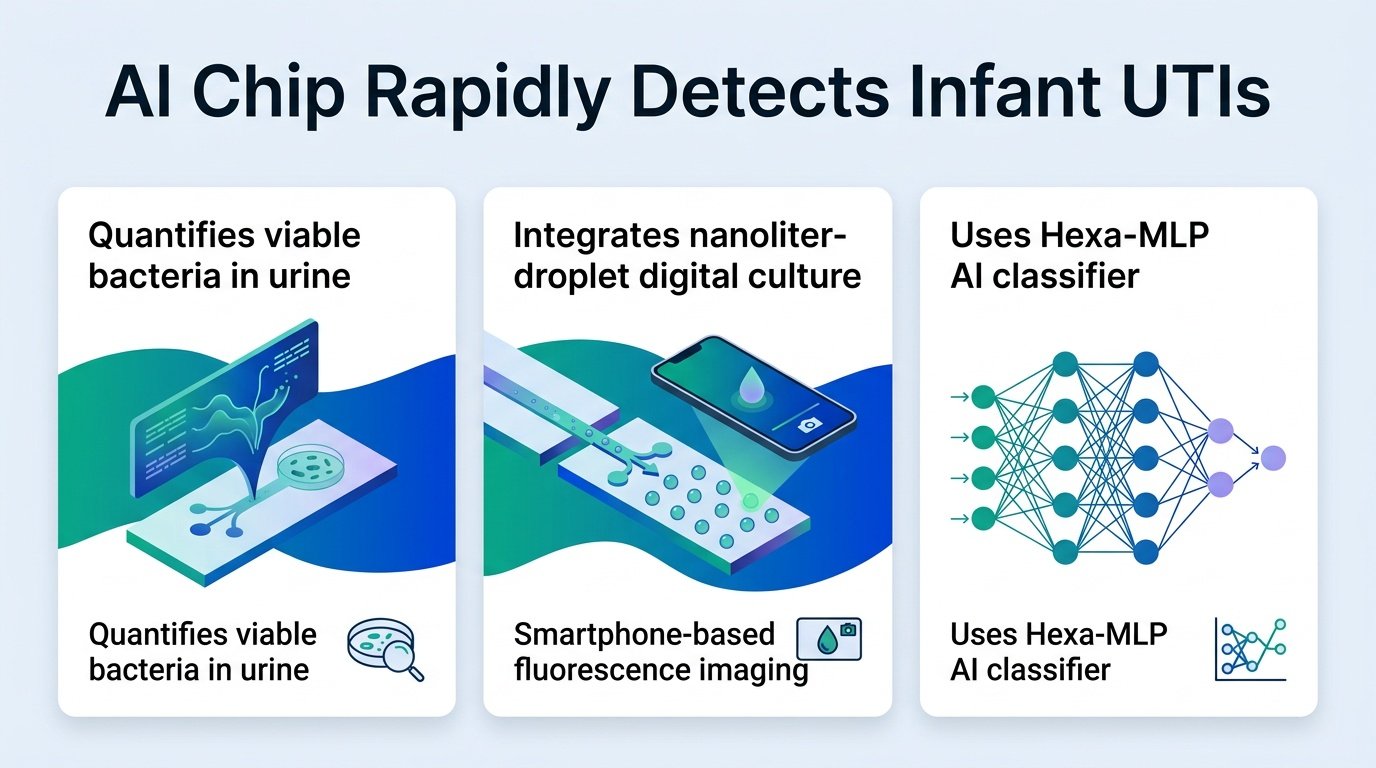
A new portable device combines microfluidics and machine learning to diagnose pediatric urinary tract infections in hours instead of days.
Waiting days for a urine culture to return while an infant runs a high fever is an agonizing gamble for pediatricians. Treat immediately with broad-spectrum antibiotics, and you risk fueling drug resistance. Wait for the lab, and you risk permanent kidney damage in a vulnerable patient.
This tension defines pediatric urinary tract infection (UTI) care. A new diagnostic platform called ViDAI-SlipChip aims to resolve this dilemma by bypassing the central lab entirely. It forces us to rethink the necessity of overnight incubation.
The real shift here is not just speed, but the elimination of sample preparation. Most rapid diagnostics require complex DNA extraction or pre-culture steps that keep them tethered to hospital laboratories. By shrinking the culture environment to nanoliter droplets and using AI to read the results, this approach proves that we can bring quantitative biology directly to the bedside. It challenges the assumption that rapid testing must sacrifice the quantitative accuracy of traditional culture plates.
How the chip works
The system works by partitioning a raw urine sample into thousands of tiny 5-nL droplets on a portable chip. These droplets contain a fluorogenic substrate that glows when cleaved by viable bacteria, specifically targeting Escherichia coli. Instead of waiting for colonies to grow visible to the naked eye, a smartphone camera captures the fluorescence.
A machine learning classifier called Hexa-MLP then analyzes the complex glowing patterns to count the active bacteria. This algorithm overcomes the limitations of conventional thresholding, which often struggles with background noise in raw clinical samples.
The clinical trial results
Researchers validated the platform using 120 pediatric urine samples. The system delivered results within 4 hours, compared to the typical 24-to-48-hour wait for standard lab cultures.
- The device achieved a sensitivity of 94.4%.
- It demonstrated a specificity of 100%.
- The overall diagnostic accuracy reached 95.83%.
The hurdles ahead
Despite these strong numbers, the technology faces a major real-world hurdle. The study relied on E. coli as its primary model pathogen. While E. coli causes the vast majority of pediatric UTIs, clinical reality is messy. The chip must prove it can identify other common pathogens, and distinguish them in polymicrobial infections, before it can truly replace the standard agar plate.
If the developers can expand the chip’s target enzyme substrates, this could reshape pediatric triage. Pediatricians could prescribe targeted antibiotics during the initial clinic visit, reducing the overuse of broad-spectrum drugs.
Read the full study in ACS Sensors.