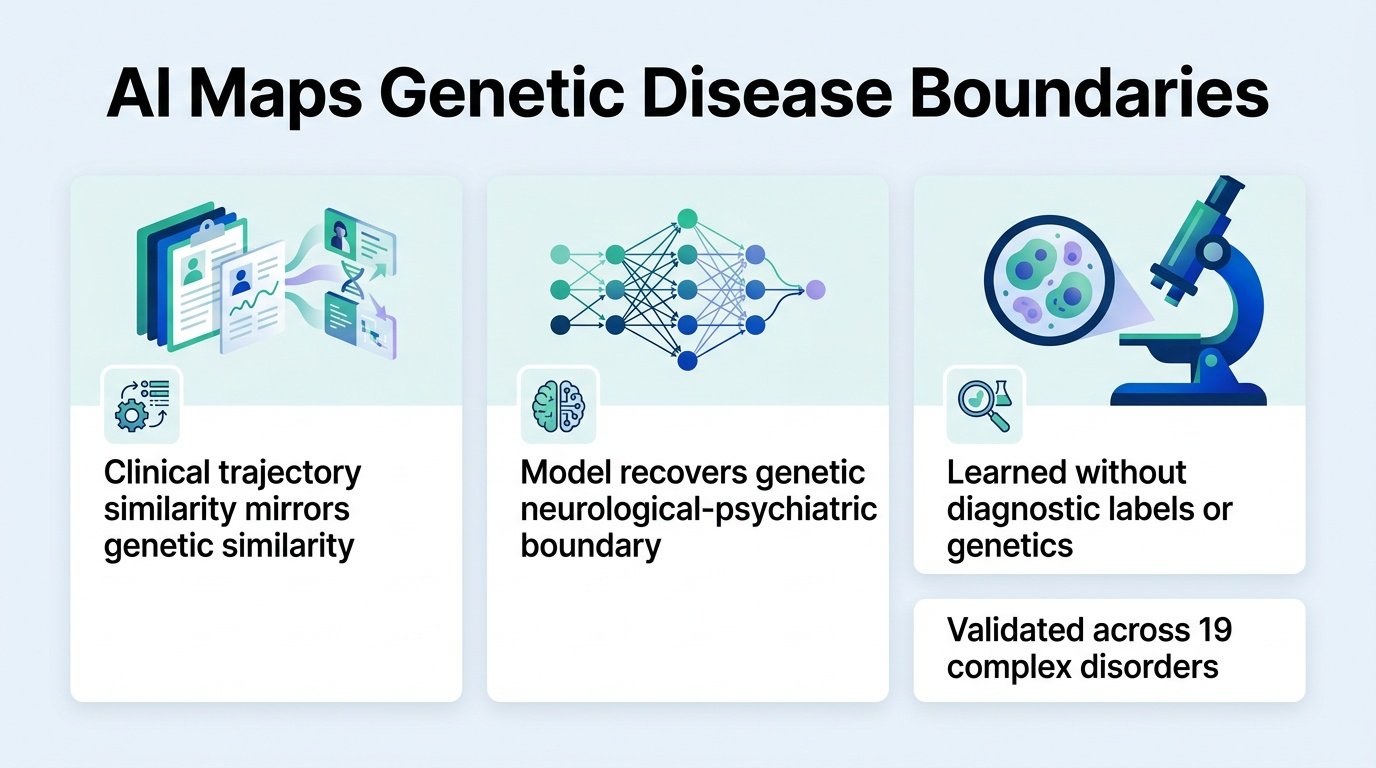
An attention-based AI model has mapped the genetic boundaries between neurological and psychiatric diseases using nothing but raw electronic health records.
Can an AI understand the biology of a disease if it only reads billing codes and doctor notes? Skeptics argue that clinical records are too messy and superficial to capture true human genetics. They view clinical data as a noisy administrative byproduct rather than a biological map.
This new study challenges that skepticism. By showing that clinical trajectory embeddings mirror actual genome-wide genetic architecture, the research suggests that clinical data is not just a superficial proxy. Instead, standard medical records contain a deep mathematical reflection of our underlying biology.
The genetic mirror
Researchers evaluated an attention-based transformer model trained on health records to see if its mathematical representations of disease matched genetic reality. The model analyzed clinical trajectories across 19 neurological and psychiatric disorders. Crucially, the AI had zero access to diagnostic labels or genetic data during its training phase.
Despite this blind spot, the model’s clinical trajectory similarity closely mirrored genetic similarity. It successfully mapped the complex boundary between neurological and psychiatric conditions, identifying which specific disorders cross that line. A model with no biological training essentially reconstructed a genetic map of the human brain.
This finding aligns with a broader shift toward using unstructured clinical data. For instance, a 2026 study in npj Digital Medicine showed that large language models improve transferability of electronic health record-based predictions across different countries. But while previous work focused on prediction, this new paper proves that AI models capture actual biological structures.
Why this matters
This is not about building a cheaper diagnostic tool. It is about validating that AI health embeddings are biologically meaningful. If a model trained on billing codes automatically clusters schizophrenia and bipolar disorder the same way a geneticist does, it proves our clinical tracking systems are deeply aligned with molecular reality.
This could streamline how we select patients for clinical trials. Instead of requiring complex multi-modal AI integration that blends expensive imaging and genomics, researchers might extract similar biological insights directly from standard health records.
Key findings
- The model mapped clinical trajectories across 19 distinct neurological and psychiatric disorders.
- Clinical trajectory similarity directly mirrored genome-wide genetic architecture.
- The AI successfully identified the neurological-psychiatric boundary without any genetic training data.
The reality check
We must remain cautious about the limitations. This research is currently a preprint and has not yet undergone full peer review. Furthermore, the model relies entirely on the quality of the underlying electronic health records, which can vary wildly between hospital systems and introduce demographic biases.
This analysis is based on a preprint study published in medRxiv.