
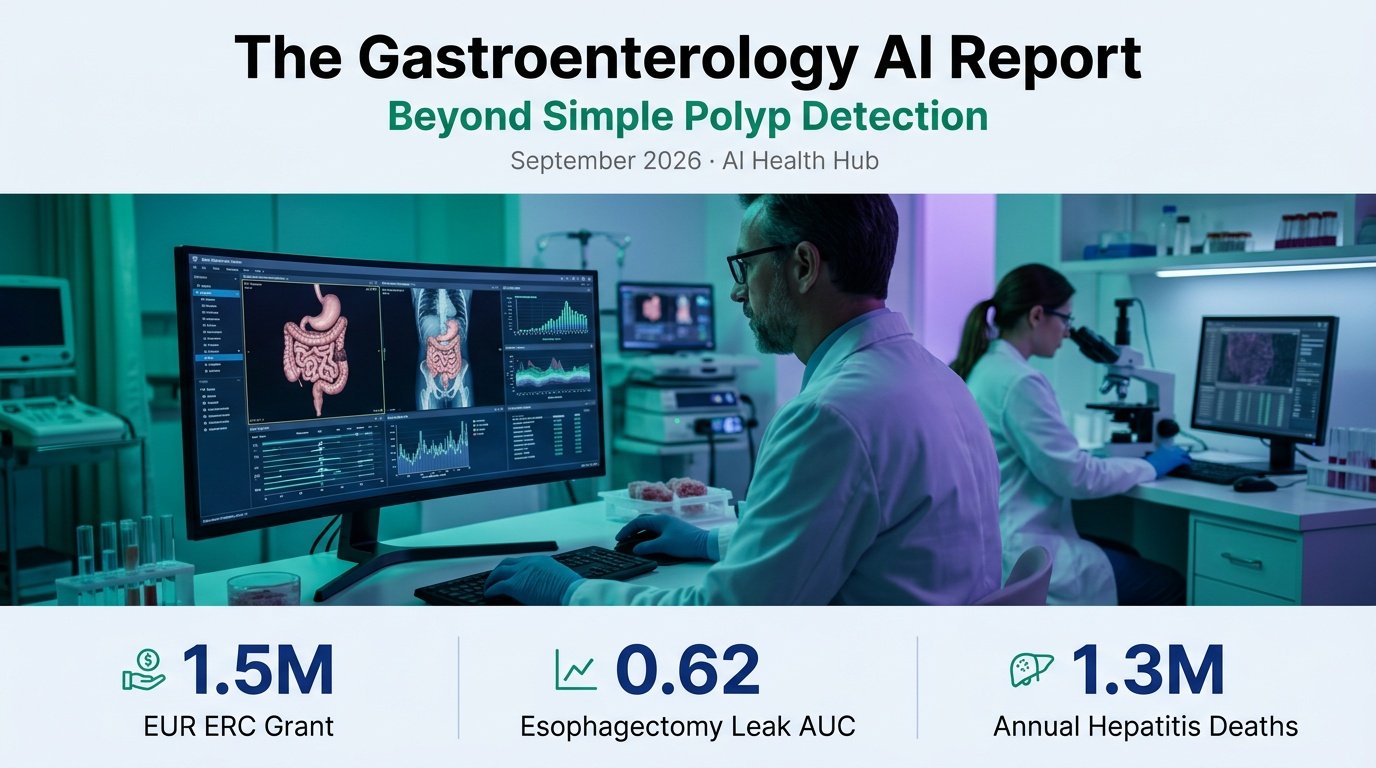
Gastroenterology is undergoing a structural shift in how artificial intelligence is deployed. For the past several years, clinical AI in this specialty was largely synonymous with real-time computer vision during colonoscopy—specifically, computer-aided detection (CADe) of polyps. In September 2026, the frontier has moved. The focus is shifting toward integrating multi-omics data for complex liver diseases, applying large language models (LLMs) to automate deep clinical registries, and deploying virtual, multidisciplinary care platforms that manage chronic gastrointestinal conditions outside the endoscopy suite.
This transition comes at a critical time as clinicians debate the long-term cognitive impacts of real-time AI assistance. While computer vision continues to mature, the integration of generative AI and longitudinal risk stratification models is redefining the clinical workflow from episodic, procedural interventions to continuous, data-driven patient management.
Notable papers
• EndoVLM: A Vision-Language Assistant for Gastrointestinal Endoscopy
This study introduces EndoVLM, a specialized vision-language model designed to act as an interactive assistant during gastrointestinal endoscopy, moving beyond simple bounding boxes to generate descriptive clinical narratives.
Brand take: Genuinely useful clinically, as it bridges the gap between raw pixel detection and structured operative reporting.
• A novel inflammatory bowel disease registry powered by artificial intelligence and natural language processing
Researchers developed an automated IBD registry using natural language processing to extract deep clinical phenotypes from unstructured electronic health records, dramatically reducing manual curation time.
Brand take: Underrated, because high-quality, real-world registries are the bottleneck for all subsequent clinical AI validation.
• Large language models with supervised fine-tuning for inflammatory bowel disease diagnosis and prognosis
This paper evaluates fine-tuned LLMs in clinical decision support for IBD, demonstrating that supervised fine-tuning significantly improves diagnostic accuracy and prognostic stratification compared to base models.
Brand take: Overhyped, as general-purpose LLMs still pose hallucination risks that require strict physician oversight before direct clinical deployment.
• Gut Microbiota and Metabolic Pathway Signatures for Inflammatory Bowel Disease Identified via Subject-Stratified Random Forest Based on the Longitudinal HMP2 Cohort
By addressing data leakage in longitudinal datasets, this study used subject-stratified random forest models to identify robust microbial signatures, preventing the artificially inflated AUC values common in prior literature.
Brand take: Genuinely useful clinically, as it establishes a rigorous methodological standard for machine learning in microbiome diagnostics.
• From checklist to closed-loop: the case for AI-supported perioperative management in esophagectomy
The authors demonstrate that static preoperative risk scores plateau at an AUC of approximately 0.62 for predicting anastomotic leaks, and argue for dynamic, closed-loop AI monitoring to adapt to evolving postoperative patient data.
Brand take: Genuinely useful clinically, highlighting the limitations of static checklists in complex surgical oncology.
• Multi-Omics Integration and Artificial Intelligence for Dynamic Risk Stratification of Hepatocellular Carcinoma in MASLD: Toward Precision Surveillance and Personalized Immunotherapy
This framework outlines how integrating genomics, transcriptomics, and clinical imaging via AI can identify high-risk hepatocellular carcinoma candidates within the metabolic dysfunction-associated steatotic liver disease (MASLD) population.
Brand take: Underrated, as non-cirrhotic MASLD patients frequently escape traditional surveillance protocols.
Products, deals & funding
• AI Medical Service (AIM) FDA Breakthrough Designation
AI Medical Service received FDA Breakthrough Device Designation for its AI-powered endoscopy technology, designed to accelerate the identification of gastric neoplastic lesions during upper endoscopies.
Brand take: Genuinely useful clinically, as upper GI tract AI has historically lagged behind colonoscopy-focused software.
• ERC Starting Grant for “LIVER-CIRCUITS”
Prof. Kai Markus Schneider at TUD Dresden was awarded a EUR 1.5 million European Research Council (ERC) Starting Grant to investigate how nerve fibers influence bile duct tumors using advanced computational biology.
Brand take: Underrated, as mapping neuro-immune-oncology circuits will provide the biological ground truth needed for future predictive AI models.
• Oshi Health & Sentara Health Plans Partnership
Sentara Health Plans expanded member access to Oshi Health’s virtual multidisciplinary gastroenterology clinic, integrating digital coaching, dietary support, and GI-focused behavioral health.
Brand take: Genuinely useful clinically, proving that the immediate commercial value of GI digital health lies in virtual care coordination rather than standalone software tools.
Regulatory & clinical adoption
The regulatory landscape is preparing for a wave of interactive tools. The FDA released a discussion paper seeking public feedback on a proposed regulatory framework for generative AI-enabled medical devices. This is highly relevant to gastroenterology, where generative models are being positioned to draft endoscopy reports and synthesize multi-modal patient histories in real time.
However, clinical adoption is facing psychological and operational headwinds. A study published in The Lancet Gastroenterology & Hepatology has sparked intense debate among endoscopists regarding “skill blunting.” The study raises concerns that routine, continuous reliance on real-time AI polyp detection during colonoscopies may degrade an endoscopist’s manual adenoma detection rate when they operate without the technology. This highlights a critical tension: while AI improves baseline diagnostic quality, it may introduce clinical dependency that must be addressed in training programs.
Trends & what to watch
Over the next 1-3 months, expect a growing division between procedural AI and longitudinal care coordination. While real-time computer vision tools are reaching market saturation, their clinical utility is being scrutinized through the lens of cognitive dependency and actual long-term adenoma prevention. Product teams should focus on building “explainable” overlays that actively train clinicians rather than simply highlighting screen regions.
Concurrently, the integration of multi-omics and clinical data for chronic liver diseases like MASLD is accelerating. As therapeutic pipelines for metabolic liver diseases expand, non-invasive, AI-driven risk-stratification tools will become essential for identifying patients who require aggressive intervention before progressing to advanced fibrosis or hepatocellular carcinoma.
Bottom line
The future of gastroenterology AI belongs to systems that manage the patient’s entire longitudinal disease journey, not just the minutes they spend on the endoscopy table.