A new deep learning model bypasses slow genetic sequencing to identify dangerous bacterial strains in minutes, but instrument variation stands in the way of global deployment.
When a deadly superbug outbreak hits a hospital ward, infection control teams cannot afford to wait days for genetic sequencing to tell them which strain they are fighting. They need to know immediately if they are facing a highly contagious clone or an isolated case. This diagnostic delay is where outbreaks slip out of control.
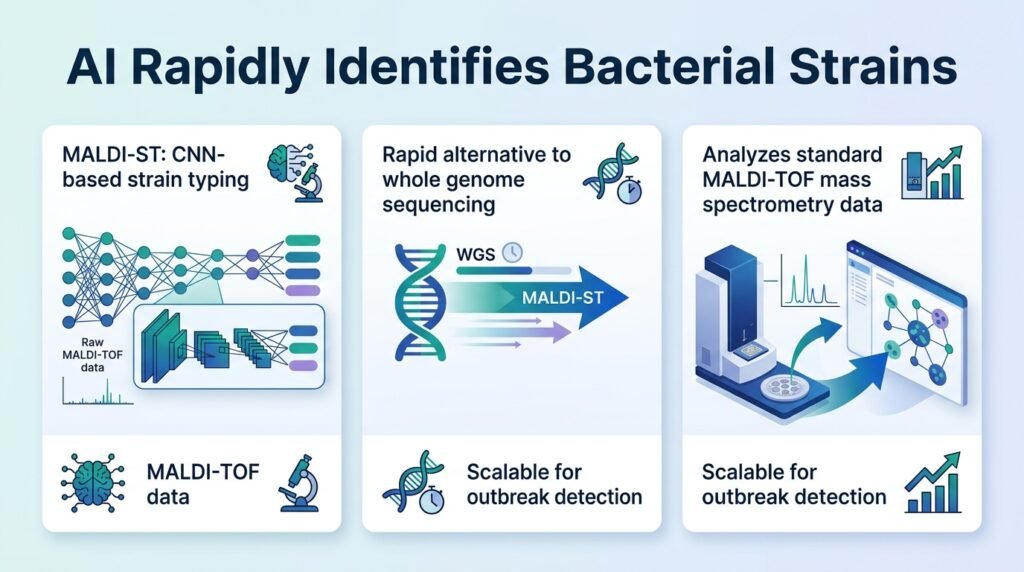
For years, clinical labs have treated mass spectrometry as a tool just for identifying bacterial species, leaving strain-level typing to slow genomic sequencing. This new study challenges that divide. By applying deep learning to existing hardware, we might bypass the sequencing bottleneck entirely.
High accuracy across pathogens
Researchers built MALDI-ST, a convolutional neural network designed to type bacterial strains directly from mass spectrometry data. The team trained and tested the model using an 80/20 split, pairing mass spectra with genomic labels. The dataset included 804 E. coli samples, 562 S. aureus samples, 385 P. aeruginosa samples, and 222 E. faecium samples.
The model achieved high performance across the four pathogens on the test sets:
- E. coli reached a mean balanced accuracy of 0.971 (95% CI: 0.953-0.988).
- P. aeruginosa achieved a mean balanced accuracy of 0.910 (95% CI: 0.850-0.971).
- S. aureus reached a mean balanced accuracy of 0.931 (95% CI: 0.915-0.963).
- E. faecium achieved a mean balanced accuracy of 0.943 (95% CI: 0.918-0.967).
The model spotted distinct spectral signatures for specific high-risk strains, including P. aeruginosa ST111, as well as S. aureus ST12 and ST30. Using genomic clustering via PopPUNK further boosted the accuracy for P. aeruginosa. The researchers also built decision trees based on key peaks, which simplified predictions for some strains but failed to work consistently across all of them.
The instrument variation bottleneck
But the real test of any diagnostic AI is how it handles the messy reality of different hospitals. This is where the study delivers a crucial reality check.
When the researchers ran external validations, they found that center- and instrument-specific variation substantially degraded the model’s performance. A model trained on one machine struggles when fed data from a different manufacturer or location. This hardware sensitivity is a common hurdle for clinical AI. Mass spectrometers are highly sensitive physical instruments, meaning microscopic differences in laser calibration or sample preparation can alter the spectral peaks.
This limitation is not a failure of the AI, but a map of the work ahead. It means we cannot simply download a pre-trained model and expect it to work in every lab. True utility will require massive, multi-center data collection to train models that are robust against instrument brand. Until then, this technology remains a promising local tool rather than a universal clinical standard.
Read the full preprint in medRxiv.