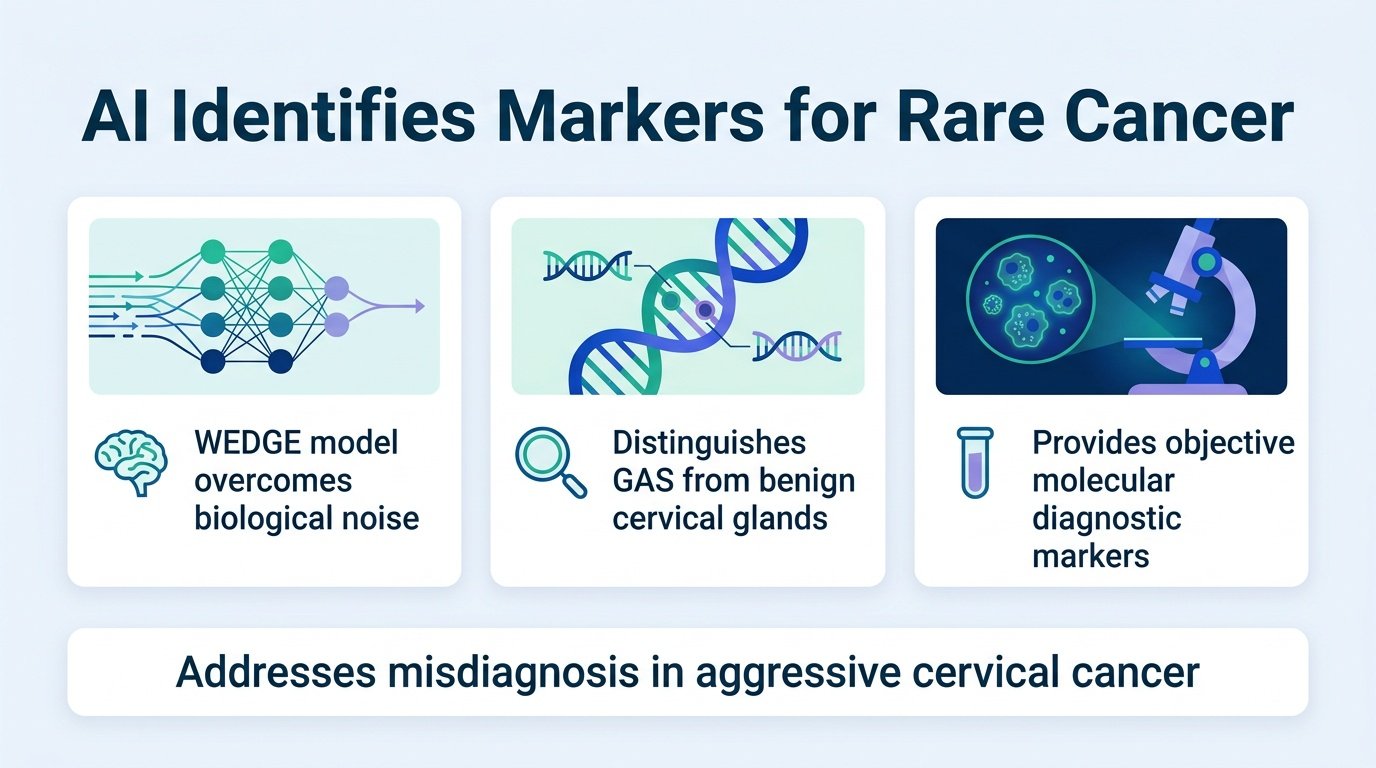
A new AI tool bypasses the limits of scarce patient data to identify a two-protein signature that accurately flags a deadly, non-HPV cervical cancer.
Standard cervical cancer screening relies heavily on finding HPV. But gastric-type adenocarcinoma of the uterine cervix, known as GAS, completely bypasses this virus. It mimics benign glands so perfectly that doctors routinely miss it, leading to delayed, ineffective treatments for an exceptionally aggressive disease.
To spot this stealth killer, researchers developed an AI framework called WEDGE. They analyzed **407** cervical tissue samples, which is a very small pool for traditional machine learning. WEDGE solved this scarcity by using generative AI to synthesize realistic artificial proteomic profiles, expanding the training data without losing biological accuracy.
This approach revealed a simple, elegant solution: a two-protein signature consisting of Pepsinogen C (PGC) and DNA Methyltransferase 1 (DNMT1). The AI proved that we do not need massive, complex panels to find rare cancers. A highly targeted molecular test can do the heavy lifting.
How the math performed
- Achieved **93%** diagnostic accuracy in the internal test cohort.
- Reached **97%** accuracy in an independent external proteomic cohort.
- Validated at **87.9%** accuracy using standard immunohistochemistry tissue staining.
- Improved patient risk prediction to a C-index of **0.701** when combining PGC with clinical features.
Why this finding matters
This finding complicates the current diagnostic paradigm. For years, oncology has leaned on massive genetic sequencing panels to catch rare mutations. This study suggests that a simple, two-protein test can achieve high diagnostic accuracy without expensive genomic infrastructure. It builds on established efforts to translate complex mass spectrometry data into practical clinical tools, a challenge long recognized in proteomic research.
Still, relying on synthetic data to train diagnostic models carries risks. Generative AI can replicate and amplify subtle biases present in the initial **407** samples. If those original tissues do not represent the full genetic diversity of GAS patients globally, the AI’s synthesized profiles might miss crucial variations. Clinical trials must validate these markers in broader, more diverse patient populations before pathologists can safely rely on them.
Read the full study in medRxiv.