
Doctors write down clues about their patients’ loneliness, but those warnings usually sit buried in unstructured text where no one can find them.
A physician notes that an elderly patient lives alone and has no local family. This detail sits in an electronic health record, completely invisible to the hospital’s automated risk algorithms. Traditional software cannot parse these informal narratives, leaving critical social determinants of health entirely ignored.
A new study challenges the assumption that we need massive, resource-heavy models to extract this nuanced social context. By fine-tuning smaller, targeted models, researchers proved that highly specialized clinical understanding does not require giant, expensive computing infrastructure. This shifts the focus from “bigger is better” to precise, context-aware training.
Why this data matters
Social isolation is a clinical risk factor on par with smoking or obesity, yet it is rarely coded as a formal diagnosis. Finding these cues in unstructured text allows health systems to flag vulnerable patients before they relapse or miss follow-up appointments. It moves AI from a mere administrative tool to a clinical safety net.
Using NLP to track patient-provider communication has already shown promise in global health. For instance, researchers previously analyzed texting conversations in Rwanda to monitor home-based care at scale (Natural language processing to evaluate texting conversations). Applying similar text analysis to clinical notes is the logical next step for preventive care.
How the models performed
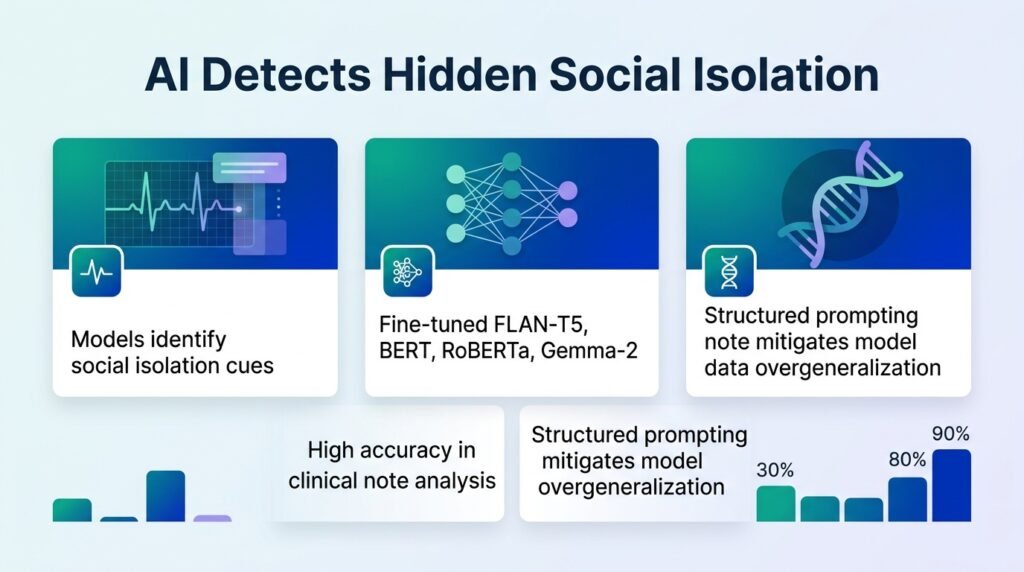
The researchers compared four models to see which could best parse complex social cues. They trained the models on annotated clinical notes, teaching them to recognize both true and false positives, including negations and ambiguous terms.
- FLAN-T5-Large achieved the highest overall performance with a Macro-F1 score of 0.92±0.04.
- This top model balanced all categories well, scoring 0.91±0.03 for social isolation, 0.94±0.05 for no isolation, and 0.90±0.04 for social support.
- Gemma-2-2B performed comparably with a Macro-F1 of 0.89±0.10.
- Older models struggled, with BERT scoring 0.77±0.17 and RoBERTa reaching only 0.80±0.21 with high variability.
The limits of text
The real achievement here is the dual framework. By training the models on both isolation and social support, the system does not just look for problems. It also maps out a patient’s active safety net, which is crucial for discharge planning.
However, clinical notes are notoriously messy and subjective. A model trained on one hospital’s writing style might struggle to maintain this accuracy when deployed in a different health system with different charting habits. Until these models are tested across diverse, multi-center datasets, we should remain cautious about their real-world generalizability.
Read the full study in medRxiv.