A new AI tool reveals that many prostate cancers upgraded during active surveillance were actually mischaracterized from the very start.
When a man with low-risk prostate cancer chooses active surveillance, he is gambling that his tumor will grow slowly. But what if the slow-growing label was wrong from day one? For many patients, the anxiety of a future biopsy upgrade is not about a changing tumor, but a flawed initial map.
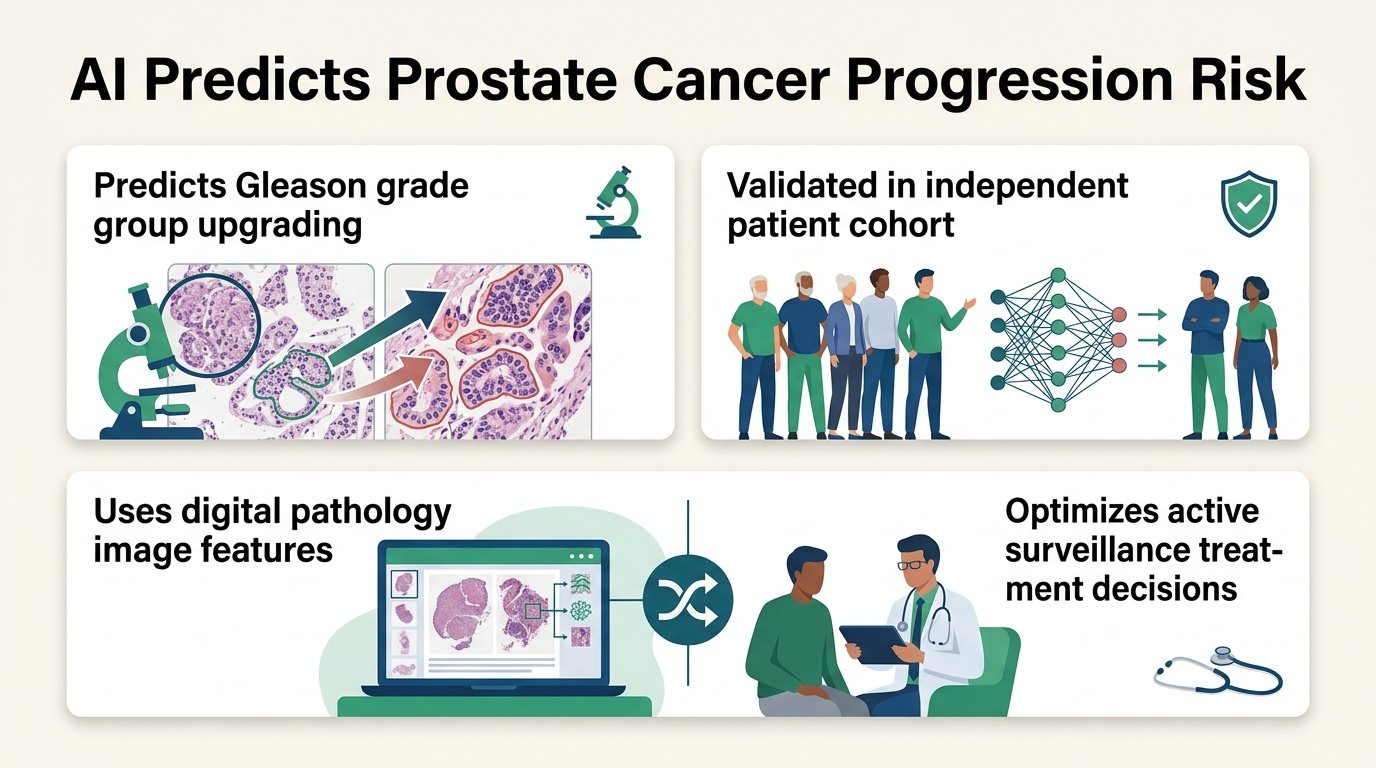
A new study introduces AI-GUR, an artificial intelligence tool designed to predict Gleason grade group upgrading. This tool challenges how we view active surveillance. Instead of tracking a disease that changes over time, we are often just correcting initial diagnostic blind spots.
The diagnostic blind spot
Researchers trained the AI-GUR model using biopsy images from 998 patients. They then validated it using an independent cohort of 296 patients who were candidates for active surveillance. The model looks at digital pathology slides to find patterns human pathologists routinely miss.
The results suggest that active surveillance cohorts, like the one tracked in the Canary Prostate Active Surveillance Study, face a systematic sampling problem. The AI proved that the risk of finding a higher-grade cancer remained flat whether the second biopsy happened at one, 1.5, or two years. If the cancer were truly progressing, the risk would rise over time.
Instead, the flat line points to initial biopsy mischaracterization.
This insight shifts the clinical narrative. We should stop viewing reclassification as a failure of active surveillance or a sudden tumor mutation. It is usually just the late discovery of a disease that was already there. This aligns with older data on prostate cancer adverse pathology reclassification, which showed high rates of early upgrading.
What the AI found
- The AI-GUR model predicted upgrade risk with an odds ratio of 1.60 (p = 0.0003).
- It outperformed standard clinical tools, including CAPRA and cribriform morphology (all p < 0.01).
- Predicted upgrade risks ranged from 10% to 85% and did not change based on the time since diagnosis (p = 0.50).
Rethinking active surveillance
For years, the medical community has debated whether active surveillance is safe for everyone. This AI suggests we are asking the wrong question. The issue is not whether surveillance is safe, but whether our initial biopsy is accurate enough to qualify a patient for it in the first place.
This tool could change how doctors counsel patients. Instead of waiting a year for a confirmatory biopsy to reveal a missed high-grade tumor, clinicians can run the AI on the initial tissue. This allows patients to avoid the anxiety of a missed diagnosis.
There are clear limitations. The study is retrospective. We do not yet know if using AI-GUR to guide early treatment actually improves long-term survival. However, the data makes a strong case that our current entry criteria for active surveillance are blind to existing risks.
The study was published in Future Oncology.