A massive new study shows AI can spot cardiovascular danger on routine mammograms, but the technology faces a major reality check when compared to standard clinical risk calculators.
Why are we ignoring a heart disease warning sign hiding in plain sight on millions of mammograms? Breast arterial calcification (BAC) is easily visible, yet radiologists rarely report it because manual tracking is too tedious. This leaves a massive gap in preventive care for women, who are often underdiagnosed for cardiovascular issues.
A new deep-learning model promises to automate this process. But the analysis reveals a sobering truth: while the AI is highly accurate, it barely improves our existing clinical prediction tools. This challenges the assumption that opportunistic AI screening will automatically rewrite preventive cardiology. Instead, its real value may lie in catching patients who slip through the cracks of routine checkups.
The clinical data
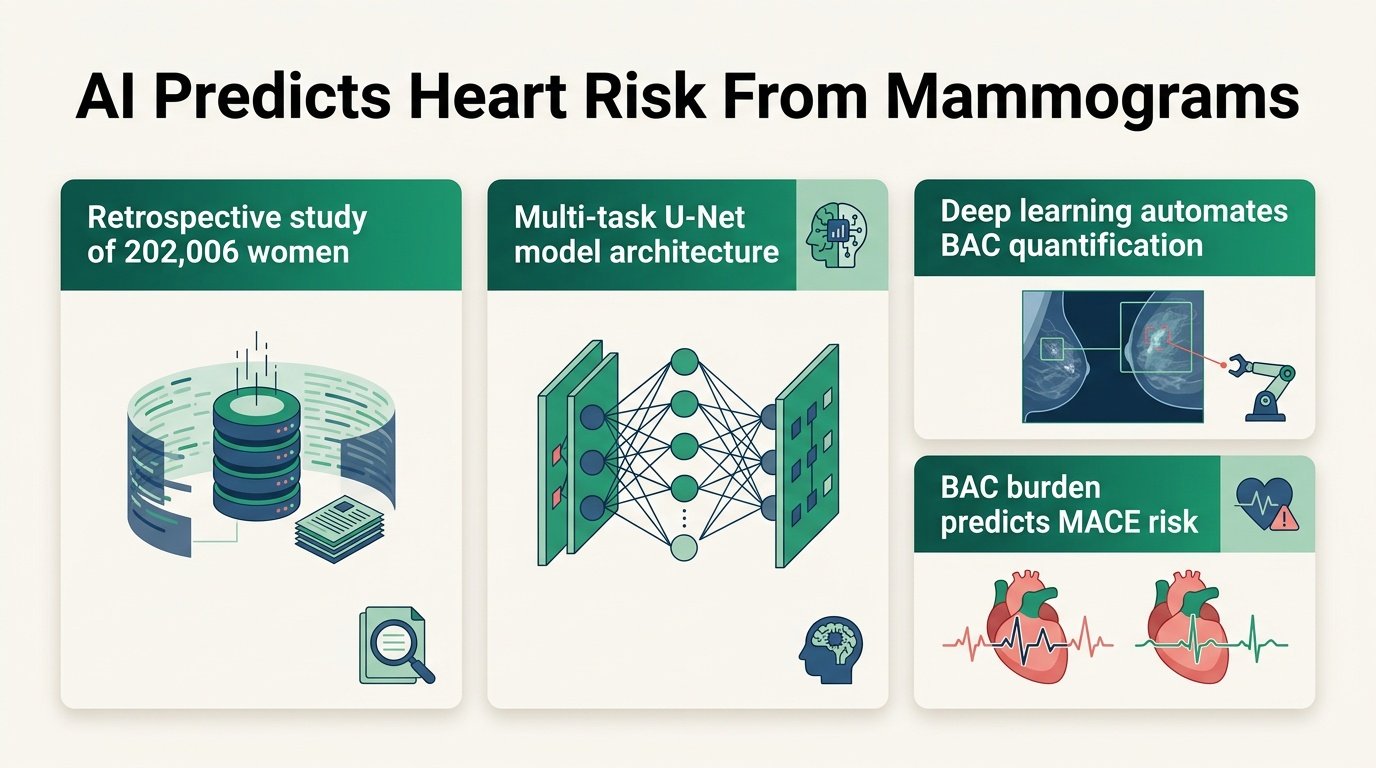
The researchers evaluated a multi-task U-Net model with a ResNet-18 encoder on a massive cohort of 202,006 women. The cohort had a mean age of 54.8 years (with a standard deviation of 11.7 years) and no prior history of major adverse cardiovascular events (MACE). On a geographically held-out test set, the model achieved an AUROC of 0.97, a Dice score of 0.6678, and a Pearson correlation of 0.961 between AI and manual annotations. This builds on earlier work, such as a 2020 study on DU-Net convolutional networks, which proved that deep learning could segment these calcifications.
The long-term tracking data revealed clear trends over a median follow-up of 7.5 years:
- The AI detected BAC in 23.1% of the women.
- A total of 7,701 women (3.8%) experienced a MACE during the follow-up period.
- Five-year MACE incidence rose from 1.5% in women with no calcification to 6.9% in those with high BAC burden.
- As a standalone predictor, the AI achieved a 5-year AUROC of 0.661 and a 10-year AUROC of 0.650.
The predictive limits
The tension lies in the comparison to standard clinical tools. The standard PREVENT score achieved a 5-year AUROC of 0.781 and a 10-year AUROC of 0.771. When researchers added the AI’s calcification data to the PREVENT score, they saw minimal improvement in overall risk discrimination.
This is a crucial reality check. If the AI does not significantly boost a standard clinical questionnaire, why use it?
The answer lies in clinical inertia. Many women do not get their cardiovascular risk calculated regularly, but they do get mammograms. This makes the AI an opportunistic safety net rather than a superior diagnostic tool. It aligns with recent findings on how automated BAC quantification associates with cardiovascular disease in real-world workflows.
An opportunistic safety net
We must be honest about the limitations. This study is retrospective and relies on electronic health records, which can miss unstructured data. It also used a single model architecture, meaning performance could vary across different mammography hardware.
Ultimately, this tool should not be judged by whether it beats standard risk scores in a spreadsheet. It should be judged by how many high-risk women it flags who would otherwise never have their cardiovascular health evaluated. The technology is ready, but the clinical workflow must adapt to make it useful.
Read the full study in medRxiv.