A new study shows that even advanced vision models struggle to predict preterm birth when tested on new hospital equipment.
Can an AI look at a mid-trimester ultrasound and tell if a pregnancy will end too early? For years, researchers hoped computer vision would spot subtle cervical changes that human eyes miss. If successful, this would give doctors a reliable tool to identify high-risk patients during routine mid-trimester scans.
A new validation study exposes the fragile reality of these imaging models. A tool that looks promising in its home lab can completely collapse when moved to a different scanner down the road. This disconnect challenges the assumption that complex deep learning can easily overcome real-world clinical variation.
The generalization trap
The researchers built several predictive models using data from the prospective GARBH-Ini cohort. They tested image-texture analysis using Local Binary Patterns with a Random Forest, a deep-learning Vision Transformer, clinical variables, and multimodal combinations. The goal was to predict spontaneous preterm birth from mid-trimester cervical ultrasounds.
The internal results offered a glimmer of hope. The best overall model achieved an internal-test area under the receiver-operating-characteristic curve (AUC) of 0.71. While not perfect, this suggested the algorithm was finding meaningful patterns in the cervical tissue.
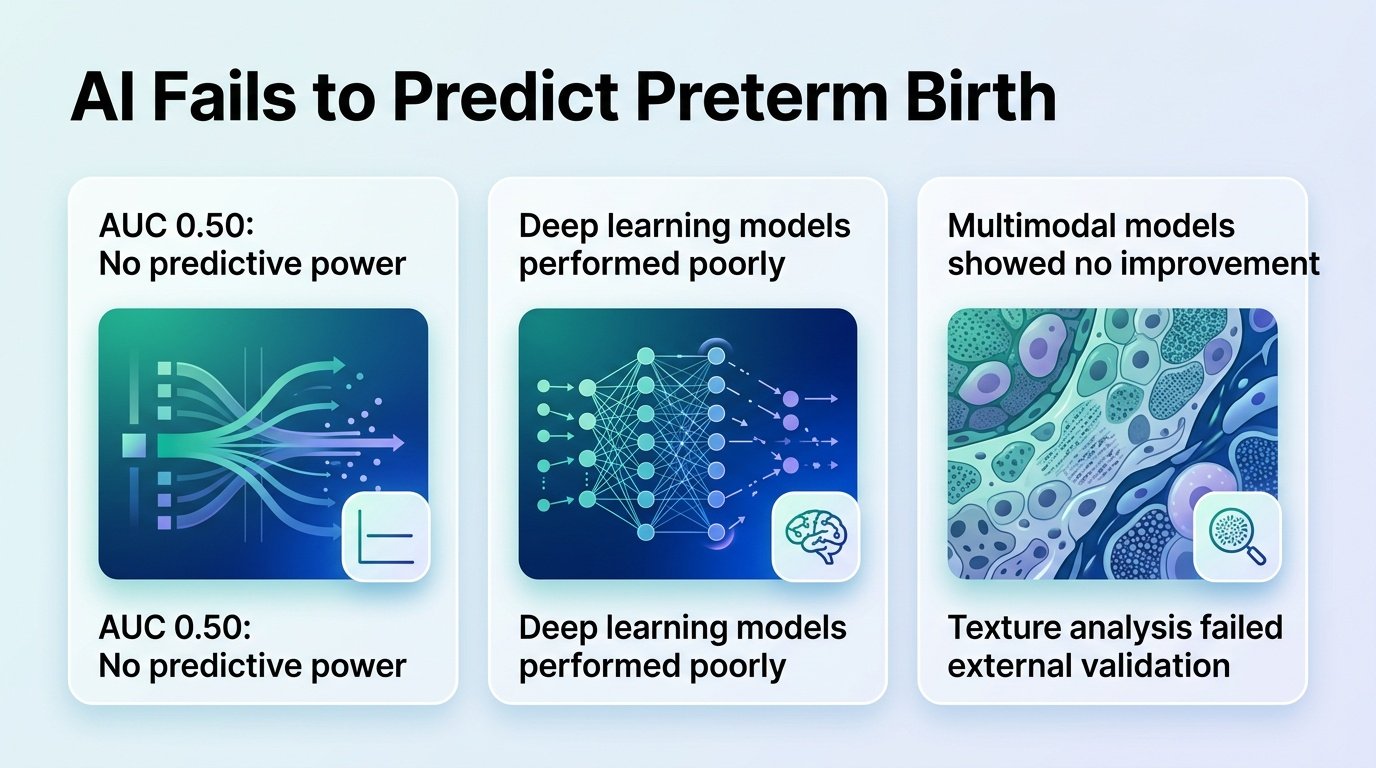
Then came the external validation. When the team tested the models on an independent cohort scanned with a different ultrasound machine, the performance plummeted. The best model dropped to an AUC of 0.52, which is essentially a coin toss. The advanced Vision Transformer and multimodal models failed to perform any better.
Key performance metrics
The data highlights the steep drop-off between controlled development and real-world testing:
- The best model achieved an internal AUC of 0.71 with a 95% confidence interval of 0.60 to 0.82.
- External validation collapsed to an AUC of 0.52 with a 95% confidence interval of 0.38 to 0.64.
- Discrimination appeared higher in a clinically high-risk subgroup at the 34-week threshold, though small case numbers made this estimate imprecise.
Rethinking ultrasound AI
Why did these sophisticated models fail so thoroughly on external data? Ultrasound images are highly sensitive to operator technique and machine hardware. A model trained on one machine often learns to read the specific artifacts of that manufacturer rather than the underlying biology of the cervix.
There is also a biological hurdle. Preterm birth is not a single, uniform condition. It is a complex syndrome with many different causes. Expecting a single vision model to predict every subtype of spontaneous preterm birth from a mid-trimester scan is likely unrealistic.
To move forward, developers must stop treating the cervix as an isolated image. Future models will need to integrate additional biomarkers and clinical data domains. Until we build models that can handle both machine diversity and biological complexity, ultrasound AI will remain confined to the research lab.
Read the full preprint study on medRxiv.