
Electronic health records are failing vulnerable patients because standard billing codes ignore the messy reality of clinical notes.
How much critical patient history is invisible to the algorithms designed to save lives?
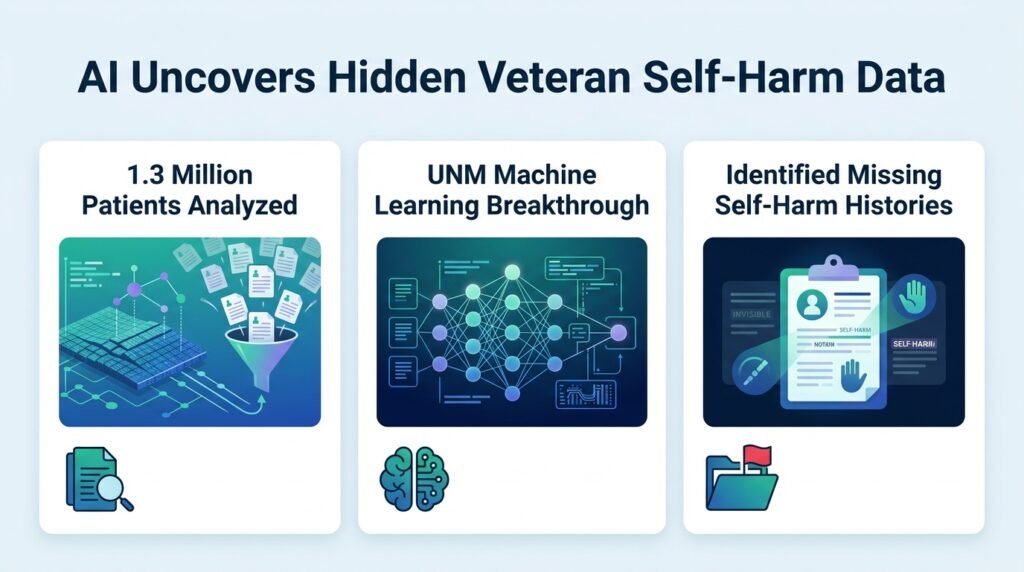
A massive analysis of 1.3 million patients within the Veterans Health Administration reveals a stark disconnect. While standard diagnostic codes flagged self-harm in just 1.85% of veterans, a machine learning tool scanning unstructured text found the true rate was 10.46%.
This means healthcare systems are missing more than three-quarters of self-harm cases.
The Coding Blindspot
Doctors do not just check boxes. They write detailed, narrative clinical notes. But traditional risk-prediction models rely heavily on structured billing codes. When critical mental health crises are buried in free-text notes, automated suicide prevention programs cannot see them.
The Department of Veterans Affairs has long prioritized predictive analytics to combat a veteran suicide rate that is roughly double that of civilian adults. Yet, predictive tools are only as good as their inputs. If the foundational data ignores 80% of the target behavior, the intervention strategy is fundamentally compromised.
Limits of Automation
Deploying natural language processing at this scale is not a simple fix. Algorithms can flag past behavior, but they cannot solve the underlying clinical workflow crisis.
If systems flood clinicians with alerts based on newly uncovered historical data, alert fatigue could worsen. The challenge now is not just finding the data, but figuring out how clinicians can act on it without being overwhelmed.
This is a wake-up call for health IT. True risk assessment requires looking beyond structured codes to the messy, unstructured narratives where patient realities actually live.