A new study shows artificial intelligence can read standard electrocardiograms to spot a deadly genetic heart condition before traditional symptoms appear.
When a patient carries the gene for hypertrophic cardiomyopathy, doctors face a frustrating waiting game. They must order expensive, repeated heart scans for years, never knowing if or when the heart muscle will actually thicken. This trial challenges the current gold standard of serial cardiac imaging. By using AI to analyze cheap, standard 12-lead ECGs, we can shift from blind, scheduled imaging to precise, risk-based tracking. It suggests that the electrical signatures of genetic heart disease manifest long before structural changes show up on an ultrasound.
How the model performed
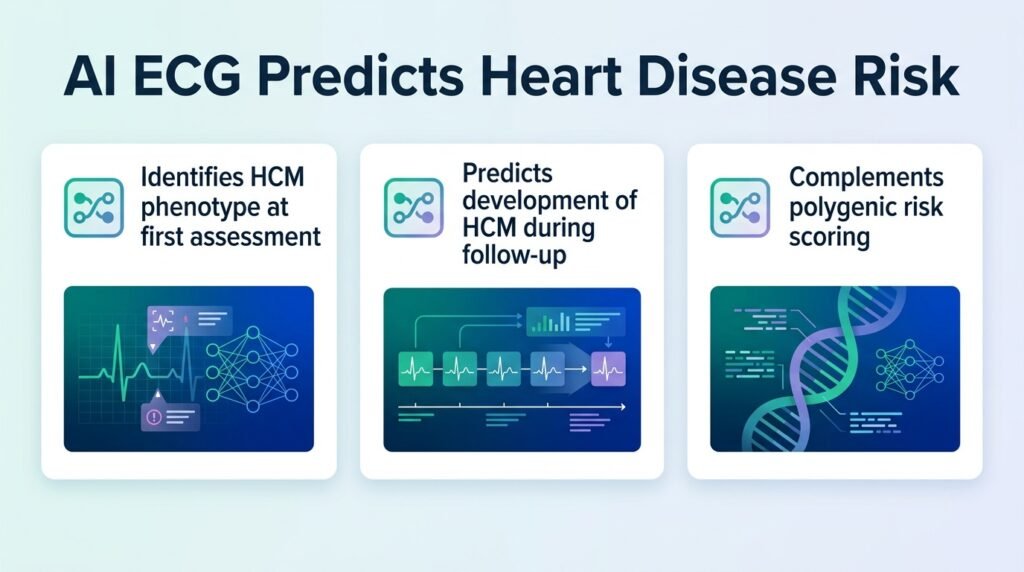
Researchers analyzed **1,095** genotype-positive individuals with a median age of **46** years, of whom **52.1%** were female. At their first clinical assessment, **808** patients already had physical signs of the disease, while **56** developed it during follow-up, and **231** remained symptom-free. This diverse cohort provided a strong test for the algorithm’s diagnostic accuracy.
The AI model analyzed standard ECG images with remarkable accuracy. It achieved an area under the receiver operating characteristic curve (AUROC) of **0.91** for detecting disease at baseline and **0.92** for identifying manifest disease. At a set threshold of 0.15, the tool delivered a **0.89** specificity and a **0.95** positive predictive value.
- An AUROC of 0.92 for identifying manifest hypertrophic cardiomyopathy.
- A high positive predictive value of 0.95, meaning positive results are highly reliable.
- A hazard ratio of 1.38 for predicting future disease in currently symptom-free gene carriers.
- A 60.2-fold increase in disease odds when combining high AI scores with high polygenic risk.
Predicting future silent threats
The real value of this tool lies in prediction. For gene carriers who looked completely healthy at baseline, a higher AI-ECG score predicted the future development of the disease with an adjusted hazard ratio of **1.38** per standard deviation. This means the electrical signals are changing before the heart muscle physically deforms.
When tested on **57,007** UK Biobank participants, the AI showed how it complements genetic testing. Patients with both a high AI-ECG score and high polygenic risk had **60.2-fold** higher odds of developing the condition. This is a massive leap compared to a **15.0-fold** risk for high AI alone, or just **4.1-fold** for genetic risk alone.
The limits of prediction
We must be honest about the tool’s weak spots. The negative predictive value was only **0.59**, which means a low AI score cannot safely rule out the disease. Patients with negative AI readings will still require traditional monitoring. This means the technology cannot act as a standalone diagnostic gatekeeper just yet.
Despite this limitation, the clinical implications are clear. This tool will not replace imaging, but it will optimize it. Instead of scanning every gene carrier every few years, clinics can use this software to prioritize high-risk patients. This shifts cardiology away from rigid, calendar-based medicine toward dynamic, biology-based tracking.
Read the full study in medRxiv.