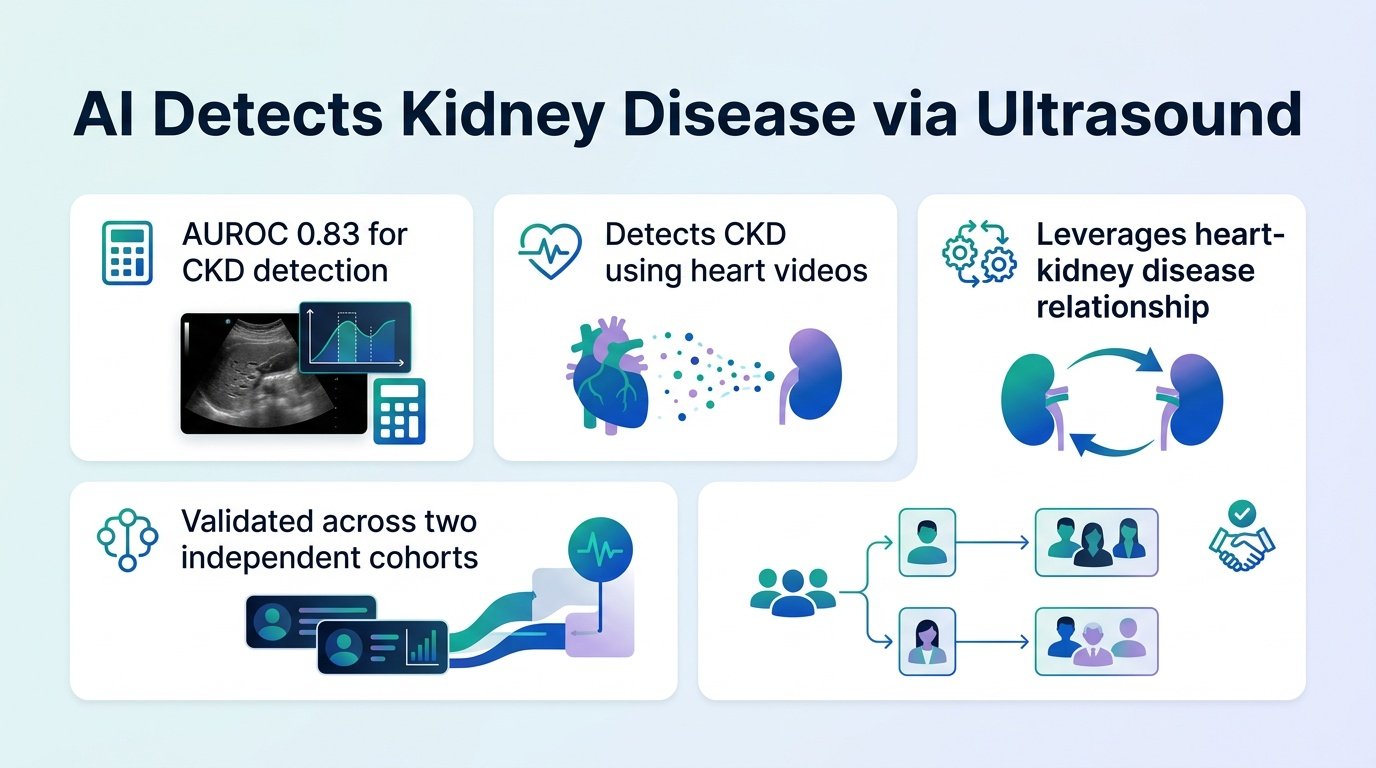
A new deep learning model spots chronic kidney disease using routine heart ultrasounds, bypassing the need for immediate blood work.
Why would a cardiologist look at the heart to check your kidneys? It sounds like a diagnostic mismatch. Yet a new study shows that artificial intelligence can spot chronic kidney disease (CKD) using nothing but routine cardiac ultrasound videos.
This approach challenges the traditional, siloed view of organ systems. It suggests we can use opportunistic screening to find one disease while looking for another. But is the model’s performance strong enough to change clinical workflows, or will it simply create a flood of false alarms?
Researchers built the model using a massive dataset of 325,377 parasternal long-axis videos. These scans came from 62,818 patients at Cedars-Sinai Medical Center. To prove the model works outside its home institution, the team tested it on two independent cohorts: 2,224 patients at Stanford Healthcare and 41,611 patients at Kaiser-Permanente Northern California.
How the model performed
- It detected any stage of CKD in the Cedars-Sinai test group with an AUC of 0.756.
- Performance remained stable at Kaiser-Permanente with an AUC of 0.718.
- The model achieved a similar AUC of 0.719 at Stanford Healthcare.
The opportunistic screening shift
Nearly 850 million people worldwide live with CKD, and a staggering 60% of them do not know they have it. Usually, diagnosing CKD requires blood or urine tests. This model exploits the tight connection between cardiovascular health and kidney function to flag renal decline during a standard echocardiogram.
This changes how we think about diagnostic boundaries. Instead of treating an echocardiogram as a single-purpose tool for heart valves, we must view it as a systemic window. If a patient is already getting a heart scan, this software can run in the background to catch silent kidney decay.
The false positive problem
However, we must look closely at the numbers. An AUC of roughly 0.72 is respectable but far from perfect. It means the tool will miss some cases and, more importantly, flag healthy patients as sick.
In a real-world clinic, a low-specificity screener can overwhelm primary care doctors with unnecessary follow-up tests. This tool should not replace standard lab work. Instead, its true value lies in triggering a simple blood test for high-risk patients who might otherwise slip through the cracks of a busy healthcare system.
This research was published in medRxiv.