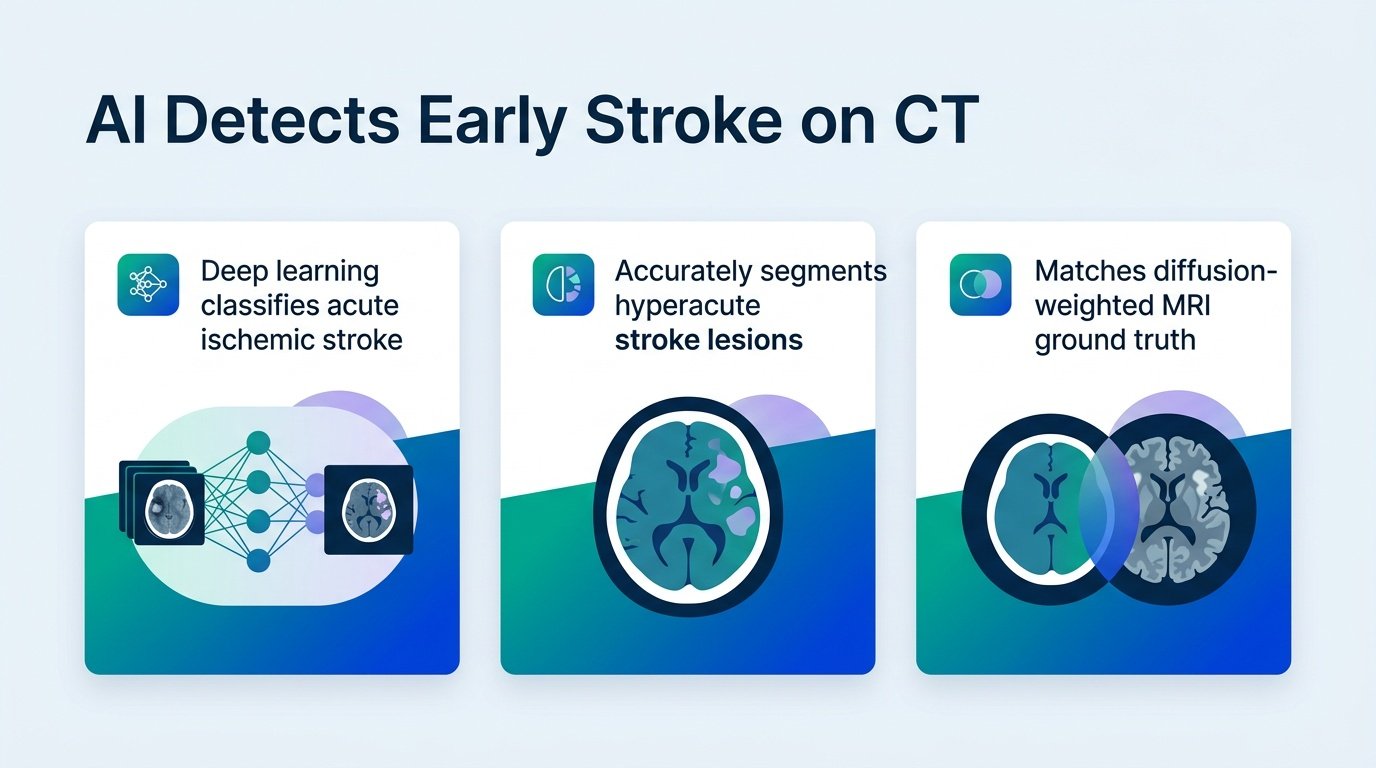
A new algorithm can spot hyperacute stroke tissue changes on cheap, standard CT scans, but it struggles to map the exact boundaries of smaller lesions.
Can a computer see a stroke that is invisible to a human radiologist? In the opening minutes of an acute ischemic stroke, every second costs brain tissue. Yet the standard first-line tool, a non-contrast CT scan, rarely shows the early, subtle density changes of a fresh clot. Doctors must wait for an MRI, losing critical time while the brain starves.
A new preprint from researchers Goyal and Stevens challenges this diagnostic delay. By pairing hyperacute CT scans with diffusion-weighted MRI as the ground truth, they trained a deep learning model to find what human eyes miss. The results reveal a striking split in AI capability: near-perfect detection, paired with mediocre mapping.
The diagnostic split
The researchers split the AI’s job into two distinct tasks. First, a ResNet50 model classified whether a patient was having a stroke. Second, a series of U-Net architectures attempted to segment, or draw 3D boundaries around, the damaged tissue.
The classification results were remarkably strong. The model achieved:
- An overall accuracy of 98.5% on the evaluation set.
- A precision rate of 97.4%.
- A perfect recall rate of 100%, meaning it missed zero strokes.
Crucially, this classification performance remained robust even when restricted to lesions smaller than 5 mL, which made up the majority of the test cases. This is a massive leap forward. It suggests that basic, cheap imaging can serve as an immediate alarm system for tiny, early-stage blockages.
The mapping bottleneck
The story changes entirely when we look at segmentation. While the U-Net models performed acceptably on large stroke lesions, their performance declined sharply when trying to map smaller lesions.
This limitation is the real story. It exposes a fundamental boundary in current medical computer vision. Knowing a stroke is happening is valuable, but clinicians need to know its exact size to make safe treatment decisions. If an AI cannot reliably measure a small lesion, doctors cannot use it to calculate the volume of salvageable brain tissue. This shortfall prevents the tool from being a complete diagnostic solution.
This issue is not unique to this model. Earlier research on ischemic stroke segmentation on non-contrast CT shows that while AI can match expert radiologists in some windows, hyperacute micro-lesions remain incredibly difficult to outline. Another study on identifying ischemic cores relied on adding CT angiography to get a clearer picture. The physics of basic CT scans simply do not provide enough contrast for fine-grained spatial mapping of hyperacute tissue.
Why this matters
This finding should force healthcare systems to rethink how they deploy AI in emergency rooms. We should stop waiting for a single algorithm that does everything. Instead, hospitals should use this technology immediately as a rapid triage bell to fast-track patients to MRI, rather than relying on it to plan delicate interventions. It is a powerful screening tool, not a surgical map.
Read the full preprint on medRxiv.