
A new AI system identifies a reversible “pre-disease” window for depression, proving that treatment timing matters more than the tool itself.
Why do depression treatments fail so often? The answer may not be the drug or the device, but the calendar. By the time clinical depression is diagnosed, the brain may have already crossed a biological point of no return.
This reality challenges the reactive model of mental health tech. Instead of waiting for a crisis, we must target the fragile transition phase before illness locks in. Most wearable health tech acts like a smoke detector, sounding an alarm only after the fire starts. That approach is too late for the brain.
The implication is stark: treating depression after onset is a losing battle for full recovery. We must shift clinical validation from how well a device treats a disease to how accurately it spots the slide into it. If we do not catch the slide, the best therapies on the market will continue to underperform.
Predicting the tipping point
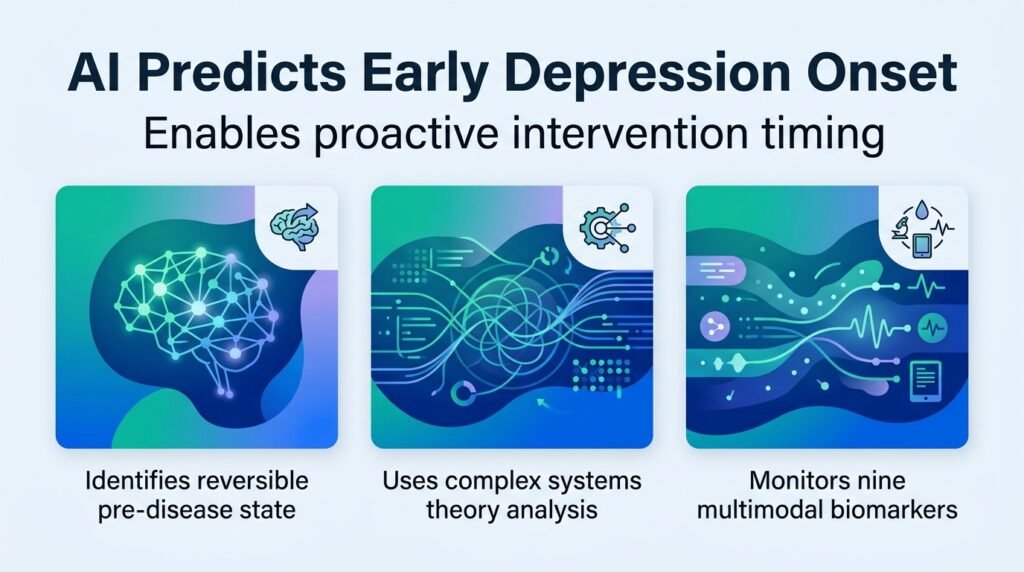
Researchers built a tripartite classification framework to map the transition from healthy to depressed states. They continuously monitored nine multimodal biomarkers, tracking electrophysiological, behavioral, and biological changes. Using ultrasoft neural probes for low-damage recording, an AI agent classified these states with 95.2% accuracy.
This high accuracy is crucial because the window of opportunity is narrow. The researchers tested a skin-attachable wireless vagus nerve stimulator on subjects at different stages. Those treated during the pre-disease window showed faster recovery and stronger therapeutic responses. In contrast, subjects who received treatment after full disease onset failed to achieve full recovery.
The invasive hurdle
The science is compelling, but the hardware presents a massive hurdle. The study relies on ultrasoft neural probes to achieve its high-fidelity data. While the therapeutic stimulator is skin-attachable, gathering the initial diagnostic data still requires highly specialized sensors. This creates a bottleneck between clinical efficacy and real-world utility.
Scaling this to the general public is the real challenge. Consumers will not wear neural probes to prevent a hypothetical depressive episode. For this framework to succeed outside the lab, researchers must translate these nine deep biomarkers into signals that consumer-grade smartwatches can reliably detect. Until then, this remains a brilliant lab proof-of-concept rather than a scalable tool.
Key study outcomes
- The AI achieved 95.2% accuracy in classifying normal, pre-disease, and disease states.
- Monitoring relied on nine distinct biomarkers spanning electrophysiological, behavioral, and biological data.
- Vagus nerve stimulation during the pre-disease phase led to faster, complete recovery.
- Intervention after full disease onset failed to restore subjects to baseline health.
The era of reactive psychiatry is reaching its limits. This study proves that the transition state is the most valuable target in mental health.
Read the full analysis in Science Advances.