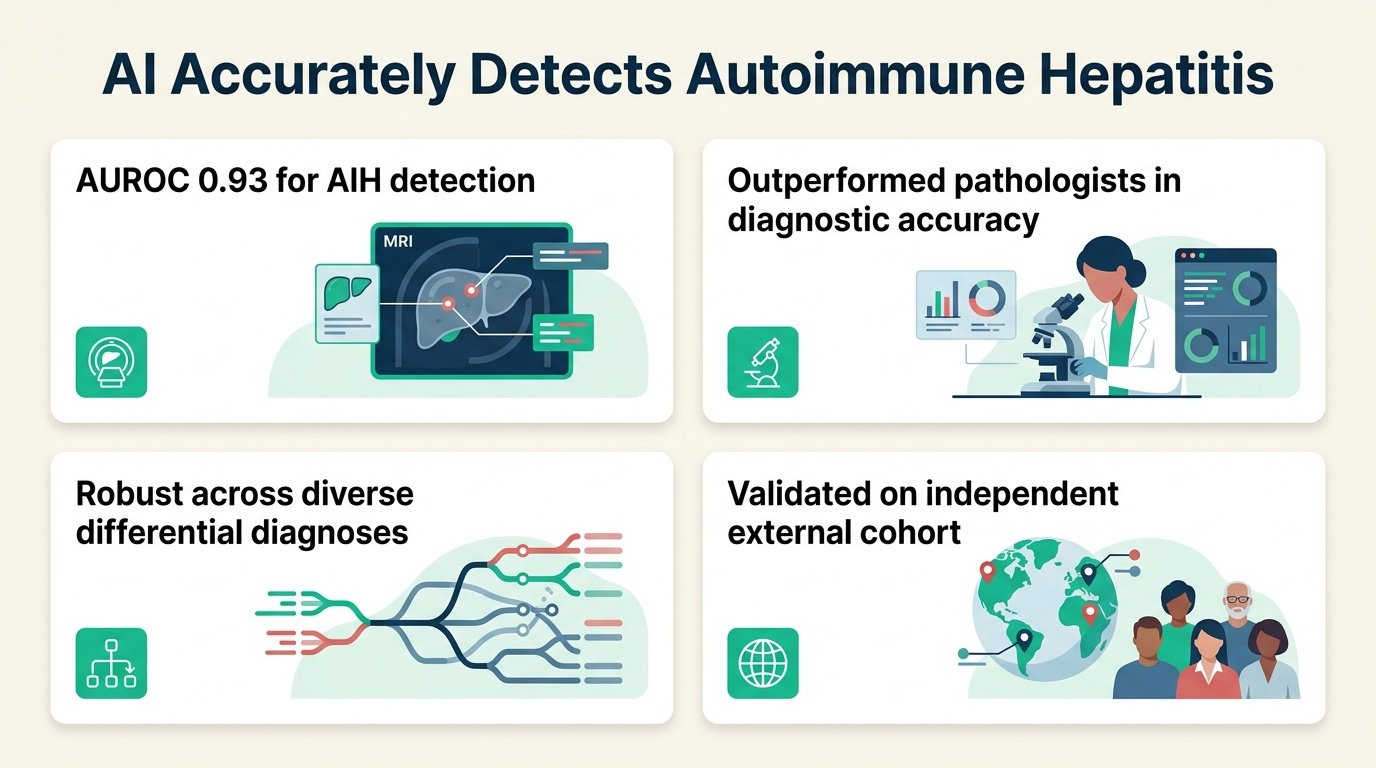
A new deep-learning model diagnoses autoimmune hepatitis with expert-level accuracy in some scenarios, but its failure against hepatitis B reveals a critical diagnostic blind spot.
Can an algorithm diagnose a complex autoimmune disease using nothing but a digital image of liver tissue? Pathologists usually need a mountain of clinical data, blood tests, and treatment responses to confirm autoimmune hepatitis (AIH). This study bypassed that entire diagnostic safety net, training a deep-learning model named AIOLI on raw biopsy slides alone.
The results show that while neural networks can spot patterns invisible to the naked eye, they remain highly vulnerable to diagnostic lookalikes. This challenges the assumption that computer vision can operate in a clinical vacuum without integrated lab data.
The performance gap
The researchers built AIOLI using a training cohort of 170 untreated AIH patients and 232 control cases. The model initially achieved an outstanding AUC of 0.92 ± 0.02 on this training data. However, when tested on an external dataset of 61 AIH cases and 124 controls, performance dropped to an AUC of 0.74. In a prospective, real-life trial conducted between January and June 2025, the model managed a sensitivity of 0.86, a specificity of 0.76, an F1-score of 0.69, and an overall AUC of 0.73.
The real story lies in how the model handled specific lookalike diseases. AIOLI excelled at ruling out metabolic conditions but struggled mightily with viral infections. Here is how the model performed across different differential diagnoses:
- An AUC of 0.98 against metabolic dysfunction-associated steatohepatitis (MASH).
- An AUC of 0.89 against acute alcoholic hepatitis.
- An AUC of 0.76 against drug-induced liver injuries.
- An AUC of only 0.42 against Hepatitis B Virus (HBV).
The viral blind spot
An AUC of 0.42 is worse than a coin flip.
This means AIOLI consistently confused Hepatitis B with autoimmune hepatitis. In a clinical setting, this error is dangerous. Misclassifying a viral infection as an autoimmune flare-up could lead doctors to prescribe immunosuppressants, which can cause viral replication to skyrocket.
To build trust, the system extracts the five most predictive image tiles to show pathologists which cellular patterns drove its decision. While this interpretability is useful, it does not solve the underlying data deficit. AI cannot safely diagnose autoimmune hepatitis from pixels alone when viral mimics are present.
This finding matters because it proves that histology-only AI has reached its limit in hepatology. To move forward, developers must integrate clinical and viral biomarkers directly into the neural network. Relying solely on visual patterns will keep these tools confined to assistant roles rather than standalone diagnostic engines.
Read the full study in Archiv für Pathologische Anatomie und Physiologie und für Klinische Medicin.