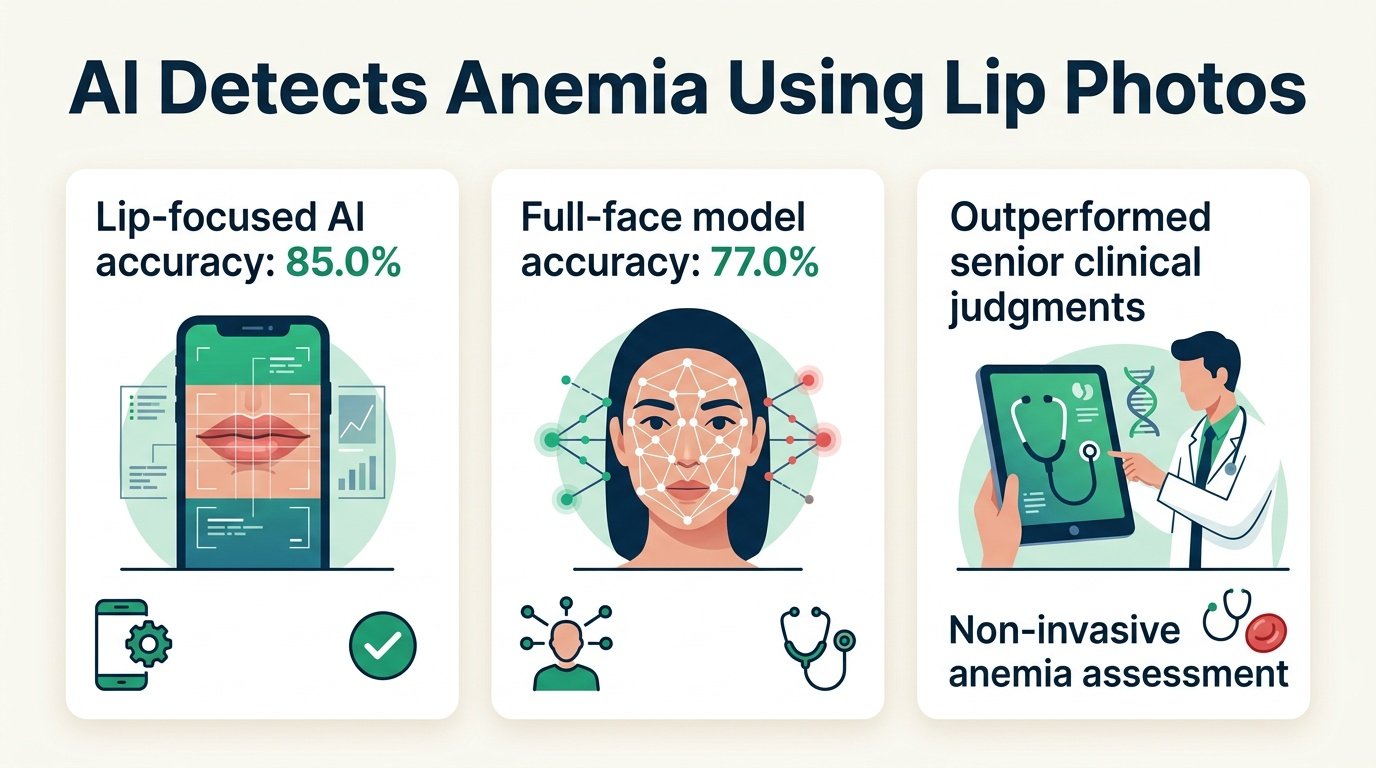
A new deep learning model diagnoses anemia from lip photos far better than experienced emergency room doctors.
Can a computer screen patients for anemia faster and more accurately than a senior physician? In a chaotic emergency department, doctors routinely look for pale skin or gums to spot low red blood cell counts. Yet this visual guesswork is notoriously unreliable, forcing clinics to rely on slow, invasive blood draws for basic triage.
A new study published in *Scientific Reports* suggests a simple photo of a patient’s lips could change this workflow entirely.
The diagnostic gap
The researchers developed a deep learning model using the Detection Transformer framework to analyze images of patients in an emergency department. They compared a model focused strictly on the lip region against one that analyzed the entire face. The results reveal a stark contrast in performance.
While the full-face model hit 77.0% accuracy, the lip-focused model achieved 85.0% accuracy.
This performance gap becomes even more significant when compared to human clinicians. Senior physicians managed only 59.3% accuracy in their clinical judgments, while junior physicians fell to 49.95%—essentially a coin flip. The AI processed each image in just 127.50 ms, classifying anemia into three distinct severity levels.
Why the lips matter
This finding complicates the traditional medical training that teaches doctors to look at the whole patient. By narrowing the focus to the mucosal surface of the lips, the AI filters out confounding visual noise like skin tone, lighting, or makeup.
Other non-invasive approaches have targeted different areas, such as nail-based anemia disease detection algorithms or smartphone apps like NiADA. However, the lip mucosal membrane provides a highly direct, vascularized signal that this transformer model successfully isolated. This suggests that future diagnostic tools should focus on specific anatomical micro-regions rather than broad, full-face scans.
The real value here is not just the high accuracy, but the speed of triage.
Limitations and next steps
We must remain realistic about the hurdles. Emergency departments feature highly variable lighting, and patients may present with dry, damaged, or pigmented lips that could confuse the model. The study does not detail how the algorithm handles diverse ethnic skin tones or pre-existing lip conditions.
Nevertheless, replacing subjective clinical guesswork with a fraction-of-a-second digital scan could streamline emergency triage before a single needle is prepped.
- The lip-focused AI model achieved 85.0% diagnostic accuracy.
- Senior physicians scored 59.3% accuracy, and junior physicians scored 49.95%.
- The system classifies anemia into three severity tiers in 127.50 ms.
Read the full study in Scientific Reports.