A new analysis reveals how much of a brain-computer interface’s output comes from the user’s mind versus the AI’s predictive text.
Who is actually speaking when a paralyzed patient uses a brain-computer interface? If a smart algorithm predicts the next word, the final sentence might belong more to the machine than the patient. This tension is no longer theoretical as language models get integrated into clinical hardware.
This study challenges the assumption that high-accuracy brain-computer interfaces (BCIs) are purely reading the brain. When we celebrate a high-speed spelling device, we are often grading the algorithm’s predictive power rather than the user’s neural control. This complicates how we evaluate clinical trials. If the AI does the heavy lifting, we risk misjudging the actual efficacy of the neural sensor.
Where the words originate
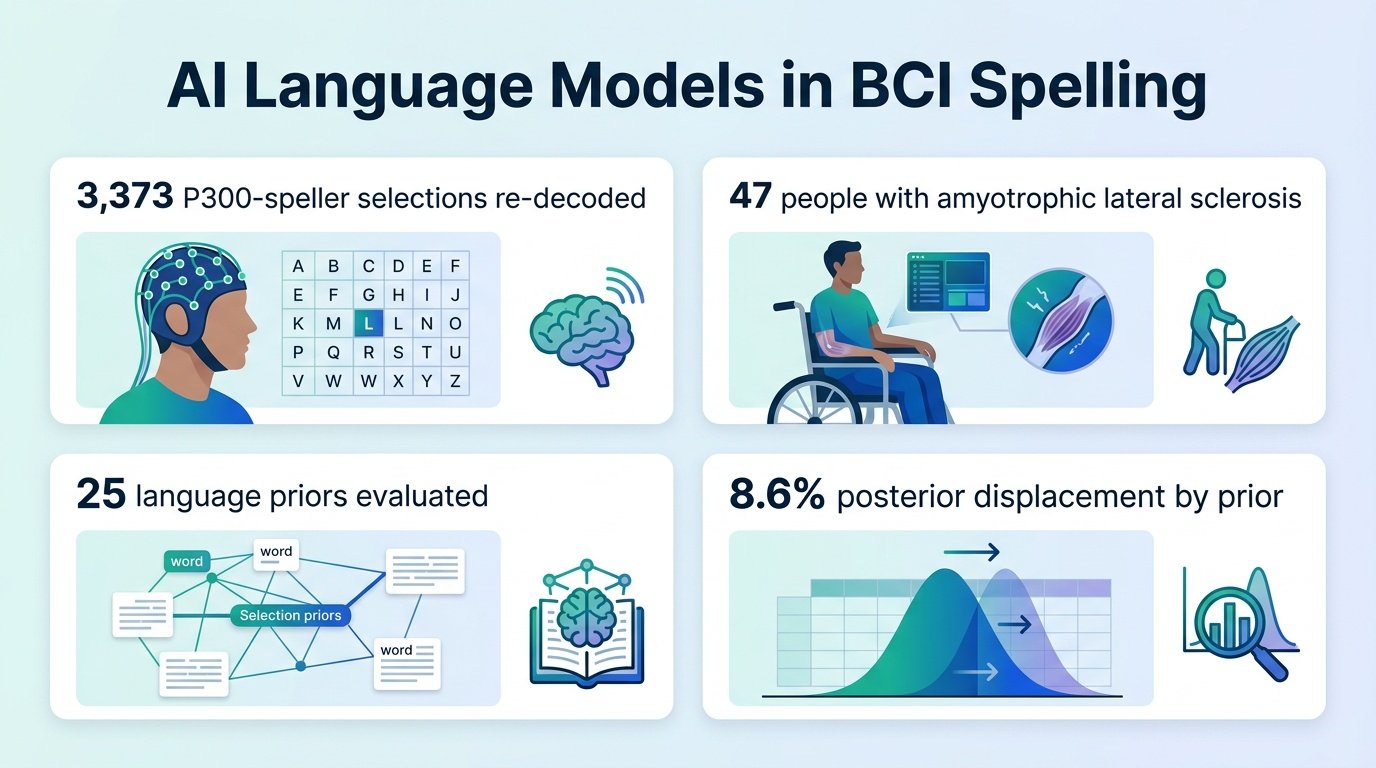
To measure this split, researchers retrospectively re-decoded 3,373 P300-speller selections from 47 people with amyotrophic lateral sclerosis (ALS). They reconstructed the neural signals and combined them with 25 different language priors, ranging from simple 5-grams to massive 46.7-billion-parameter models. This allowed them to isolate the exact influence of the AI versus the brain.
The analysis revealed a clear, lopsided division of labor:
- The language prior accounted for a participant-weighted mean of 8.6% of the posterior displacement, with a median of 2.9%.
- The neural contribution fraction remained dominant at 0.914 (95% CI, 0.896-0.934).
- In 4.4% of selections (95% CI, 3.5-5.3), the combined system emitted the correct character even though the neural evidence alone would have missed it.
- These dynamics remained highly consistent across 21 different neural language models.
The illusion of neural control
This finding exposes a hidden trade-off in assistive tech. We want BCIs to be fast and accurate, which is why researchers have integrated predictive models for years, as seen in early work like A Two-Level Predictive Event-Related Potential-Based Brain–Computer Interface. More recently, systems like ChatBCI have pushed this integration further. But if the AI corrects 4.4% of errors, we must ask: at what point does assistive technology become a mouth-piece for the algorithm?
This is not just about spelling accuracy. It is about autonomy. If a patient wants to spell a rare or highly personal word, a strong language model might override their actual neural intent. This risk is especially high in systems that prioritize speed over raw neural signal clarity.
The study has clear limits. It is a retrospective analysis of P300-spellers, which are discrete selection tools. It does not capture how users might adapt their thinking in real-time when they notice the AI predicting their thoughts. Future prospective trials must measure this cognitive feedback loop directly.
Read the full study in medRxiv.