A new conversational platform uses real-time patient feedback to improve seizure detection without requiring clinician intervention.
Medical devices gather massive streams of brain data, yet they rarely share real-time insights with the people wearing them. That silence wastes a critical opportunity. If software cannot converse with patients during clinical events, it misses out on immediate human context that could make its algorithms far sharper.
That disconnect is what this prototype aims to solve.
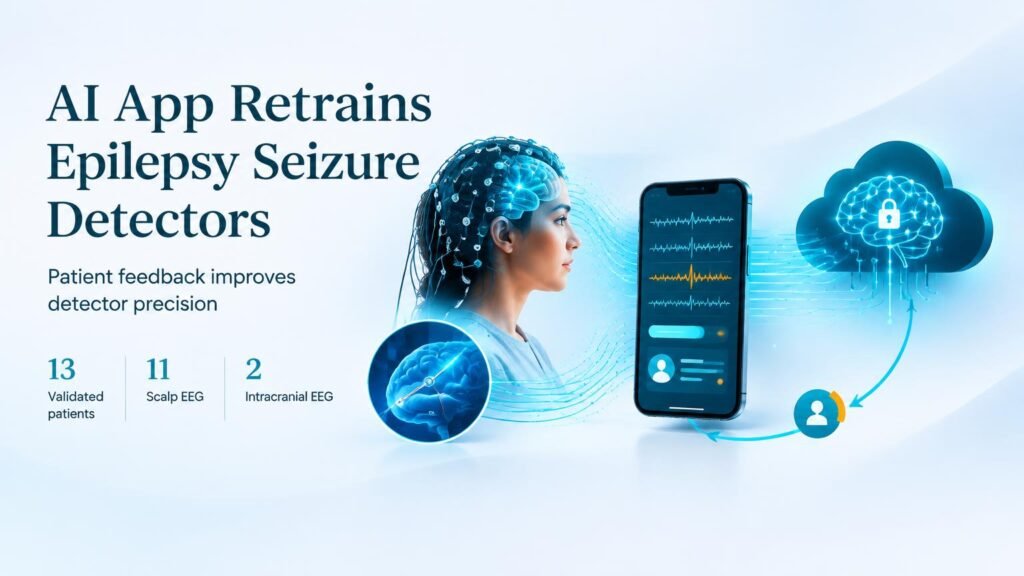
A team built a platform connecting scalp and intracranial electroencephalography (EEG) data to a large language model via a smartphone app. Instead of relying solely on remote experts to tweak detection thresholds, the system asks patients about their symptoms and uses their answers to retrain itself.
Closing the patient feedback loop
Nearly one-third of the world’s 70 million people with epilepsy suffer from drug-resistant seizures. Implantable and wearable devices can track sleep, cognition, missed medication, and impending seizures, but standard hardware leaves patients in the dark. This conversational system turns passive monitoring into an interactive loop.
Researchers validated the setup in an inpatient hospital setting with 13 patients undergoing video-EEG monitoring. The group included 11 patients monitored via scalp EEG and 2 patients with intracranial EEG setups. The mobile app notified individuals of clinical trends, logged reported symptoms, and adjusted its detector based on direct patient responses.
Self-correcting seizure algorithms
The primary operational hurdle for continuous EEG monitors is false alarms. High false-alarm rates exhaust patients and overload clinical staff. In a pseudoprospective simulation, the platform used patient responses alone to retrain its algorithms, raising detector precision without clinician involvement.
Key findings from the pilot include:
- Targeted a global population where one-third of 70 million individuals do not respond to anti-seizure drugs.
- Tested bidirectionally across 13 inpatient video-EEG cases using both scalp and intracranial inputs.
- Improved seizure detector precision and reduced false alarms through automated retraining driven strictly by patient feedback.
Direct patient feedback replaced manual tuning in the test model.
Early trial realities
Promising simulation metrics are not proof of real-world clinical efficacy. The study relied on a small inpatient cohort of 13 people, and the performance gains were measured in a pseudoprospective environment rather than a multi-center outpatient trial. A retrospective or controlled hospital result does not mean the software is safe for unmonitored home use or capable of replacing physician management.
The practical takeaway lies in operational scalability. If interactive patient feedback can reliably suppress false alarms without expert oversight, continuous neurological monitoring becomes far easier to deploy outside the hospital. The full findings were published in Nature Medicine.