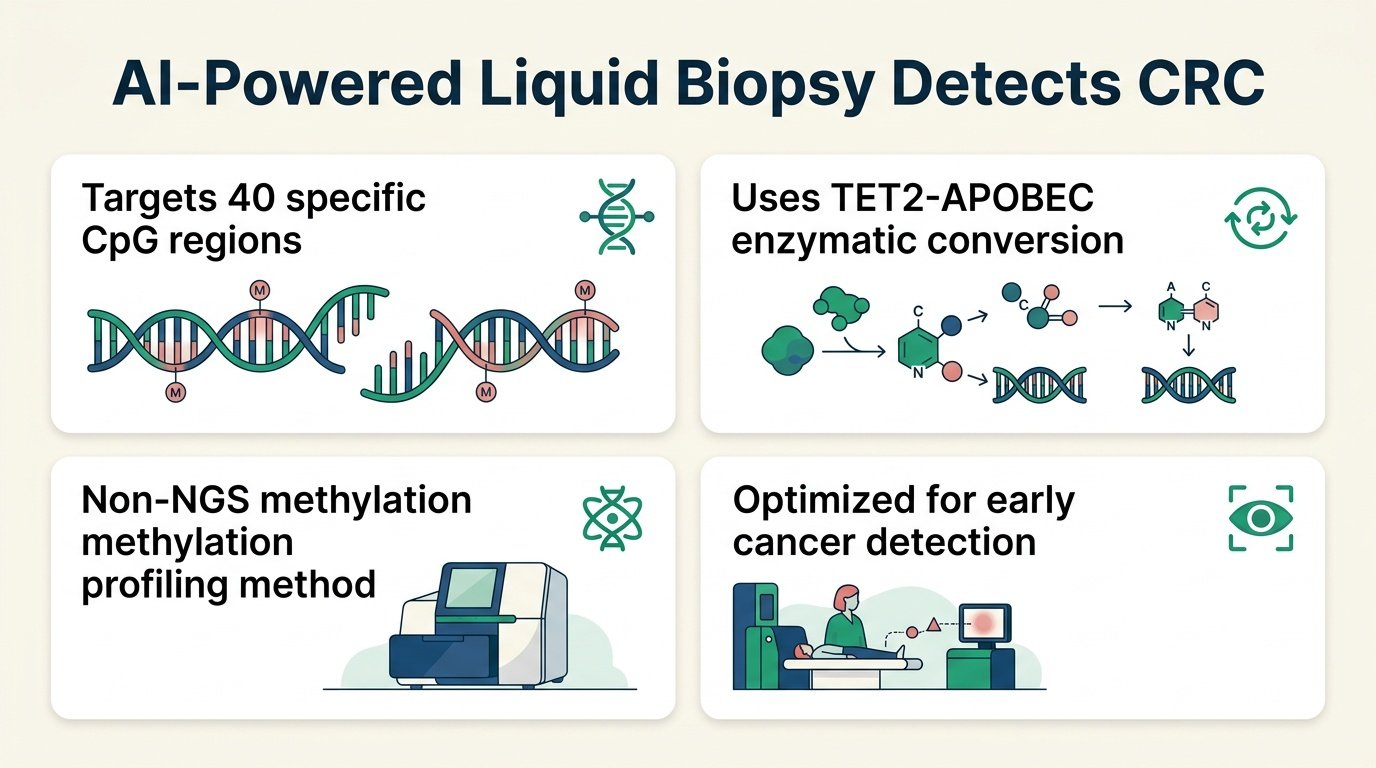
By ditching expensive gene sequencing for a simpler neural network and qPCR setup, researchers may have found a way to make early cancer screening practical for local clinics.
Why does liquid biopsy for cancer remain a luxury of high-end academic medical centers? The answer lies in our heavy reliance on next-generation sequencing. This technology requires massive computing power, expensive reagents, and days of processing time. It keeps screening locked away from the communities that need it most.
This new study challenges the assumption that we need deep sequencing to achieve high-accuracy liquid biopsies. By combining a targeted enzymatic assay with a simple neural network, the researchers bypassed sequencing entirely. This shifts the focus of AI diagnostics from analyzing massive datasets to processing cheaper, targeted data points. It suggests that the future of cancer screening may rely on smarter algorithms rather than heavier machinery.
Smarter Chemistry Over Raw Power
Instead of sequencing the whole genome, the assay targets just 40 specific CpG regions. The workflow relies on a TET2-APOBEC enzymatic conversion method to prepare the DNA. This chemistry preserves the integrity of circulating cell-free DNA far better than traditional, harsh chemical treatments. This approach builds on previous efforts to optimize enzymatic conversion for low-input cfDNA, proving that gentle sample preparation yields cleaner signals.
The researchers evaluated their assay on a cohort of 216 plasma samples, which included 86 colorectal cancer cases and 130 healthy controls. They fed the resulting qPCR methylation signals, alongside patient age, into neural network-based predictive models. In the validation subset, 14 high-performing models demonstrated that this stripped-down approach could compete with expensive sequencing pipelines.
High Accuracy in Early Stages
- Validation sensitivity across the models ranged from 80.8% to 92.3%.
- Specificity remained high, ranging from 84.6% to 97.4%.
- A representative model achieved a validation sensitivity of 92.3% and a specificity of 97.4%.
- This same model detected early-stage (Stage I/II) colorectal cancer with 100% sensitivity.
Rethinking the Sequencing Monopoly
These findings prove we do not need to map the entire methylome to catch early-stage colorectal cancer. If a standard qPCR machine—found in almost every local hospital—can achieve high sensitivity when paired with a neural network, the primary barrier to screening disappears. This aligns with other recent attempts to use enzymatically converted cfDNA for fragmentation analysis, showing that enzymatic preparation is becoming a viable alternative to sequencing.
However, we must treat the perfect 100% early-stage sensitivity with caution. The study cohort was small, and the number of early-stage patients was highly limited. In a massive, diverse screening population, that perfect score will almost certainly drop. We need larger, prospective trials to confirm whether these neural networks can maintain their precision when facing the messy biological noise of the general public.
Read the full study in Cancer Prevention Research.