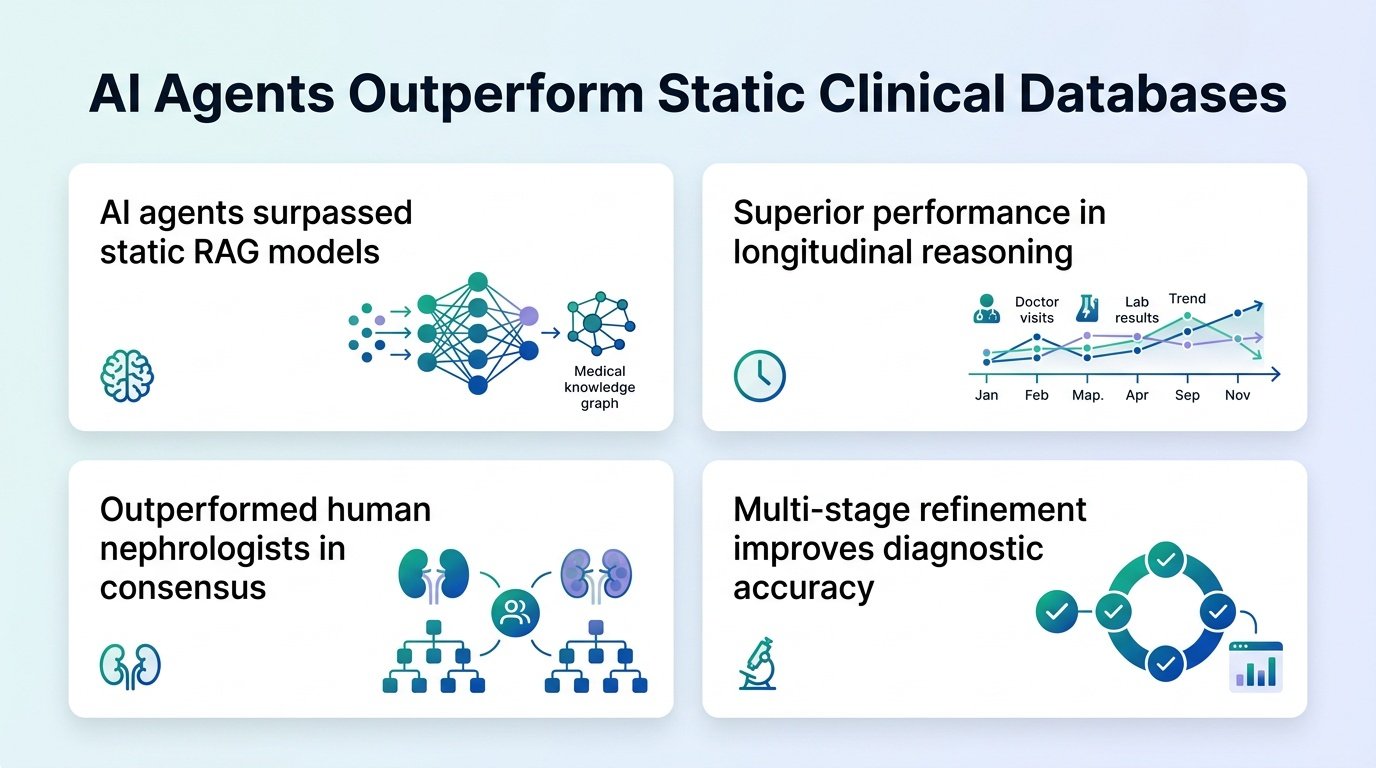
Adding medical guidelines to an AI does not make it a better doctor, but teaching it to argue with itself does.
For years, the digital health industry assumed that feeding clinical guidelines directly to large language models would solve their accuracy problems. This new study reveals that static lookup is a dead end for complex cases. The real value lies in multi-agent debate, not bigger databases.
This finding challenges the massive industry investment in Retrieval-Augmented Generation (RAG). If simply retrieving guidelines performs no better than a raw model, we are building the wrong infrastructure. We must transition from passive search to active, multi-agent reasoning.
The failure of static search
Researchers tested three AI setups on 10 complex, longitudinal kidney cases. Four board-certified nephrologists evaluated the models across 9 cognitive steps. Model A was a standard baseline model. Model B used static, guideline-based RAG. Model C used a multi-agent framework with iterative self-critique.
On a 20-point human evaluation scale, Model C scored a mean of 17.2. Meanwhile, Model A scored 16.1 and Model B scored 16.2. The static RAG model showed no statistically significant improvement over the baseline. Simply dumping textbook knowledge into the prompt did not help the AI navigate shifting patient data.
Why debate beats retrieval
The study shows that complex medicine requires planning, not just memorization. When a patient’s kidney function declines over months, a doctor does not just look up a guideline. They weigh competing explanations, discard weak hypotheses, and adjust the plan. Static RAG treats clinical reasoning like an open-book quiz, whereas the multi-agent framework treats it like a grand rounds discussion.
Monolithic models failed at dynamic differential diagnoses because early errors cascaded through the treatment plan. The multi-agent pipeline solved this by letting different AI agents critique each other’s work. This collaborative architecture is proving successful across other medical specialties. Similar gains have been documented in a multi-agent approach to neurological clinical reasoning. Furthermore, research into medical intents via LLM-based agent collaboration confirms that distributed workflows are essential for preventing diagnostic errors.
The key results from the nephrology trial highlight this performance gap:
- Model C achieved a diagnostic accuracy score of 17.6 compared to lower-performing static models.
- Therapeutic management scores reached 17.3 by successfully intercepting planning bottlenecks.
- Automated AI evaluations on a 15-point scale confirmed the trend, with Model C scoring 14.7 while Model B lagged at 14.3.
The limits of self-correction
We must look closely at the study’s scope. The researchers used only 10 clinical cases. While these cases were highly complex and vetted through a rigorous Delphi consensus, a larger sample size is needed to prove safety in clinics. Running multiple agents also increases computing costs and processing time.
Even with these hurdles, the implication is clear. Clinical AI is not a database search problem. It is a reasoning problem, and the solution is a team of digital specialists arguing toward a consensus.
Read the full study in medRxiv.