
A new molecular signature could finally give drug developers a reliable way to measure treatments for a severe neurodevelopmental disorder.
How do you test a drug for a brain disease when you cannot easily peer inside the patient’s skull? For ReNU syndrome, a severe neurodevelopmental condition, clinical trials face this exact wall. Without a clear, measurable signal of the disease in the blood, testing new therapies is a guessing game.
A new preprint suggests we can stop guessing. By identifying a tiny, six-site RNA signature, researchers have created a highly specific molecular compass. This shifts the focus from broad clinical observation to precise, quantitative tracking.
This is not just a diagnostic tool. It is a blueprint for clinical trials. If a therapy can correct these specific genetic missteps, researchers will know almost immediately, long before clinical symptoms change.
The search for a signal
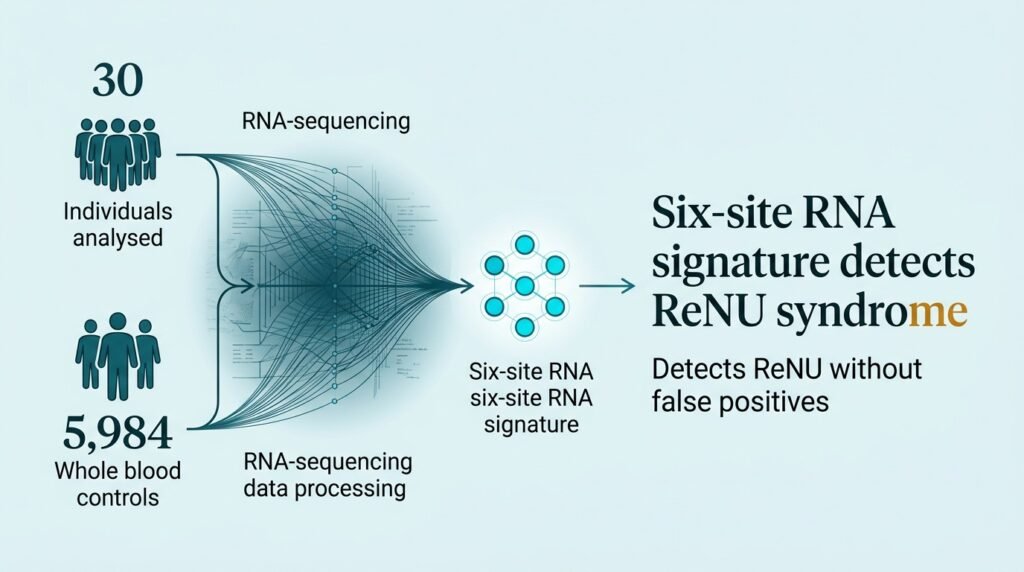
The researchers analyzed RNA-sequencing data from two independent cohorts. The dataset included 30 individuals with ReNU syndrome and 54 controls. They initially identified 483 alternative splicing events shared across both groups, narrowing them down to 105 alternative 5′ splice-site events.
From there, the team built a minimal signature using just six sites. This tiny signature perfectly distinguished 19 patients with a specific genetic insertion from the controls. To test its accuracy, they ran it against 5,984 whole blood controls and got zero false positives.
- 483 shared alternative splicing events identified.
- 105 highly concordant splice-site events.
- 6 key sites used to build the final signature.
- 0 false positives across nearly 6,000 controls.
Tracking the severe cases
The signature is highly specific to variants in the T-loop of the RNU4-2 gene. This is crucial because T-loop mutations are linked to the most severe clinical symptoms. The researchers also confirmed the signature’s stability by testing it in stem cell models, where it persisted as the cells matured into cortical neurons.
But this specificity is also a limitation. While the test works perfectly for T-loop variants, patients with Stem III mutations show different splicing patterns. A single, universal test for all ReNU patients does not exist yet. Furthermore, these findings come from a preprint and require peer review before clinical adoption.
Even with these limits, the study provides a clear framework for tracking rare genetic diseases. It proves that we do not need to map thousands of genes to find a reliable signal. Sometimes, just six sites are enough to show the way forward.
Read the full study in medRxiv.