AI reads sleep pulse signals to predict disease
A new foundation model shows that overnight pulse oximetry data contains deep physiological signatures that can predict future hypertension and next-day blood sugar levels.
Why do millions of people wear smart rings and wristbands to sleep? Most users just want to check if they got enough deep sleep. But what if the simple light sensors on your skin are quietly recording the early warning signs of chronic disease?
This question challenges how we view basic consumer health tech. For years, we treated pulse oximeters as simple tools to measure blood oxygen and heart rate. This new research suggests we are throwing away the most valuable data. The complex shapes of blood flow waves contain hidden clues about our blood vessels, metabolism, and nervous system.
Predicting future chronic disease
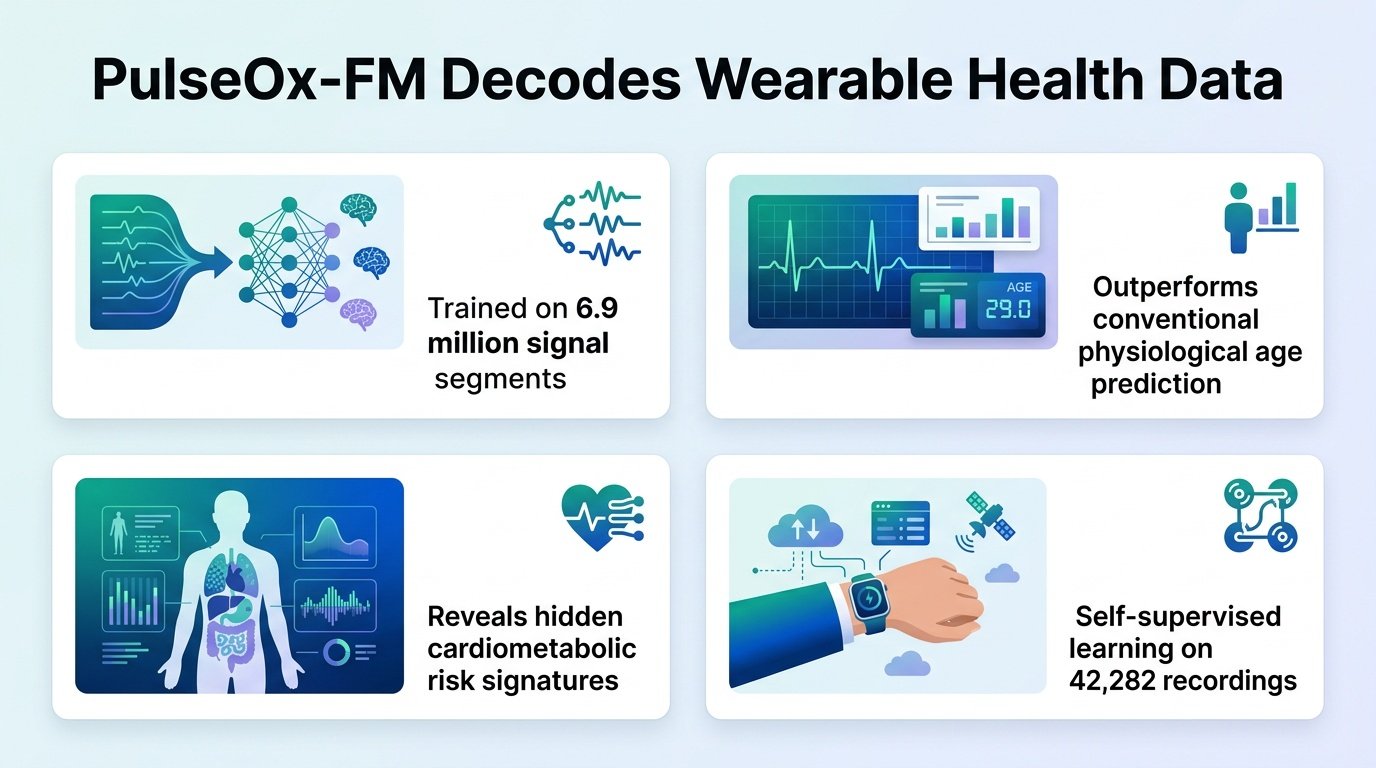
Researchers built a foundation model called PulseOx-FM using self-supervised learning. They trained the system on 6,995,558 segments of pulse oximetry signals. These signals came from 42,282 overnight sleep recordings of 10,704 participants in the Human Phenotype Project.
The model used chronological age as a global health benchmark to test its accuracy. It easily beat existing open-source and proprietary tools. By analyzing the subtle patterns in overnight blood flow, the AI mapped 64 different clinical targets across metabolic and mental health domains.
- Analyzed over 6.9 million pulse oximetry segments from 10,704 people.
- Predicted 64 distinct clinical targets across metabolic and mental health.
- Identified two-year risk of high blood pressure in healthy adults.
- Tracked next-day blood sugar levels independent of sleep quality.
The most striking finding is the model’s ability to look into the future. It successfully identified which healthy, normotensive individuals would develop high blood pressure within two years. This shifts the timeline for preventive care, letting clinicians spot vascular decline long before a blood pressure cuff flags a problem.
Tracking daily metabolic shifts
The model does not just look years ahead. It also tracks immediate, day-to-day changes inside the body. The nightly signals predicted next-day blood sugar, diet, and activity states.
Crucially, this next-day blood sugar signal was a direct physiological effect. It was not just a byproduct of poor sleep architecture or next-day food choices. The pulse wave itself carries the signature of metabolic strain.
The limits of wearables
We must be realistic about the hurdles. This model was trained on high-quality sleep monitoring data, not noisy daytime wrist movements. Constant motion during the day still ruins optical signals, meaning these insights require quiet, overnight wear to be reliable.
Furthermore, this is a preprint. We need to see how the model performs across diverse, global populations outside the initial cohort. However, the implications are clear. The hardware in your current smartwatch is already powerful enough to screen for major diseases. The bottleneck is no longer the sensor, but the math we use to read it.
Read the full preprint on medRxiv.