 Yusuf Yesil, MD, MIS
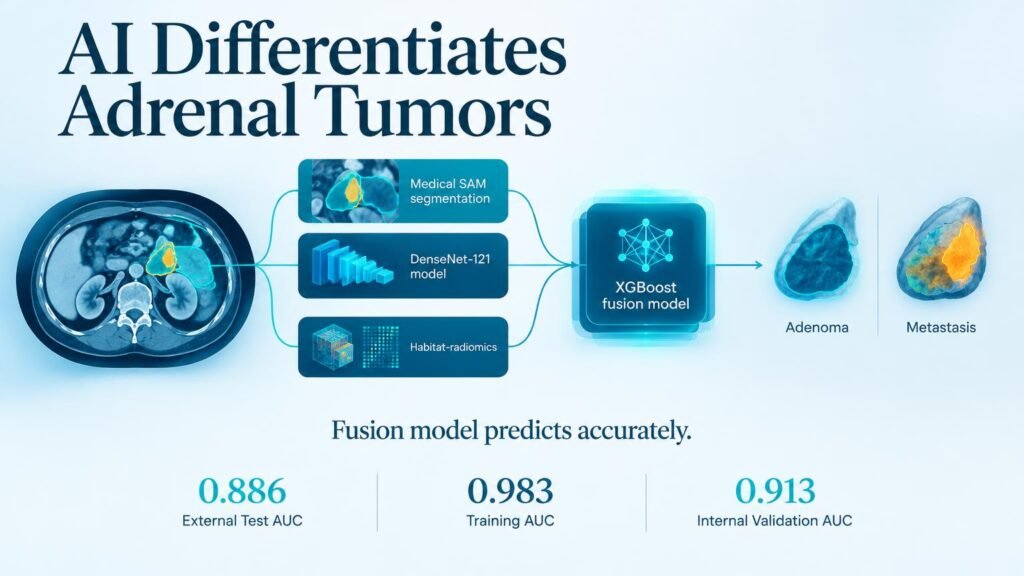
Misdiagnosing an adrenal mass leads to vastly different clinical paths. A benign adenoma requires monitoring, while a metastasis demands immediate aggressive cancer treatment. A new multicenter study shows that combining deep learning with spatial habitat modeling can automate this screening process without surgical intervention.
This approach pushes beyond standard radiomics by mapping intratumoral heterogeneity. Rather than treating an adrenal lesion as a uniform blob, habitat-radiomics captures distinct microenvironments within the tumor. It builds upon prior research into automatic segmentation-based radiomics for adrenal masses, demonstrating that spatial sub-regions provide clearer diagnostic signals than global image averages.
Model performance across cohorts
Researchers collected imaging and clinical data from 390 patients across two hospitals. They split the cohort into a training set, an internal validation set, and an external test set. Lesions were automatically segmented using the Medical SAM foundation model.
The team extracted features via a 2.5D DenseNet-121 deep learning architecture and K-means habitat clustering, feeding them into XGBoost classifiers. Key metrics include:
- The combined fusion model achieved an AUC of 0.983 in training, 0.913 in internal validation, and 0.886 in external testing.
- Standalone 2.5D deep learning models yielded AUCs ranging from 0.847 to 0.980 across cohorts.
- Habitat-radiomics models alone maintained AUCs between 0.805 and 0.967.
The step-down in accuracy from internal training (0.983) to the external site (0.886) highlights the real-world friction these algorithms face. Drop-offs in external performance remain the primary bottleneck preventing algorithm deployment in routine oncology workflows, a pattern seen across other CT-based adrenal radiomics models.
The operational reality
High diagnostic accuracy on archived scans does not automatically translate to improved patient outcomes. This study proves technical feasibility, but retrospective single-site and two-center testing cannot prove that the tool safely replaces biopsy or alters clinician decisions.
The real clinical test is prospective. Until trial leads demonstrate that AI-guided triage reduces unnecessary procedures without missing malignant growths, health systems will treat these models as experimental secondary reads rather than diagnostic replacements.
Read the full study in Frontiers in Endocrinology.