 Yusuf Yesil, MD, MIS
Health systems are buying ambient AI scribes to stop physician burnout. Doctors love the software because it drafts clinical notes in real time during visits. But a major review reveals that health systems are measuring user satisfaction while ignoring basic patient safety.
That disconnect is the real story.
For years, healthcare leaders assumed that happy clinicians meant safe technology. This evaluation proves that relief from paperwork does not guarantee accurate medical notes.
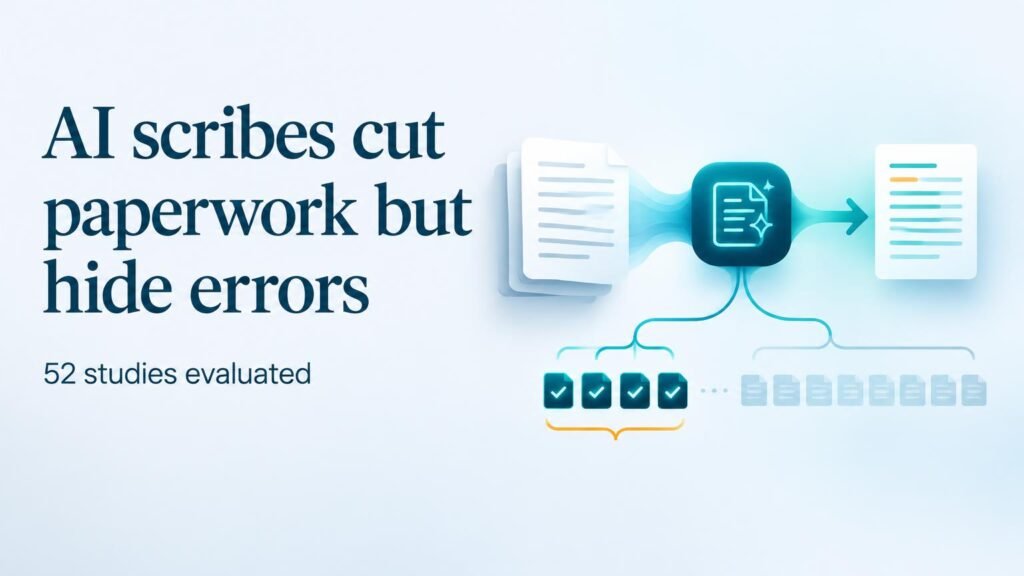
A comprehensive scoping review in The Lancet Digital Health evaluated 52 empirical studies published between 2023 and 2026. Most were small pilot projects or observational implementations. Only 4 were randomized controlled trials.
While clinician satisfaction was consistently high, formal accuracy audits were surprisingly rare. When researchers actually audited the generated notes, they found substantial error rates, with clinical omissions standing out as a recurring hazard.
Unchecked errors in routine care
Most health systems deploy these tools based on administrative enthusiasm rather than safety data. Critical acoustic variables—such as room noise and microphone placement—were rarely reported, despite directly altering transcript accuracy.
Structured error tracking and harm grading were almost completely absent in real-world settings. Studies on ambient artificial intelligence documentation platforms show rapid adoption, but deploying tools without standardized safety audits creates silent patient risk.
Key weaknesses identified across the current literature include:
- Only 4 of 52 published studies used a randomized controlled trial design.
- Formal accuracy checks revealed frequent clinical omissions and errors.
- Patient perspectives, equity evaluations, and harm monitoring were virtually missing.
- Environmental factors like microphone setup were under-reported across settings.
A new framework for safety
To establish baseline standards, the authors created REDI-ADS, a two-tier checklist covering 9 domains across 4 operational layers. Tier 1 mandates bench validation, technical testing, and explicit error taxonomies before deployment. Tier 2 requires health systems to demonstrate safe workflow integration, clear patient consent, and long-term safety monitoring.
Without standardized metrics, healthcare executives risk confusing saved time with high-quality care. Early literature on ambient AI scribes to alleviate documentation burden confirmed that tools shave minutes off note-taking. Yet saving time offers little value if omitted clinical details cause medical errors downstream.
The operational takeaway is straightforward. Healthcare leaders must stop treating clinician satisfaction as proof of technical accuracy, and demand rigorous safety auditing before bringing ambient tools to scale.
Read the full scoping review in The Lancet Digital Health.