 Yusuf Yesil, MD, MIS
Emergency clinicians traditionally rely on anatomical scoring and CT scans to evaluate trauma severity. That process takes critical time when systemic inflammation is already cascading. A new multi-center study demonstrates that standard admission biomarkers can rapidly estimate injury burden, challenging the reliance on delayed imaging alone for early risk stratification.
The core finding confirms that early biological signals closely mirror physical injury depth. While previous research explored early immunological markers for organ dysfunction, this model predicts anatomical trauma severity directly from blood drawn at hospital admission.
High accuracy across external cohorts
Researchers built and tested ten machine learning models using a development cohort of 775 participants. This group included healthy controls, non-trauma acute-care patients, and trauma cases categorized by Injury Severity Score (ISS) into mild (ISS <16), moderate (ISS 16–25), or severe (ISS >25). Models evaluated 19 initial lab values alongside basic demographic features.
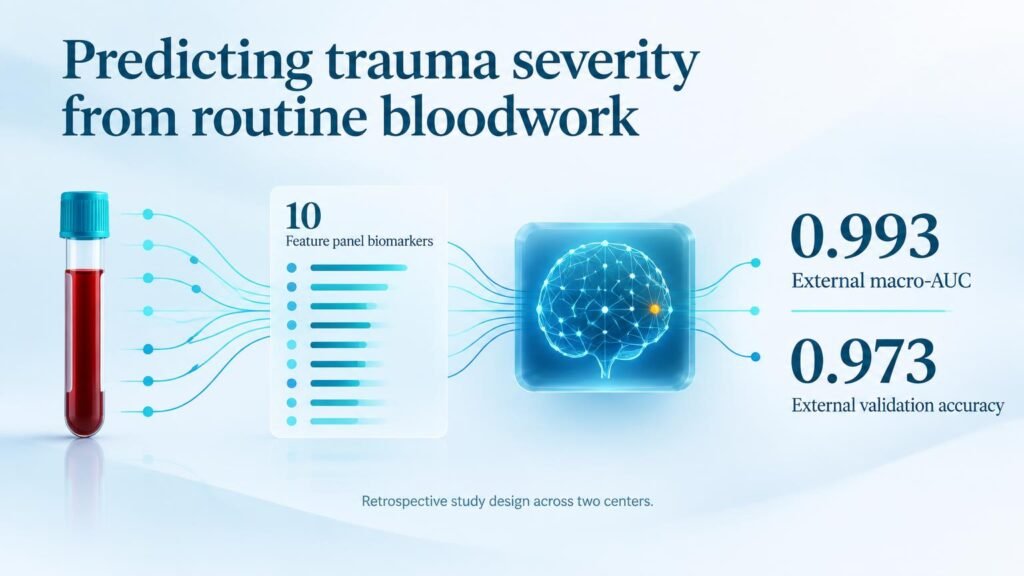
A simple multinomial logistic regression algorithm outpaced complex architectures once feature selection narrowed the inputs to a 10-biomarker panel.
- Model selection reduced 19 variables down to a 10-feature panel of routine blood metrics.
- The model achieved an accuracy of 0.941 on the internal holdout set.
- In an independent external validation cohort of 349 participants, accuracy reached 0.973.
- The external validation yielded a macro-area under the curve (macro-AUC) of 0.993.
- Model interpretation identified neutrophil count and red cell distribution width CV (RDW-CV) as the strongest contributors.
Beyond basic triage scores
Predicting an ISS score from lab work shifts how triage teams assess occult biological stress. Increasing injury burden triggered non-linear shifts in neutrophil-related indices, lymphocyte counts, and serum albumin. Rather than replacing physical exams, this computational layer highlights systemic immune dysregulation early.
This approach aligns with efforts focused on biomarker models for post-trauma organ failure, expanding predictive analytics into the earliest minutes of care.
High classification accuracy does not mean this software can replace clinical judgment or definitive imaging. The study relies on retrospective data from two centers, evaluating biological estimates of anatomical injury rather than direct improvements in patient survival or emergency department throughput.
For health systems, the immediate value lies in automated decision support. Algorithms running on routine admission labs could flag patients at risk of rapid deterioration before full imaging workups finish.
Detailed findings were published in Frontiers in Immunology.