 Yusuf Yesil, MD, MIS
Discharging a patient after their first episode of acute pancreatitis is often an exercise in uncertainty. Clinicians know a subset will return to the emergency department within months, but spotting those high-risk individuals before release remains difficult.
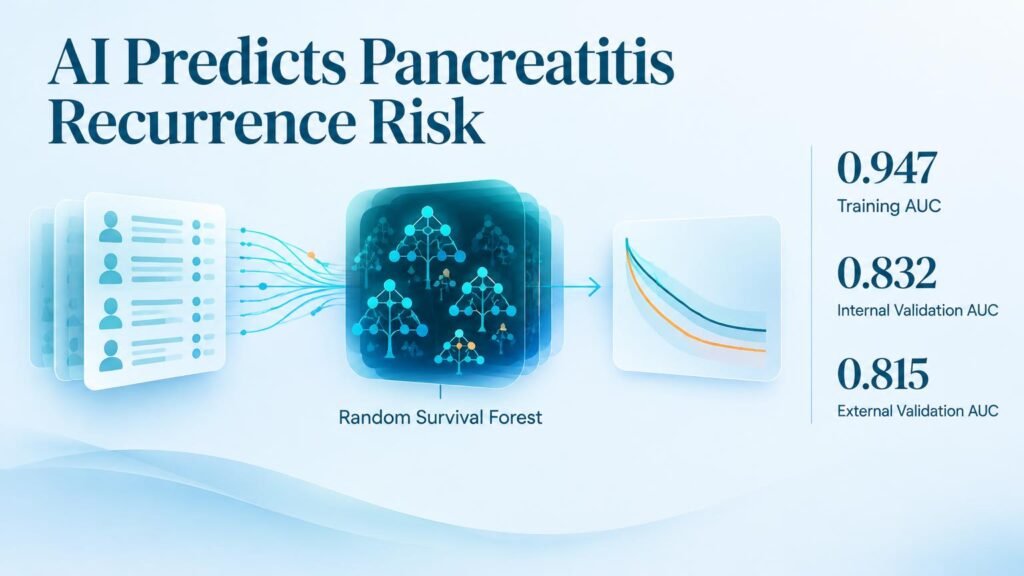
A retrospective study tackles this challenge by applying a machine learning prediction model to forecast one-year recurrence. The research demonstrates strong predictive accuracy over standard statistical methods. However, the performance drop seen during external validation proves that algorithmic precision does not automatically translate to clinical readiness.
Comparing the Data
Researchers evaluated 568 patients admitted to Cangzhou Central Hospital, tracking them for 12 months after their initial attack. Overall, 14.1% of cases (80 out of 568) suffered a recurrence within one year. The primary dataset was split into a 398-patient training cohort and a 170-patient internal validation cohort, with an additional external cohort of 77 patients used for independent evaluation.
Cox regression identified three independent risk factors: alcohol consumption (hazard ratio 2.35), baseline triglyceride levels (hazard ratio 1.13), and pancreatic necrosis (hazard ratio 5.34). Feature attribution via SHAP analysis confirmed triglycerides as the single most critical variable driving the risk scores.
Key Model Findings
- The random survival forest achieved an area under the curve of 0.947 in training, 0.832 in internal validation, and 0.815 in external validation.
- A standard risk nomogram achieved lower accuracy across all sets, scoring 0.834 in training, 0.794 in internal validation, and 0.794 in external validation.
- Decision curve analysis showed that the machine learning approach provided superior net benefit across operational decision thresholds compared to traditional scoring.
Limits of Algorithmic Accuracy
These findings mirror earlier work on pancreatitis nomogram models and broader machine learning applications in recurrent pancreatitis. Yet the sharp performance decline from the 0.947 training AUC down to 0.815 in external testing signals noticeable model overfitting.
High retrospective accuracy shows strong signal separation, but it does not prove that altering care based on these predictions will lower readmission rates or improve patient outcomes.
An external validation cohort of just 77 patients is far too small to establish reliability across broader health systems. Until prospective trials demonstrate that model-guided management actively reduces clinical harm, this tool remains an insightful analytical benchmark rather than a bedside replacement for clinical decision-making.
Read the full research in BMC Medical Informatics and Decision Making.