 Yusuf Yesil, MD, MIS
Building an algorithm that flags eye disease on a image is easy. Proving it actually helps patients in a clinic is another story entirely.
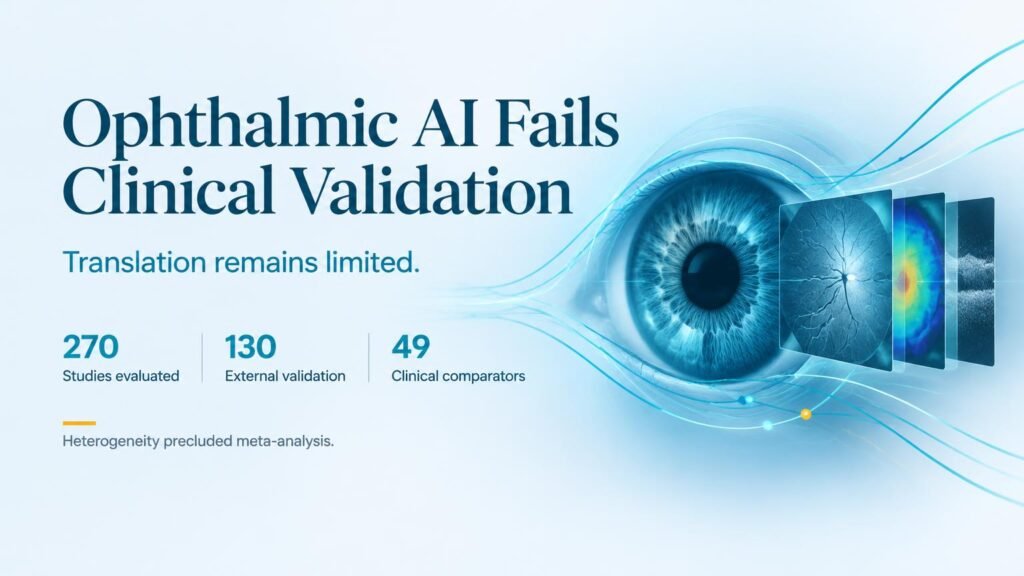
A systematic review in the Journal of Clinical Medicine evaluated 270 studies published between 2015 and 2026 across eye-disease screening, diagnosis, prognosis, treatment response, and decision support. The authors assessed these models using Joanna Briggs Institute appraisal tools to gauge true readiness. What they found exposes a deep divide between technical performance and clinical utility.
Where the Research Falls Short
Most models focus on image recognition rather than complex medical management. Diabetic retinopathy and macular edema led the clinical categories with 82 studies, followed by general retinal disease (52), glaucoma (46), and age-related macular degeneration (29). Convolutional neural networks were the dominant method, powering 136 studies.
The core problem is how these models are tested. While 130 studies claimed external validation, only 95 studies evaluated performance using clinical, geographic, prospective, or real-world data. Even worse, just 49 studies compared the algorithm directly against human clinicians in a head-to-head clinical trial.
- 270 total studies evaluated across five clinical domains.
- 136 studies relied on convolutional neural network architectures.
- 90 studies incorporated explainability features.
- 30 studies evaluated pediatric-relevant populations.
- 3 studies explicitly involved optometrists or optometry workflows.
The Implementation Gap
This lack of head-to-head testing matters because high diagnostic accuracy does not guarantee better patient care. Previous analyses of ophthalmology AI implementation noted that real translation requires seamless integration into daily practice. Yet only 3 studies in this 270-study review included optometrists, the very front-line providers who conduct routine screenings.
The field is repeating old mistakes highlighted in early reviews of diabetic eye disease screening. Developers build tools on retrospective datasets without measuring clinician workload, patient outcomes, or diagnostic harm. High internal accuracy creates a false sense of security that crumbles when deployed in diverse clinical settings.
That disconnect is the real story.
Until researchers shift focus from retrospective accuracy to prospective trials with direct human comparators, health systems should treat ophthalmic algorithms as decision aids, not replacements for human clinical judgment.
Read the full systematic review in the Journal of Clinical Medicine.