 Yusuf Yesil, MD, MIS
Predicting which heart surgery patients will crash after leaving the intensive care unit is notoriously difficult. A new study built a machine learning model using ICU data to spot high-risk patients following percutaneous coronary intervention or coronary artery bypass grafting. But the tool’s performance drop in validation highlights how sensitive predictive software remains to changing clinical routines over time.
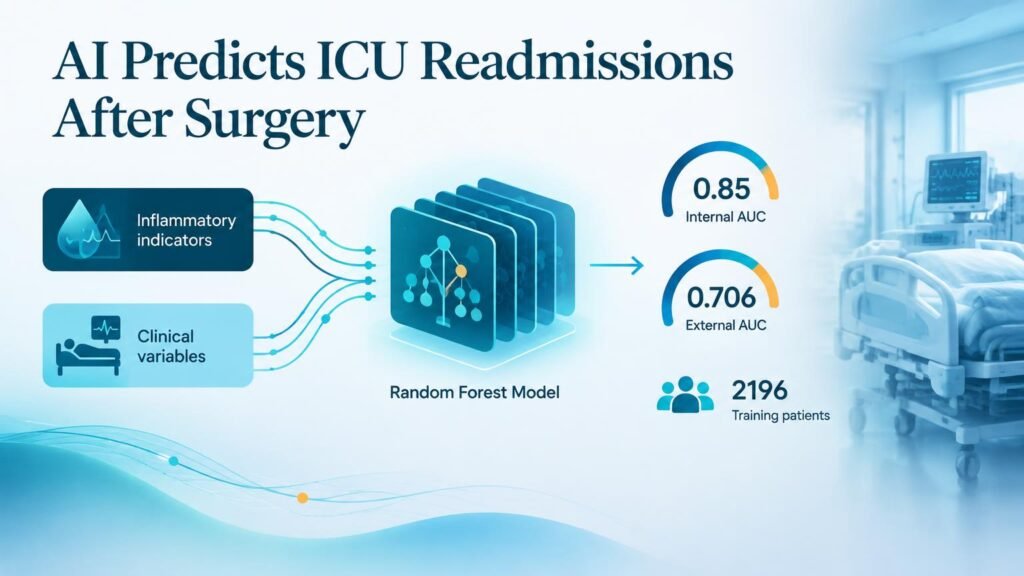
Researchers gathered retrospective data from two iterations of the same hospital database. The training cohort from MIMIC-IV included 2,196 post-procedure patients, where 674 (30.7%) required ICU readmission. The external testing set from MIMIC-III contained 1,717 patients with a 25.6% (440 patients) readmission rate.
After using LASSO regression to screen clinical variables, nine machine learning algorithms were evaluated. The Random Forest model achieved an internal AUC of 0.85, a balanced accuracy of 0.772, sensitivity of 0.748, and specificity of 0.795. These findings build on previous studies evaluating readmissions in US healthcare systems and specialized algorithms built to predict readmission after coronary artery bypass grafting.
Key Predictive Signals
- 12 key variables were selected for final deployment in an online risk screening tool.
- Monocyte-to-lymphocyte ratio (MLR) emerged as a primary inflammatory indicator of post-surgical deterioration.
- Maximum creatinine levels and the total count of invasive procedures heavily driven higher risk scores.
- AUC dropped to 0.706 when validated against the older patient cohort.
Validation Exposes Generalization Limits
The sharp performance drop from 0.85 to 0.706 exposes the core challenge of bedside AI deployment. Because MIMIC-III and MIMIC-IV represent different historical periods at the exact same medical center, this degradation proves that shifting clinical practice patterns degrade predictive power even without changing geographic sites.
That instability is the real takeaway for hospital administrators.
Retrospective performance on a single center’s historical data does not equal clinical readiness. While SHAP explainability values clarify why the model flags specific patients, the software cannot replace clinical intuition. A sensitivity of 0.748 means the algorithm fails to flag more than 25% of readmitted patients.
Translating Scores to Bedside Action
A high specificity of 0.795 helps minimize false alarms on telemetry wards, preventing unnecessary resource consumption. Streamlining the feature set down to 12 parameters makes web tool integration feasible during ICU step-down handoffs.
Yet predictions alone do not alter patient trajectories. Health systems must test whether acting on these algorithmic alerts actually reduces post-discharge mortality or readmission rates in live clinical workflows.
Read the full paper in BMC Medical Informatics and Decision Making.